If you have any questions, you are always welcome to contact us. We'll get back to you as soon as possible, withing 24 hours on weekdays.
Customer service
All questions about your order, return and delivery must be sent to our customer service team by e-mail at yourstore@yourdomain.com
Sale & Press
If you are interested in selling our products, need more information about our brand or wish to make a collaboration, please contact us at press@yourdomain.com
Help
If you have any questions, you are always welcome to contact us. We'll get back to you as soon as possible, withing 24 hours on weekdays.
Customer service
All questions about your order, return and delivery must be sent to our customer service team by e-mail at yourstore@yourdomain.com
Sale & Press
If you are interested in selling our products, need more information about our brand or wish to make a collaboration, please contact us at press@yourdomain.com
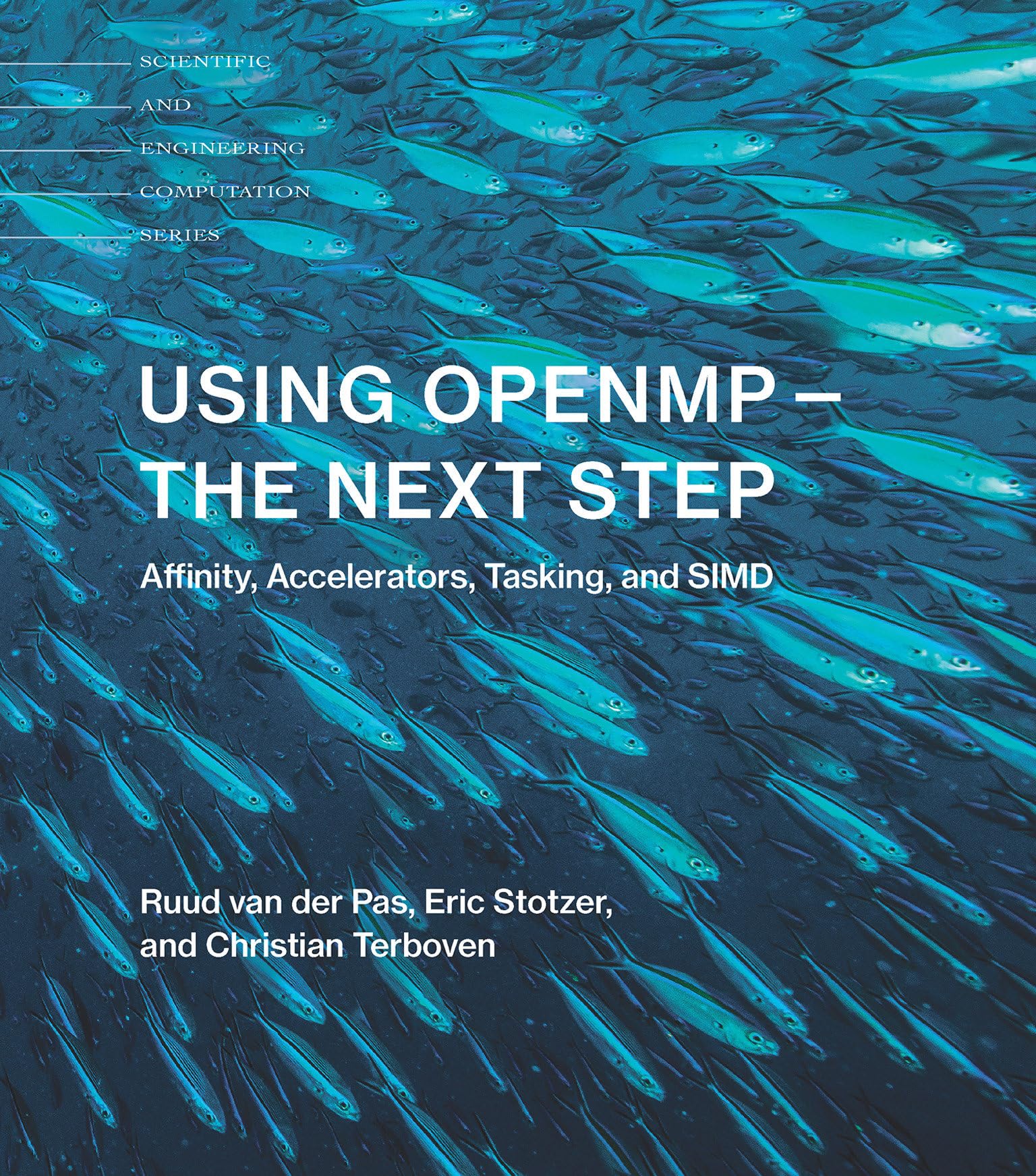
A guide to the most recent, advanced features of the widely used OpenMP parallel programming model, with coverage of major features in OpenMP 4.5.This book offers an uptodate, practical tutorial on advanced features in the widely used OpenMP parallel programming model. Building on the previous volume, Using OpenMP: Portable Shared Memory Parallel Programming (MIT Press), this book goes beyond the fundamentals to focus on what has been changed and added to OpenMP since the 2.5 specifications. It emphasizes four major and advanced areas: thread affinity (keeping threads close to their data), accelerators (special hardware to speed up certain operations), tasking (to parallelize algorithms with a less regular execution flow), and SIMD (hardware assisted operations on vectors).As in the earlier volume, the focus is on practical usage, with major new features primarily introduced by example. Examples are restricted to C and C++, but are straightforward enough to be understood by Fortran programmers. After a brief recap of OpenMP 2.5, the book reviews enhancements introduced since 2.5. It then discusses in detail tasking, a major functionality enhancement; NonUniform Memory Access (NUMA) architectures, supported by OpenMP; SIMD, or Single Instruction Multiple Data; heterogeneous systems, a new parallel programming model to offload computation to accelerators; and the expected further development of OpenMP.
⚠️ WARNING (California Proposition 65):
This product may contain chemicals known to the State of California to cause cancer,
birth defects, or other reproductive harm.
For MAP (Minimum Advertised Price) violations and Intellectual Property (IP) or Trademark concerns, please contact:
support@ergodebooks.com
⚠️ California Proposition 65 Warning: Some products sold on this website may expose you to chemicals known to the State of California to cause cancer, birth defects, or other reproductive harm. For more information, visit www.P65Warnings.ca.gov.