
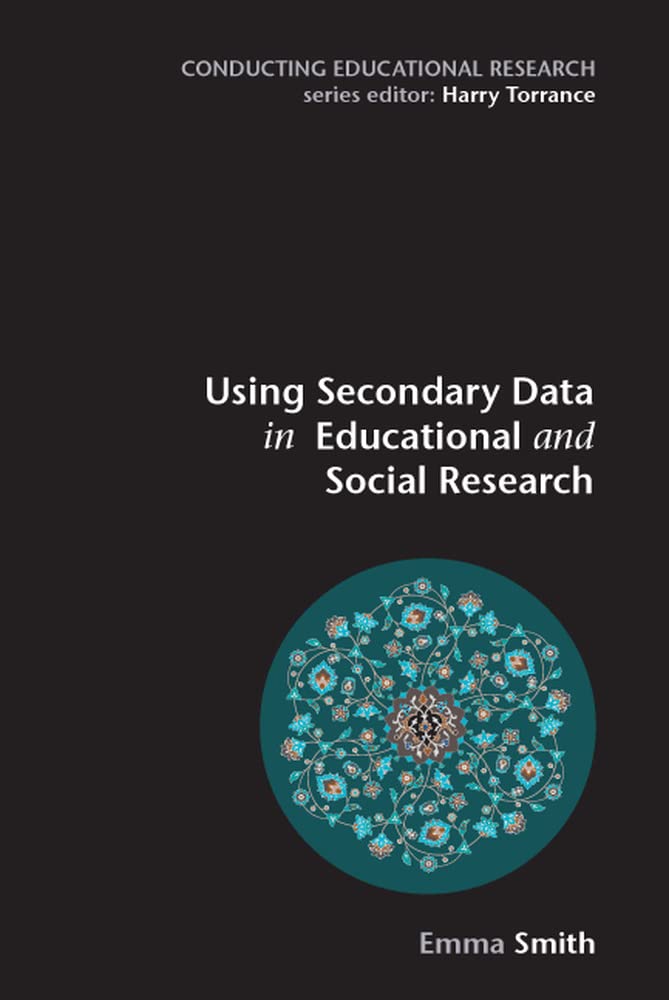
Title
Using Secondary Data In Educational And Social Research (Conducting Educational Research),New
Sold by Ergodebooks, an authorized reseller.
Returns accepted within 30 days | support@ergodebooks.com
Shipping Information
- Free Standard Shipping — United States only
- Processing Time: 3–5 business days
- Estimated Delivery: 6–10 business days after dispatch
- Double-boxed, fully insured & discreetly packaged
- Tracking number sent via email once dispatched
Returns & Refund
Returns accepted within 30 days of delivery.
Damaged or Defective Item
Free return shipping + replacement or full refund
Wrong Item Received
Free return shipping + replacement or full refund
Change of Mind
Return shipping at customer's expense · 25% restocking fee applies
Payment Option

The book is written in an admirably clear style and is effectively structured throughout its three parts with eight concise chapters. The book's intention in which it largely succeeds is to strengthen secondary data analysis as one technique in the 'methodological toolbox' available to researchers, one which has been on the margin for far too long.'British Journal of Educational TechnologySecondary data is a powerful tool for providing context to an otherwise smallscale study, as well as being an efficient way of bringing together a large amount of data, particularly where access to the field may be difficult.This comprehensive guide introduces students to the use of secondary data in educational and social research, and provides a practical resource for researchers who are new to the field of secondary data analysis. The author encourages researchers to consider the potential for using secondary data both as their primary research method, but also as a useful strategy in mixed methods designs.The first part of the book explores the role of secondary data analysis in contemporary social research. It considers the arguments for and against its use and addresses its particular benefits in mixed method research designs, especially those in the political arithmetic tradition.The second part introduces worked examples which show the potential for using secondary sources to answer a varied range of research questions. It provides stepbystep guidance on how to manipulate and analyse secondary data. The inclusion of recent national and international datasets as exemplars allows students to place their research in a 'real life' context and to consider current and topical research issues.
⚠️ WARNING (California Proposition 65):
This product may contain chemicals known to the State of California to cause cancer, birth defects, or other reproductive harm.
For more information, please visit www.P65Warnings.ca.gov.