
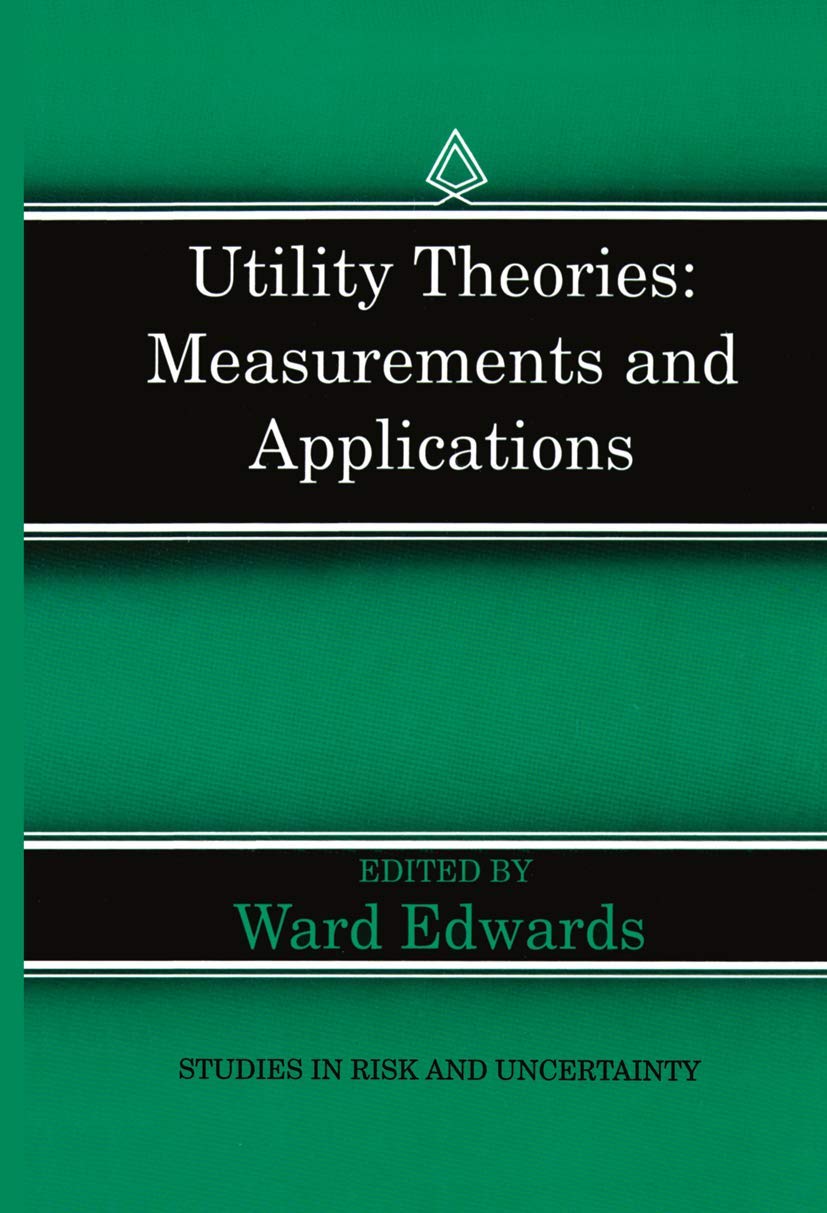
Title
Utility Theories: Measurements and Applications (Studies in Risk and Uncertainty, 3),New
Sold by Ergodebooks, an authorized reseller.
Returns accepted within 30 days | support@ergodebooks.com
Shipping Information
- Free Standard Shipping — United States only
- Processing Time: 3–5 business days
- Estimated Delivery: 6–10 business days after dispatch
- Double-boxed, fully insured & discreetly packaged
- Tracking number sent via email once dispatched
Returns & Refund
Returns accepted within 30 days of delivery.
Damaged or Defective Item
Free return shipping + replacement or full refund
Wrong Item Received
Free return shipping + replacement or full refund
Change of Mind
Return shipping at customer's expense · 25% restocking fee applies
Payment Option

The Conference on 'Utility: Theories, Measurements, and Applications' met at the Inn at Pasatiempo in Santa Cruz, California, from June II to 15, 1989. The allstar cast of attendees are listed as authors in the Table of Contents of this book (see p. V), except for Soo Hong Chew and Amos Tversky. The purpose of the conference, and of National Science Foundation Grant No. SES8823012 that supported it, was to confront proponents of new generalized theories of utility with leading decision analysts com mitted to the implementation, in practice, of the more traditional theory that these new theories reject. That traditional model is variously iden tified in this book as expected utility or subjectively expected utility maximization (EU or SEU for short) and variously attributed to von Neumann and Morgenstern or Savage. I had feared that the conference might consist of an acrimonious debate between Olympian normative theorists uninterested in what people actually do and behavioral modelers obsessed with the cognitive illusions and uninterested in helping people to make wise decisions. I was entirely wrong. The conferees, in two dramatic straw votes at the open ing session, unanimously endorsed traditional SEU as the appropriate normative model and unanimously agreed that people don't act as that model requires. (These votes had a profound impact on my thinking; detail about them and about that impact is located in Chapter 10.
⚠️ WARNING (California Proposition 65):
This product may contain chemicals known to the State of California to cause cancer, birth defects, or other reproductive harm.
For more information, please visit www.P65Warnings.ca.gov.