
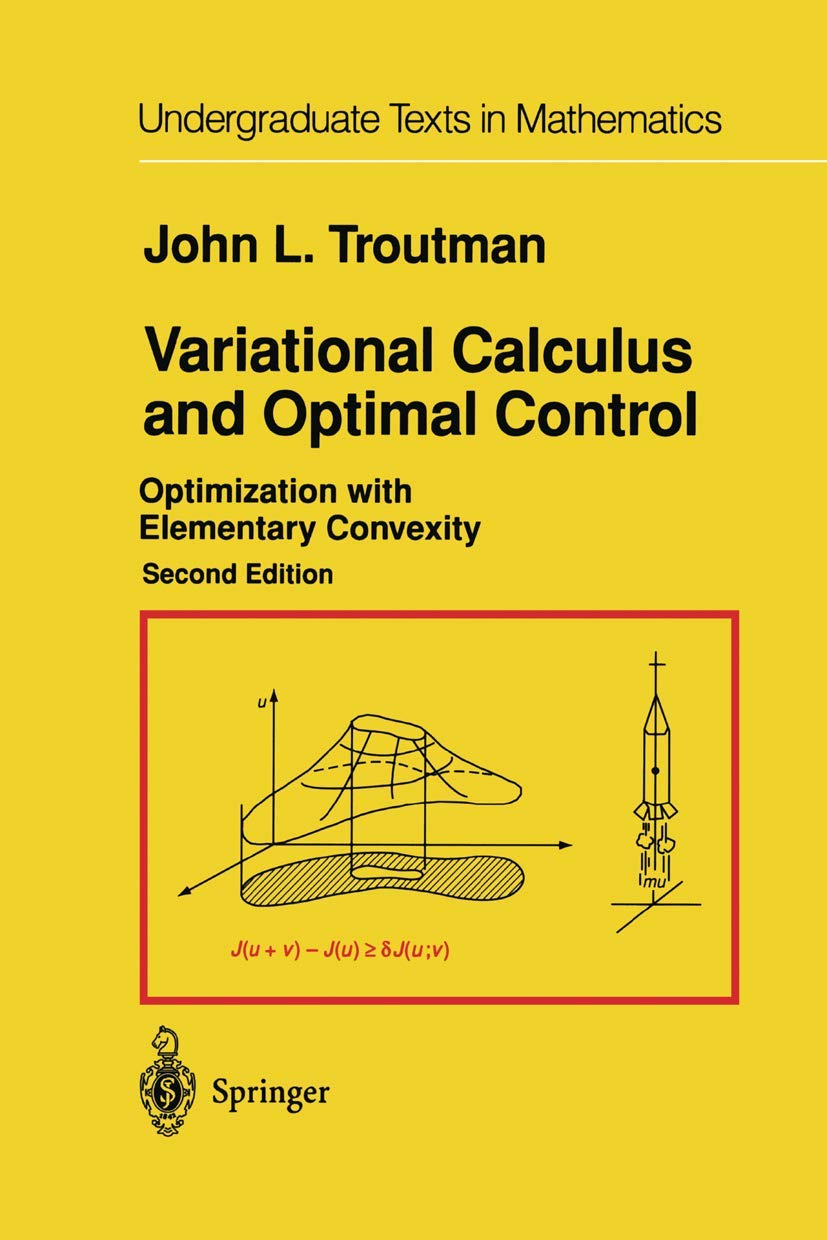
Title
Variational Calculus and Optimal Control: Optimization with Elementary Convexity (Undergraduate Texts in Mathematics),Used
Sold by Ergodebooks, an authorized reseller.
Returns accepted within 30 days | support@ergodebooks.com
Shipping Information
- Free Standard Shipping — United States only
- Processing Time: 3–5 business days
- Estimated Delivery: 6–10 business days after dispatch
- Double-boxed, fully insured & discreetly packaged
- Tracking number sent via email once dispatched
Returns & Refund
Returns accepted within 30 days of delivery.
Damaged or Defective Item
Free return shipping + replacement or full refund
Wrong Item Received
Free return shipping + replacement or full refund
Change of Mind
Return shipping at customer's expense · 25% restocking fee applies
Payment Option

Although the calculus of variations has ancient origins in questions of Ar istotle and Zenodoros, its mathematical principles first emerged in the post calculus investigations of Newton, the Bernoullis, Euler, and Lagrange. Its results now supply fundamental tools of exploration to both mathematicians and those in the applied sciences. (Indeed, the macroscopic statements ob tained through variational principles may provide the only valid mathemati cal formulations of many physical laws. ) Because of its classical origins, variational calculus retains the spirit of natural philosophy common to most mathematical investigations prior to this century. The original applications, including the Bernoulli problem of finding the brachistochrone, require opti mizing (maximizing or minimizing) the mass, force, time, or energy of some physical system under various constraints. The solutions to these problems satisfy related differential equations discovered by Euler and Lagrange, and the variational principles of mechanics (especially that of Hamilton from the last century) show the importance of also considering solutions that just provide stationary behavior for some measure of performance of the system. However, many recent applications do involve optimization, in particular, those concerned with problems in optimal control. Optimal control is the rapidly expanding field developed during the last halfcentury to analyze optimal behavior of a constrained process that evolves in time according to prescribed laws. Its applications now embrace a variety of new disciplines, including economics and production planning.
⚠️ WARNING (California Proposition 65):
This product may contain chemicals known to the State of California to cause cancer, birth defects, or other reproductive harm.
For more information, please visit www.P65Warnings.ca.gov.