
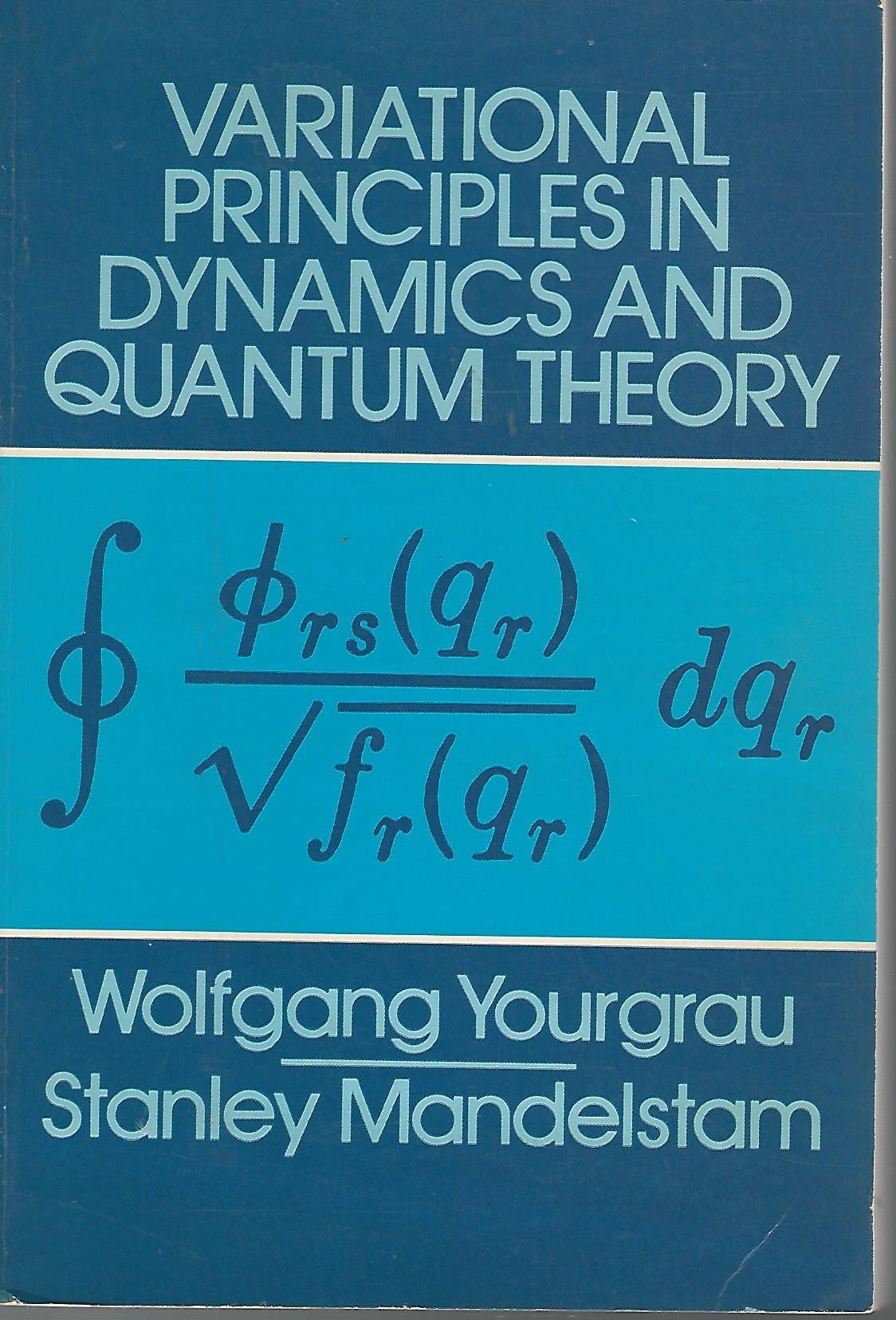
Title
Variational Principles In Dynamics And Quantum Theory (Dover Books On Physics)
Sold by Ergodebooks, an authorized reseller.
Returns accepted within 30 days | support@ergodebooks.com
Shipping Information
- Free Standard Shipping — United States only
- Processing Time: 3–5 business days
- Estimated Delivery: 6–10 business days after dispatch
- Double-boxed, fully insured & discreetly packaged
- Tracking number sent via email once dispatched
Returns & Refund
Returns accepted within 30 days of delivery.
Damaged or Defective Item
Free return shipping + replacement or full refund
Wrong Item Received
Free return shipping + replacement or full refund
Change of Mind
Return shipping at customer's expense · 25% restocking fee applies
Payment Option

Concentrating Upon Applications That Are Most Relevant To Modern Physics, This Valuable Book Surveys Variational Principles And Examines Their Relationship To Dynamics And Quantum Theory. Stressing The History And Theory Of These Mathematical Concepts Rather Than The Mechanics, The Authors Provide Many Insights Into The Development Of Quantum Mechanics And Present Much Hardtofind Material In A Remarkably Lucid, Compact Form.After Summarizing The Historical Background From Pythagoras To Francis Bacon, Professors Yourgrau And Mandelstram Cover Fermat'S Principle Of Least Time, The Principle Of Least Action Of Maupertuis, Development Of This Principle By Euler And Lagrange, And The Equations Of Lagrange And Hamilton. Equipped By This Thorough Preparation To Treat Variational Principles In General, They Proceed To Derive Hamilton'S Principle, The Hamiltonjacobi Equation, And Hamilton'S Canonical Equations.An Investigation Of Electrodynamics In Hamiltonian Form Covers Next, Followed By A Resume Of Variational Principles In Classical Dynamics. The Authors Then Launch Into An Analysis Of Their Most Significant Topics: The Relation Between Variational Principles And Wave Mechanics, And The Principles Of Feynman And Schwinger In Quantum Mechanics. Two Concluding Chapters Extend The Discussion To Hydrodynamics And Natural Philosophy.Professional Physicists, Mathematicians, And Advanced Students With A Strong Mathematical Background Will Find This Stimulating Volume Invaluable Reading. Extremely Popular In Its Hardcover Edition, This Volume Will Find Even Wider Appreciation In Its First Fine Inexpensive Paperbound Edition.
⚠️ WARNING (California Proposition 65):
This product may contain chemicals known to the State of California to cause cancer, birth defects, or other reproductive harm.
For more information, please visit www.P65Warnings.ca.gov.
- Q: What is the page count of the book? A: The book has two hundred twenty-four pages. This length provides a comprehensive overview of variational principles in dynamics and quantum theory.
- Q: What are the dimensions of the book? A: The book measures five point seventy-five inches in length, zero point fifty-one inches in width, and eight point twenty-seven inches in height. These dimensions make it easy to handle and store.
- Q: What type of binding does this book have? A: This book is paperback bound. The paperback format makes it lightweight and portable for reading on the go.
- Q: Who are the authors of the book? A: The authors are Wolfgang Yourgrau and Stanley Mandelstam. They are renowned physicists who provide insights into complex topics.
- Q: What is the main focus of the book? A: The book focuses on the applications of variational principles in modern physics. It examines their relationship to dynamics and quantum theory.
- Q: Is this book suitable for beginners? A: No, this book is not ideal for beginners. It is designed for professional physicists, mathematicians, and advanced students with a strong mathematical background.
- Q: Can I use this book for self-study? A: Yes, you can use this book for self-study. It provides a thorough examination of variational principles, making it a valuable resource for advanced learners.
- Q: Is there a historical context in the book? A: Yes, the book includes historical context from Pythagoras to Francis Bacon. This background helps readers understand the evolution of variational principles.
- Q: How should I store this book? A: Store this book in a cool, dry place away from direct sunlight. This will help preserve the quality of the paperback binding and pages.
- Q: What is the recommended way to care for this book? A: Handle the book carefully to avoid creasing the pages. Keep it on a bookshelf or a flat surface to maintain its shape.
- Q: What if the book arrives damaged? A: If the book arrives damaged, you should contact the seller for a return or exchange. Most reputable sellers have a customer service policy to address such issues.
- Q: Does this book cover Feynman's principles? A: Yes, the book discusses Feynman's principles in quantum mechanics. This makes it relevant for those interested in advanced quantum theories.
- Q: Is there a focus on classical dynamics in the book? A: Yes, the book includes a resume of variational principles in classical dynamics. It provides a comprehensive understanding of both classical and quantum mechanics.
- Q: Are there any illustrations in the book? A: The book does not list illustrations in its description. It primarily focuses on theoretical concepts rather than visual representations.
- Q: Is this book well-received in the academic community? A: Yes, the book is extremely popular, especially in its hardcover edition. It is regarded as an invaluable resource for professionals and students alike.