If you have any questions, you are always welcome to contact us. We'll get back to you as soon as possible, withing 24 hours on weekdays.
Customer service
All questions about your order, return and delivery must be sent to our customer service team by e-mail at yourstore@yourdomain.com
Sale & Press
If you are interested in selling our products, need more information about our brand or wish to make a collaboration, please contact us at press@yourdomain.com
Help
If you have any questions, you are always welcome to contact us. We'll get back to you as soon as possible, withing 24 hours on weekdays.
Customer service
All questions about your order, return and delivery must be sent to our customer service team by e-mail at yourstore@yourdomain.com
Sale & Press
If you are interested in selling our products, need more information about our brand or wish to make a collaboration, please contact us at press@yourdomain.com
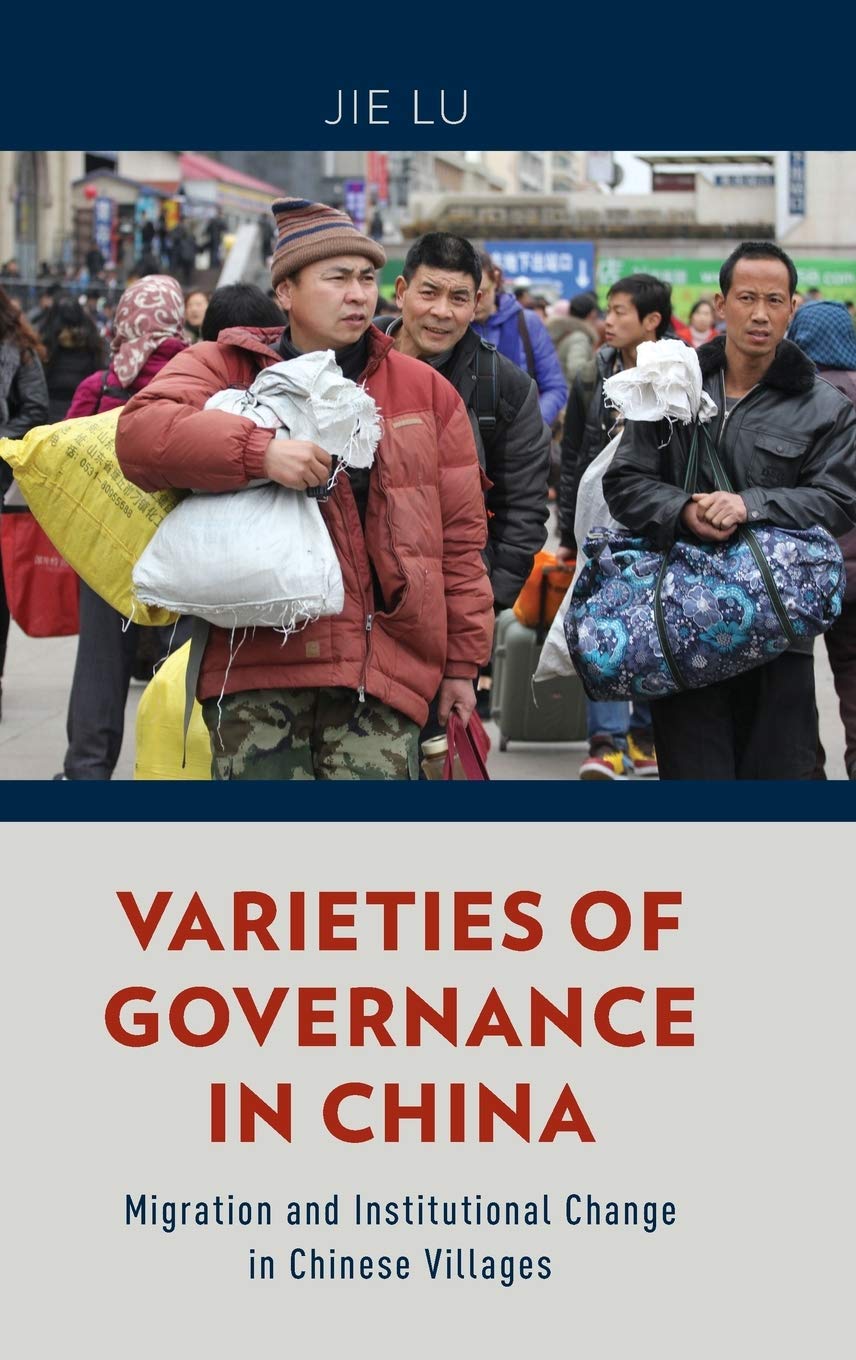
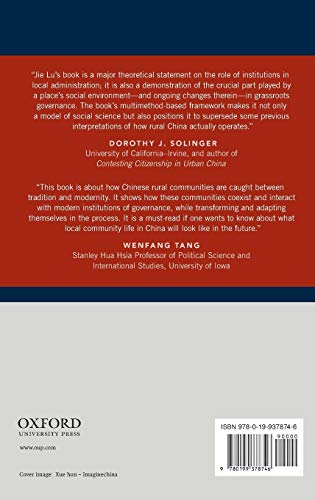
It is well understood that "good institutions" are essential for good governance. But even institutions that follow similar designs vary significantly with regard to performance across countries and even across regions within the same country. Following China's abolishment of the Commune system to accommodate marketoriented reforms in the 1980s, decentralized, grassroots democracy was introduced in rural China in order to improve the quality of local governance. In this book, Jie Lu looks at variance among local governance institutions in China to examine under what conditions indigenously cultivated institutions or externally imposed institutions are able to succeed, particularly under pressures of economic modernization.Lu argues that any governance institution can perform effectively as long as it can produce collective action and accountability, but the relative effectiveness of institutions is contingent upon the social environment in which they are embedded. When economic conditions prompt outward migration, social environments are reshaped such that rulesbased formal institutions will trump relationbased indigenous forms. In identifying the optimal social conditions for the effective performance of different governance institutions and theorizing the effects of social change on these institutions, Lu deepens understanding of how institutions, particularly in developing countries, change, and under what conditions institutional modernization or engineering may succeed or fail.
⚠️ WARNING (California Proposition 65):
This product may contain chemicals known to the State of California to cause cancer,
birth defects, or other reproductive harm.
For MAP (Minimum Advertised Price) violations and Intellectual Property (IP) or Trademark concerns, please contact:
support@ergodebooks.com
⚠️ California Proposition 65 Warning: Some products sold on this website may expose you to chemicals known to the State of California to cause cancer, birth defects, or other reproductive harm. For more information, visit www.P65Warnings.ca.gov.