
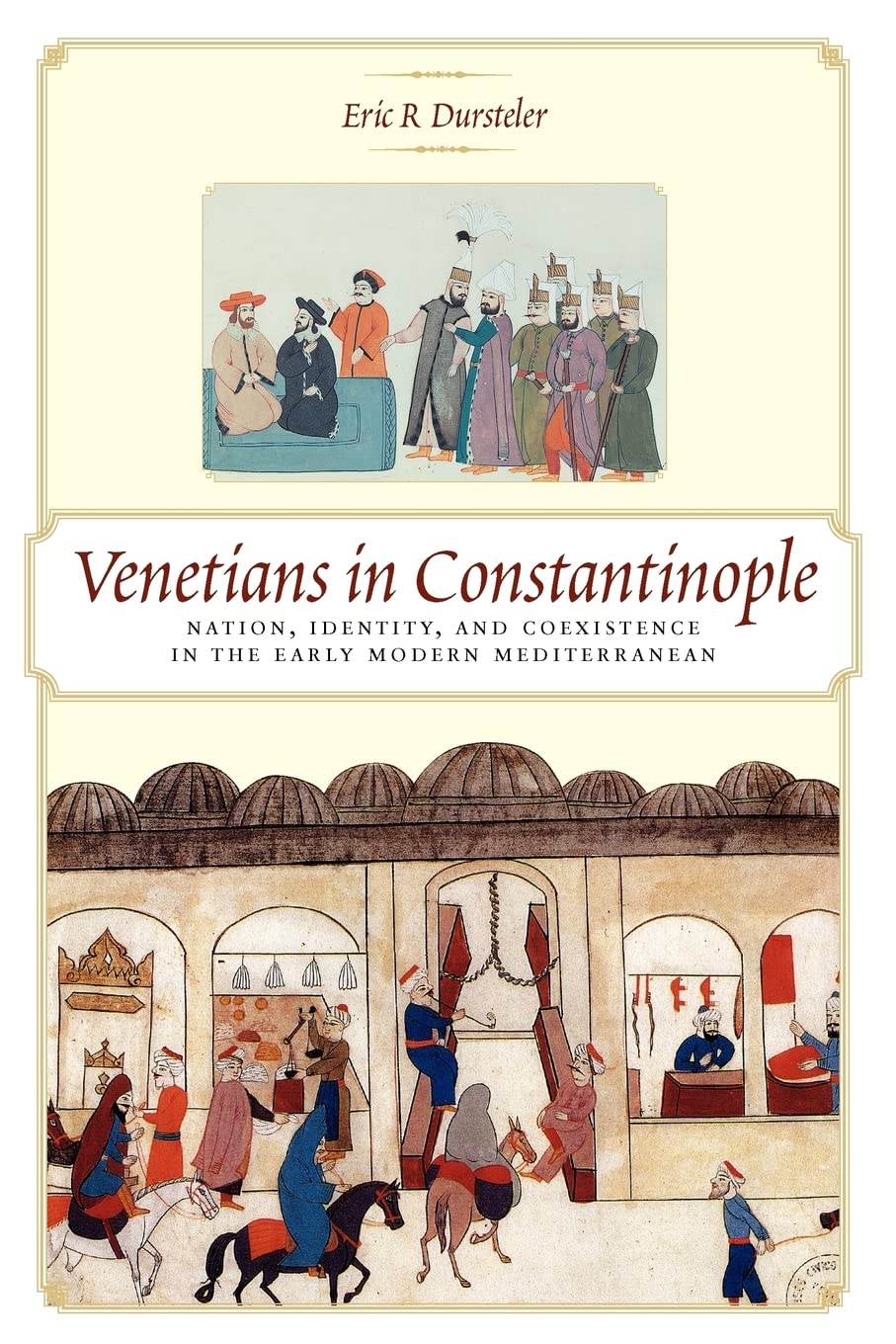
Title
Venetians In Constantinople: Nation, Identity, And Coexistence In The Early Modern Mediterranean (The Johns Hopkins University S
Sold by Ergodebooks, an authorized reseller.
Returns accepted within 30 days | support@ergodebooks.com
Shipping Information
- Free Standard Shipping — United States only
- Processing Time: 3–5 business days
- Estimated Delivery: 6–10 business days after dispatch
- Double-boxed, fully insured & discreetly packaged
- Tracking number sent via email once dispatched
Returns & Refund
Returns accepted within 30 days of delivery.
Damaged or Defective Item
Free return shipping + replacement or full refund
Wrong Item Received
Free return shipping + replacement or full refund
Change of Mind
Return shipping at customer's expense · 25% restocking fee applies
Payment Option

Historian Eric R Dursteler Reconsiders Identity In The Early Modern World To Illuminate Venetoottoman Cultural Interaction And Coexistence, Challenging The Model Of Hostile Relations And Suggesting Instead A More Complex Understanding Of The Intersection Of Cultures. Although Dissonance And Strife Were Certainly Part Of This Relationship, He Argues, Coexistence And Cooperation Were More Common.Moving Beyond The Clash Of Civilizations Model That Surveys The Relationship Between Islam And Christianity From A Geopolitical Perch, Dursteler Analyzes The Lived Reality By Focusing On A Localized Microcosm: The Venetian Merchant And Diplomatic Community In Muslim Constantinople.While Factors Such As Religion, Culture, And Political Status Could Be Integral Elements In Constructions Of Self And Community, Dursteler Finds Early Modern Identity To Be More Than The Sum Total Of Its Constitutent Parts And Reveals How The Fluidity And Malleability Of Identity In This Time And Place Made Coexistence Among Disparate Cultures Possible.
⚠️ WARNING (California Proposition 65):
This product may contain chemicals known to the State of California to cause cancer, birth defects, or other reproductive harm.
For more information, please visit www.P65Warnings.ca.gov.
- Q: How many pages does this book have? A: This book has three hundred twelve pages. It provides an in-depth exploration of Venetian and Ottoman cultural interactions.
- Q: What is the binding type of this book? A: This book is a paperback. The paperback binding makes it lightweight and easy to handle.
- Q: What are the dimensions of this book? A: The dimensions of this book are six inches in length, zero point seventy-one inches in width, and nine point zero two inches in height.
- Q: Who is the author of this book? A: The author of this book is Eric R Dursteler. He is a historian known for his work on cultural interactions in the early modern Mediterranean.
- Q: What is the main theme of this book? A: The main theme of this book is the complex interactions between Venetian and Ottoman cultures. It challenges the notion of a purely hostile relationship.
- Q: Is this book suitable for academic use? A: Yes, this book is suitable for academic use. It provides critical insights into historical cultural interactions and is part of a reputable university press series.
- Q: How should I store this book? A: Store this book in a cool, dry place away from direct sunlight. This helps preserve the integrity of the paperback binding and pages.
- Q: Can I clean the book's cover? A: Yes, you can gently clean the book's cover with a soft, dry cloth. Avoid using water or cleaning solutions that could damage the material.
- Q: Is this book safe for young readers? A: Yes, this book is safe for young readers interested in history. However, it is recommended for those with a mature understanding of historical contexts.
- Q: What type of audience would enjoy this book? A: This book is ideal for readers interested in history, culture, and the interactions between different civilizations. Scholars and students will find it particularly valuable.
- Q: What if my book arrives damaged? A: If your book arrives damaged, you should contact the seller for a return or exchange. Most sellers have policies in place for damaged items.
- Q: Can I return this book if I don't like it? A: Yes, you can typically return this book if you are unsatisfied. Check the return policy of the seller for specific details.
- Q: How does this book compare to other historical texts? A: This book offers a unique perspective on cultural coexistence, differing from traditional historical texts that emphasize conflict. It provides a nuanced view of identity in the early modern world.
- Q: Is there a glossary or index in this book? A: Yes, this book includes an index. This helps readers easily locate key terms and topics covered throughout the text.
- Q: What is the publication date of this book? A: The publication date of this book is not specified in the provided details. However, it is part of a contemporary series focusing on historical and political science.
- Q: Does this book include illustrations or maps? A: The provided details do not specify if this book includes illustrations or maps. However, such features are common in historical texts for contextual understanding.