If you have any questions, you are always welcome to contact us. We'll get back to you as soon as possible, withing 24 hours on weekdays.
Customer service
All questions about your order, return and delivery must be sent to our customer service team by e-mail at yourstore@yourdomain.com
Sale & Press
If you are interested in selling our products, need more information about our brand or wish to make a collaboration, please contact us at press@yourdomain.com
Help
If you have any questions, you are always welcome to contact us. We'll get back to you as soon as possible, withing 24 hours on weekdays.
Customer service
All questions about your order, return and delivery must be sent to our customer service team by e-mail at yourstore@yourdomain.com
Sale & Press
If you are interested in selling our products, need more information about our brand or wish to make a collaboration, please contact us at press@yourdomain.com
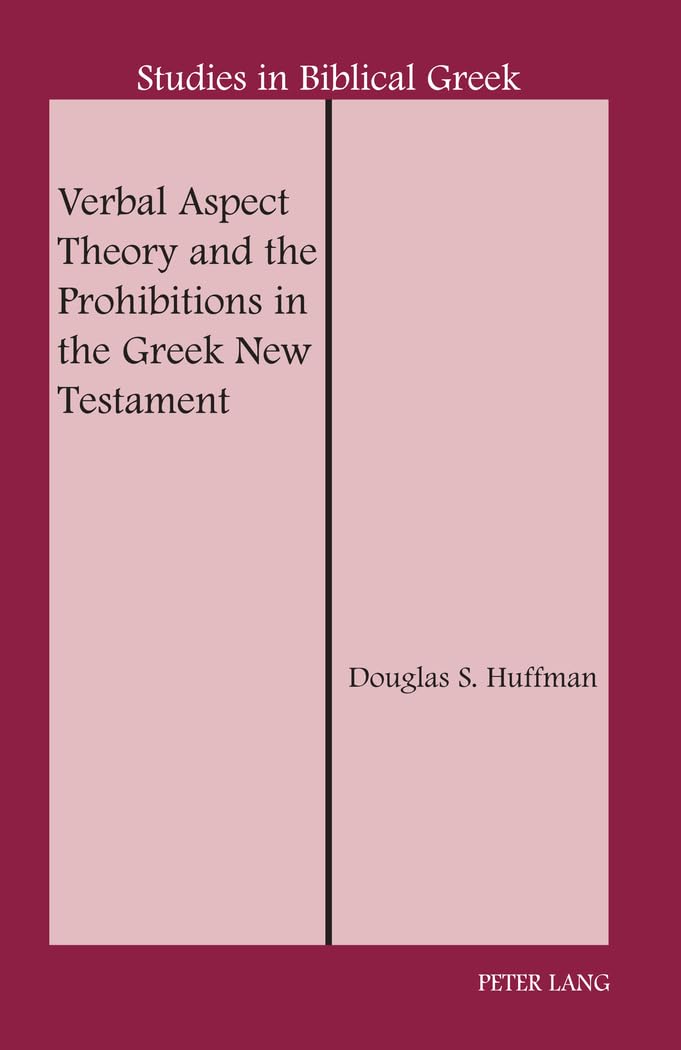
The end of the twentieth and the beginning of the twentyfirst centuries have involved much discussion on overhauling and refining a scholarly understanding of the verbal system for firstcentury Greek. These discussions have included advances in verbal aspect theory and other linguistic approaches to describing the grammatical phenomena of ancient languages. This volume seeks to apply some of that learning to the narrow realm of how prohibitions were constructed in the firstcentury Greek of the New Testament.Part 1 The Great Prohibition Debate seeks to demonstrate that verbal aspect theory has a better explanation than traditional Aktionsart theory for authorial choices between the negated present imperative and the negated aorist subjunctive in expressing prohibitions in the Greek New Testament.Part 2 All the Prohibitions in the Greek NT continues to examine prohibitions, but is more of an exercise in functional linguistics. That is, rather than apply verbal aspect theory to the grammar of prohibition constructions, Part 2 seeks only to survey the (initially surprising) wide variety of ways prohibitions can be expressed in koine Greek: more than a dozen different constructions. To do this, the NT prohibitions are grouped in their varying grammaticalsyntactical and/or pragmatic constructions, all of which function in varying degrees in a prohibitory fashion. This taxonomy may prove to be the beginnings of further investigations into how biblical Greek communicates commands.
⚠️ WARNING (California Proposition 65):
This product may contain chemicals known to the State of California to cause cancer,
birth defects, or other reproductive harm.
For MAP (Minimum Advertised Price) violations and Intellectual Property (IP) or Trademark concerns, please contact:
support@ergodebooks.com
⚠️ California Proposition 65 Warning: Some products sold on this website may expose you to chemicals known to the State of California to cause cancer, birth defects, or other reproductive harm. For more information, visit www.P65Warnings.ca.gov.