If you have any questions, you are always welcome to contact us. We'll get back to you as soon as possible, withing 24 hours on weekdays.
Customer service
All questions about your order, return and delivery must be sent to our customer service team by e-mail at yourstore@yourdomain.com
Sale & Press
If you are interested in selling our products, need more information about our brand or wish to make a collaboration, please contact us at press@yourdomain.com
Help
If you have any questions, you are always welcome to contact us. We'll get back to you as soon as possible, withing 24 hours on weekdays.
Customer service
All questions about your order, return and delivery must be sent to our customer service team by e-mail at yourstore@yourdomain.com
Sale & Press
If you are interested in selling our products, need more information about our brand or wish to make a collaboration, please contact us at press@yourdomain.com
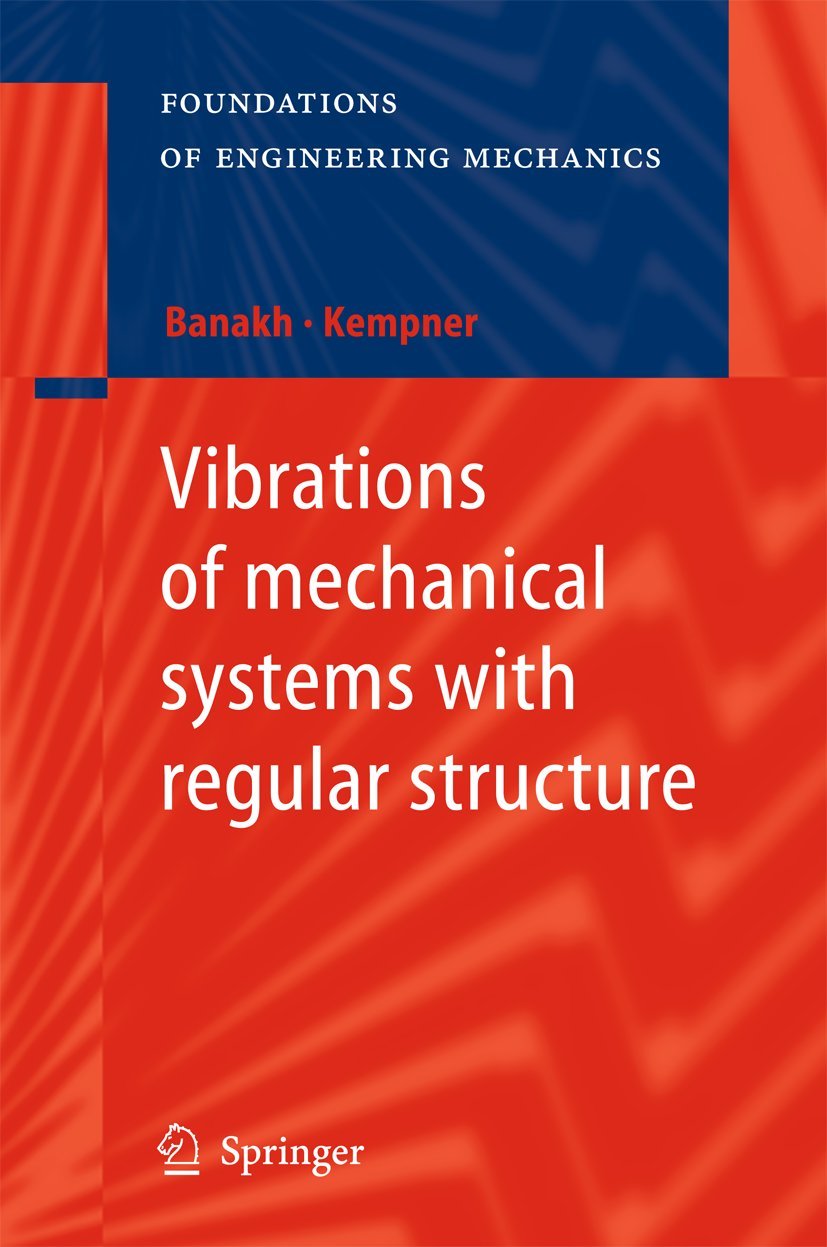
In this book, regular structures are de ned as periodic structures consisting of repeated elements (translational symmetry) as well as structures with a geom ric symmetry. Regular structures have for a long time been attracting the attention of scientists by the extraordinary beauty of their forms. They have been studied in many areas of science: chemistry, physics, biology, etc. Systems with geometric symmetry are used widely in many areas of engineering. The various kinds of bases under machines, cyclically repeated forms of stators, reduction gears, rotors with blades mounted on them, etc. represent regular structures. The study of reallife engineering structures faces considerable dif culties because they comprise a great number of working mechanisms that, in turn, consist of many different elastic subsystems and elements. The computational models of such systems represent a hierarchical structure and contain hundreds and thousands of parameters. The main problems in the analysis of such systems are the dim sion reduction of model and revealing the dominant parameters that determine its dynamics and form its energy nucleus. The two most widely used approaches to the simulation of such systems are as follows: 1. Methods using lumped parameters models, i.e., a discretization of the original system and its representation as a system with lumped parameters [including niteelement method (FEM)]. 2. The use of idealized elements with distributed parameters and known analytical solutions for both the local elements and the subsystems.
⚠️ WARNING (California Proposition 65):
This product may contain chemicals known to the State of California to cause cancer,
birth defects, or other reproductive harm.
<div class="dynamic-checkout__content" id="dynamic-checkout-cart" data-shopify="dynamic-checkout-cart"> <shopify-accelerated-checkout-cart wallet-configs="[{"name":"shop_pay","wallet_params":{"shopId":73758048501,"merchantName":"Ergodebooks","personalized":true}},{"name":"amazon_pay","wallet_params":{"checkoutLanguage":"en_US","ledgerCurrency":"USD","placement":"Cart","sandbox":false,"merchantId":"A1G1ZY975O1T6J","productType":"PayAndShip","design":"C0002"}},{"name":"paypal","wallet_params":{"shopId":73758048501,"countryCode":"US","merchantName":"Ergodebooks","phoneRequired":true,"companyRequired":false,"shippingType":"shipping","shopifyPaymentsEnabled":true,"hasManagedSellingPlanState":false,"requiresBillingAgreement":false,"merchantId":"L873BZSC9NMQS","sdkUrl":"https://www.paypal.com/sdk/js?components=buttons\u0026commit=false\u0026currency=USD\u0026locale=en_US\u0026client-id=AbasDhzlU0HbpiStJiN1KRJ_cNJJ7xYBip7JJoMO0GQpLi8ePNgdbLXkC7_KMeyTg8tnAKW4WKrh9qmf\u0026merchant-id=L873BZSC9NMQS\u0026intent=authorize"}}]" access-token="c0f52a66b386e9fa5c0ab4c2febc737c" buyer-country="US" buyer-locale="en" buyer-currency="USD" shop-id="73758048501" cart-id="2c38b4b37daa53cdb4d7b89ad59b5ed3" enabled-flags="["ae0f5bf6"]" > <div class="wallet-button-wrapper"> <ul class='wallet-cart-grid wallet-cart-grid--skeleton' role="list" data-shopify-buttoncontainer="true"> <li data-testid='grid-cell' class='wallet-cart-button-container'><div class='wallet-cart-button wallet-cart-button__skeleton' role='button' disabled aria-hidden='true'> </div></li><li data-testid='grid-cell' class='wallet-cart-button-container'><div class='wallet-cart-button wallet-cart-button__skeleton' role='button' disabled aria-hidden='true'> </div></li><li data-testid='grid-cell' class='wallet-cart-button-container'><div class='wallet-cart-button wallet-cart-button__skeleton' role='button' disabled aria-hidden='true'> </div></li> </ul> </div> </shopify-accelerated-checkout-cart> <small id="shopify-buyer-consent" class="hidden" aria-hidden="true" data-consent-type="subscription"> One or more of the items in your cart is a recurring or deferred purchase. By continuing, I agree to the <span id="shopify-subscription-policy-button">cancellation policy</span> and authorize you to charge my payment method at the prices, frequency and dates listed on this page until my order is fulfilled or I cancel, if permitted. </small> </div>
Stay in the know
Subscribe to our newsletter and stay updated on latest offers, discounts and events near you.
For MAP (Minimum Advertised Price) violations, please contact:
map@ergode.com
For Intellectual Property (IP) or Trademark concerns, please contact:
ip@ergode.com
⚠️ California Proposition 65 Warning: Some products sold on this website may expose you to chemicals known to the State of California to cause cancer, birth defects, or other reproductive harm. For more information, visit www.P65Warnings.ca.gov.