If you have any questions, you are always welcome to contact us. We'll get back to you as soon as possible, withing 24 hours on weekdays.
Customer service
All questions about your order, return and delivery must be sent to our customer service team by e-mail at yourstore@yourdomain.com
Sale & Press
If you are interested in selling our products, need more information about our brand or wish to make a collaboration, please contact us at press@yourdomain.com
Help
If you have any questions, you are always welcome to contact us. We'll get back to you as soon as possible, withing 24 hours on weekdays.
Customer service
All questions about your order, return and delivery must be sent to our customer service team by e-mail at yourstore@yourdomain.com
Sale & Press
If you are interested in selling our products, need more information about our brand or wish to make a collaboration, please contact us at press@yourdomain.com
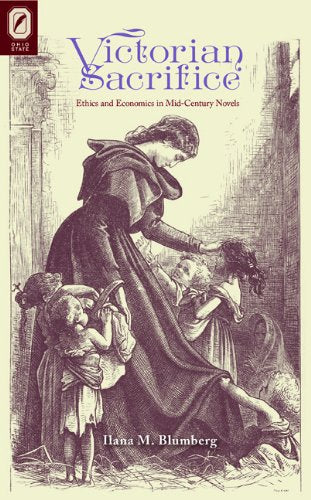
In Victorian Sacrifice: Ethics and Economics in MidCentury Novels, Ilana Blumberg offers a major reconsideration of the central Victorian ethic of selfsacrifice, suggesting that much of what we have taken to be the moral psychology of Victorian fiction may be understood in terms of the dramatic confrontation between Christian theology and the world of modern economic theory. As Victorian writers Charlotte Mary Yonge, Charles Dickens, George Eliot, Anthony Trollope, Wilkie Collins, and Mary Augusta Ward strove to forge a practicable ethics that would reconcile the influences of an evangelical Christianity and its emphasis on selfless charity with the forces of laissezfaire capitalism and its emphasis on individual profit, they moved away from the cherished ideal of painful, solitary selfsacrifice in service of anothers good. Instead, Blumberg suggests, major novelists sought an ethical realism characterized by the belief that virtuous action could serve the collective benefit of the parties involved. At a midcentury moment of economic optimism, novelists transformed the ethical landscape by imagining what the sociologist Herbert Spencer would later call a measured egoism, an ethically responsible selfconcern which might foster communal solidarity and material abundance.Bringing the recent literary turns to ethics and to economics into mutual conversation, Blumberg offers us a new lens on a matter as pressing today as 150 years ago: the search for an ethics adequate to the hopes and fears of a new economy.
⚠️ WARNING (California Proposition 65):
This product may contain chemicals known to the State of California to cause cancer,
birth defects, or other reproductive harm.
For MAP (Minimum Advertised Price) violations and Intellectual Property (IP) or Trademark concerns, please contact:
support@ergodebooks.com
⚠️ California Proposition 65 Warning: Some products sold on this website may expose you to chemicals known to the State of California to cause cancer, birth defects, or other reproductive harm. For more information, visit www.P65Warnings.ca.gov.