
Title
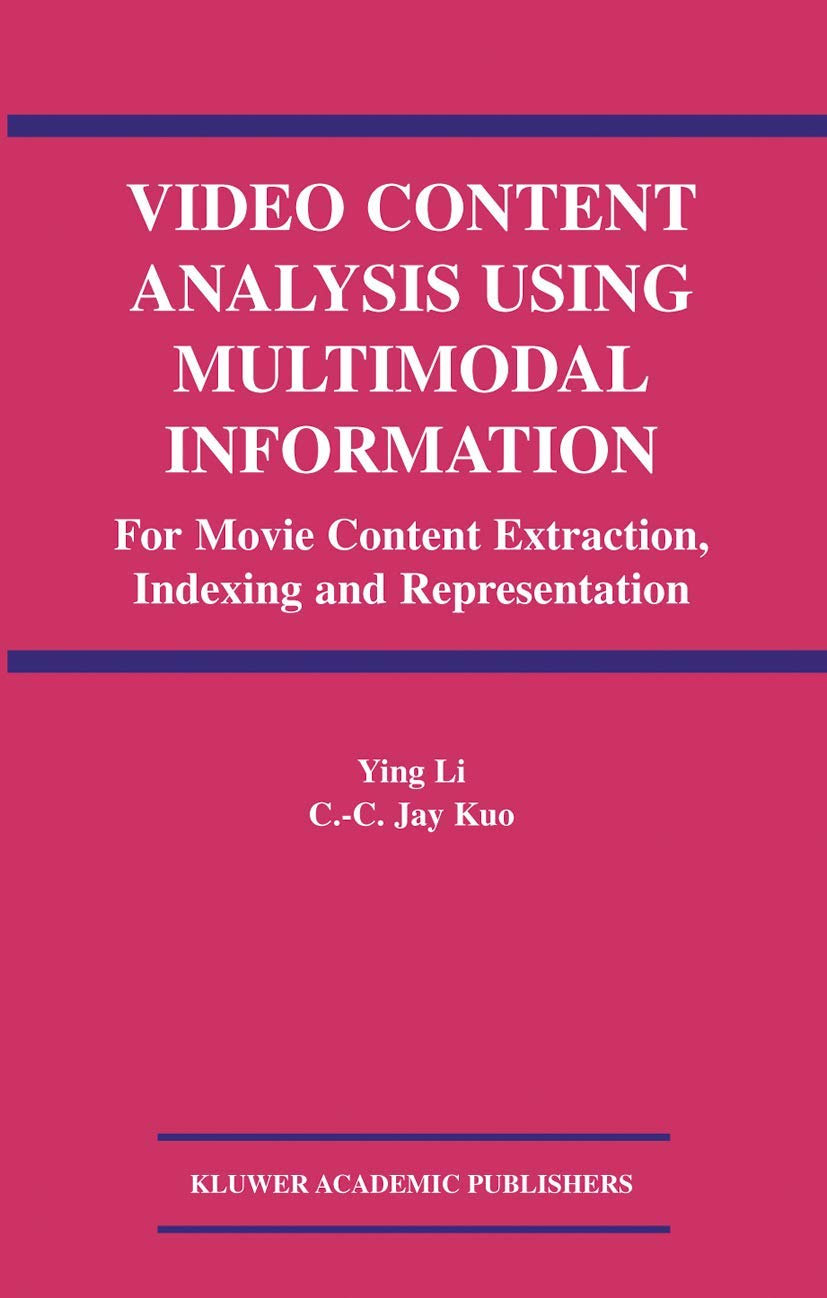
Video Content Analysis Using Multimodal Information: For Movie Content Extraction, Indexing and Representation,Used
Sold by Ergodebooks, an authorized reseller.
Returns accepted within 30 days | support@ergodebooks.com
Shipping Information
- Free Standard Shipping — United States only
- Processing Time: 3–5 business days
- Estimated Delivery: 6–10 business days after dispatch
- Double-boxed, fully insured & discreetly packaged
- Tracking number sent via email once dispatched
Returns & Refund
Returns accepted within 30 days of delivery.
Damaged or Defective Item
Free return shipping + replacement or full refund
Wrong Item Received
Free return shipping + replacement or full refund
Change of Mind
Return shipping at customer's expense · 25% restocking fee applies
Payment Option

With the fast growth ofmultimedia information, contentbased video anal ysis, indexing and representation have attracted increasing attention in re cent years. Many applications have emerged in these areas such as video ondemand, distributed multimedia systems, digital video libraries, distance learning/education, entertainment, surveillance and geographical information systems. The need for contentbased video indexing and retrieval was also rec ognized by ISOIMPEG, and a new international standard called "Multimedia Content Description Interface" (or in short, MPEG7)was initialized in 1998 and finalized in September 2001. In this context, a systematic and thorough review ofexisting approaches as well as the stateoftheart techniques in video content analysis, indexing and representation areas are investigated and studied in this book. In addition, we will specifically elaborate on a system which analyzes, indexes and abstracts movie contents based on the integration ofmultiple media modalities. Content ofeach part ofthis book is briefly previewed below. In the first part, we segment a video sequence into a set ofcascaded shots, where a shot consistsofone or more continuouslyrecorded image frames. Both raw and compressedvideo data will beinvestigated. Moreover, consideringthat there are always nonstory units in real TV programs such as commercials, a novel commercial break detection/extraction scheme is developed which ex ploits both audio and visual cues to achieve robust results. Specifically, we first employ visual cues such as the video data statistics, the camera cut fre quency, and the existenceofdelimiting black frames between commercials and programs, to obtain coarselevel detection results.
⚠️ WARNING (California Proposition 65):
This product may contain chemicals known to the State of California to cause cancer, birth defects, or other reproductive harm.
For more information, please visit www.P65Warnings.ca.gov.