
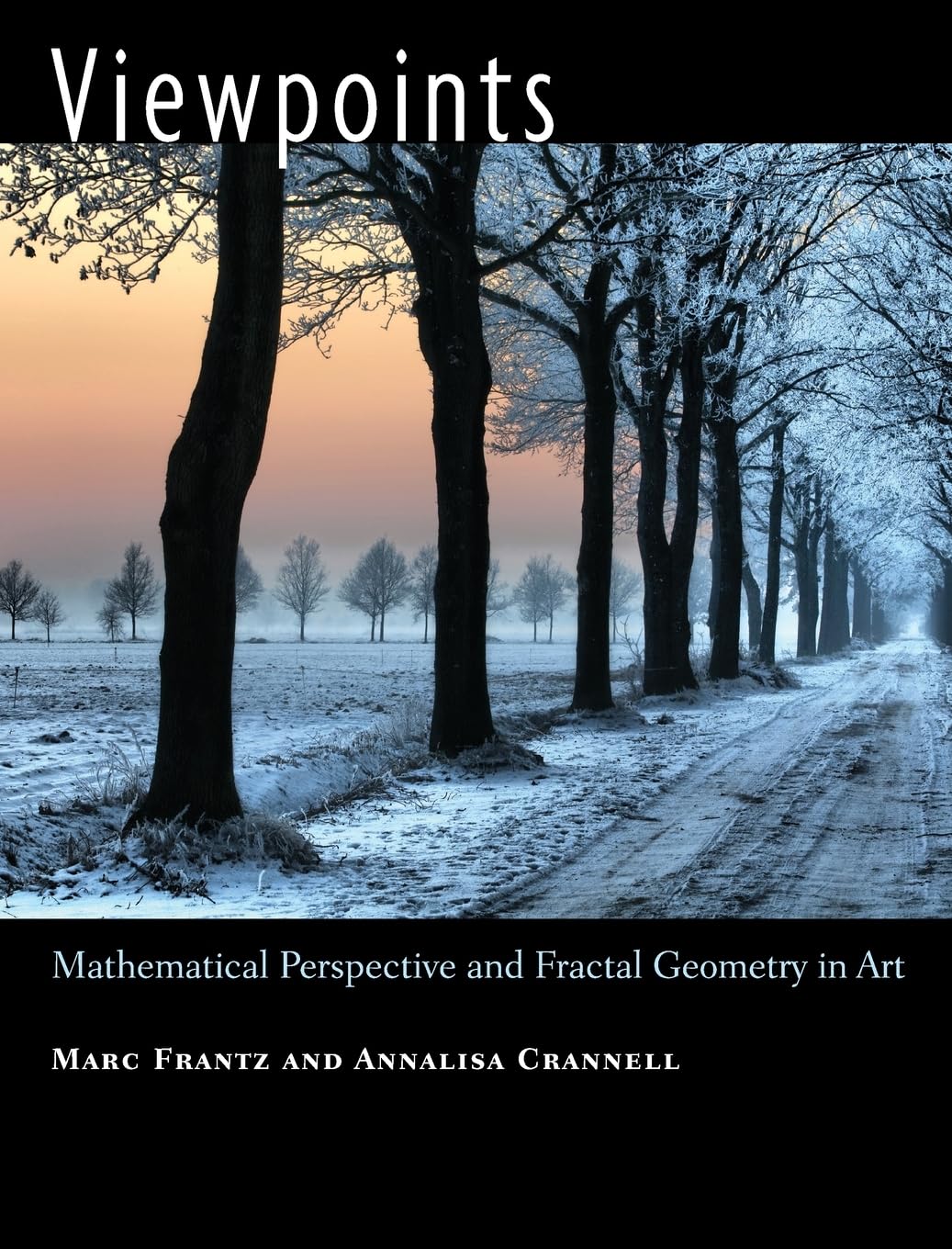
Title
Viewpoints: Mathematical Perspective and Fractal Geometry in Art,New
Sold by Ergodebooks, an authorized reseller.
Returns accepted within 30 days | support@ergodebooks.com
Shipping Information
- Free Standard Shipping — United States only
- Processing Time: 3–5 business days
- Estimated Delivery: 6–10 business days after dispatch
- Double-boxed, fully insured & discreetly packaged
- Tracking number sent via email once dispatched
Returns & Refund
Returns accepted within 30 days of delivery.
Damaged or Defective Item
Free return shipping + replacement or full refund
Wrong Item Received
Free return shipping + replacement or full refund
Change of Mind
Return shipping at customer's expense · 25% restocking fee applies
Payment Option

An undergraduate textbook devoted exclusively to relationships between mathematics and art, Viewpoints is ideally suited for mathforliberalarts courses and mathematics courses for fine arts majors. The textbook contains a wide variety of classroomtested activities and problems, a series of essays by contemporary artists written especially for the book, and a plethora of pedagogical and learning opportunities for instructors and students.Viewpoints focuses on two mathematical areas: perspective related to drawing manmade forms and fractal geometry related to drawing natural forms. Investigating facets of the threedimensional world in order to understand mathematical concepts behind the art, the textbook explores art topics including comic, anamorphic, and classical art, as well as photography, while presenting such mathematical ideas as proportion, ratio, selfsimilarity, exponents, and logarithms. Straightforward problems and rewarding solutions empower students to make accurate, sophisticated drawings. Personal essays and short biographies by contemporary artists are interspersed between chapters and are accompanied by images of their work. These fine artistswho include mathematicians and scientistsexamine how mathematics influences their art. Accessible to students of all levels, Viewpoints encourages experimentation and collaboration, and captures the essence of artistic and mathematical creation and discovery.Classroomtested activities and problem solvingAccessible problems that move beyond regular art school curriculumMultiple solutions of varying difficulty and applicabilityAppropriate for students of all mathematics and art levelsOriginal and exclusive essays by contemporary artistsForthcoming: Instructor's manual (available only to teachers)
⚠️ WARNING (California Proposition 65):
This product may contain chemicals known to the State of California to cause cancer, birth defects, or other reproductive harm.
For more information, please visit www.P65Warnings.ca.gov.
- Q: What is the focus of the textbook 'Viewpoints: Mathematical Perspective and Fractal Geometry in Art'? A: The textbook focuses on the relationships between mathematics and art, specifically exploring perspective related to drawing man-made forms and fractal geometry related to drawing natural forms.
- Q: Who is the author of 'Viewpoints: Mathematical Perspective and Fractal Geometry in Art'? A: The author of the textbook is Marc Frantz.
- Q: What type of activities does 'Viewpoints' include? A: The textbook includes a variety of classroom-tested activities, problems, and pedagogical opportunities designed for both instructors and students.
- Q: Is this textbook suitable for all levels of students? A: Yes, 'Viewpoints' is accessible to students of all levels, making it appropriate for both mathematics and art majors.
- Q: What kind of essays are included in 'Viewpoints'? A: The textbook features original essays by contemporary artists, which examine how mathematics influences their art, alongside images of their work.
- Q: What is the condition of the book? A: The book is listed as 'New' and is a used book in good condition.
- Q: What is the binding type of 'Viewpoints'? A: The textbook is available in paperback binding.
- Q: When was 'Viewpoints: Mathematical Perspective and Fractal Geometry in Art' published? A: The textbook was published on July 25, 2011.
- Q: How many pages does the textbook have? A: The textbook contains 248 pages.
- Q: Will there be additional resources for instructors? A: Yes, an instructor's manual is forthcoming and will be available only to teachers.