
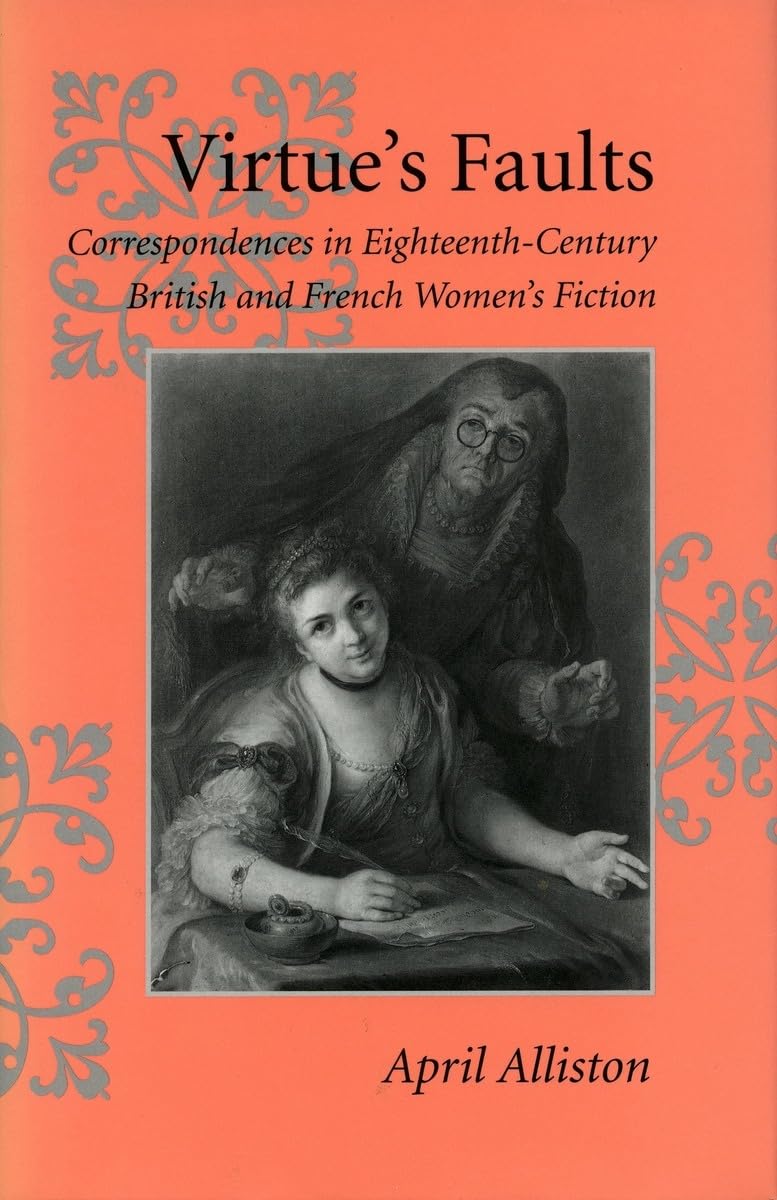
Title
Virtues Faults: Correspondences In Eighteenthcentury British And French Womens Fiction,Used
Sold by Ergodebooks, an authorized reseller.
Returns accepted within 30 days | support@ergodebooks.com
Shipping Information
- Free Standard Shipping — United States only
- Processing Time: 3–5 business days
- Estimated Delivery: 6–10 business days after dispatch
- Double-boxed, fully insured & discreetly packaged
- Tracking number sent via email once dispatched
Returns & Refund
Returns accepted within 30 days of delivery.
Damaged or Defective Item
Free return shipping + replacement or full refund
Wrong Item Received
Free return shipping + replacement or full refund
Change of Mind
Return shipping at customer's expense · 25% restocking fee applies
Payment Option

About the Author April Alliston is Professor of Comparative Literature at Princeton University. She is the editor of a critical edition of The Recess by Sophia Lee (2000), one of the books discussed in the present volume. Product Description This study focuses on fiction written by women in the eighteenth century to demonstrate how authors of the period implicitly examined and resisted patrilineal models of relationship, including the notions of literary tradition and of womens place in the family and the domestic sphere. The authors analysis of fiction from Lafayette to Austen argues that the concept of correspondence, as exemplified in epistolary fiction, leads to a deeper understanding of the connections among French and English womens works of the period.The author shows how coherences of plot, theme, form, and image link a group of over 100 littleknown novels representing textual exchanges between female characters to form a subgenre of French and English epistolary fiction, a fiction of womens correspondence. More canonical works, beyond the strict confines of form and period that define this subgenre, are reconsidered in relation to it, notably Lafayettes The Princess of Clves, which is alluded to by several of the later writers. The author also shows how works by Stal and Austen at the turn of the nineteenth century display significant affiliations with the texts of womens correspondence, even as they represent a turning away from the conventions that characterize the earlier subgenre. Review This is a work of high importance, both methodologically and substantively. Not only does it perform a rescue operation on littleknown novels by English and French women of the late eighteenth century, it contextualizes them so richly that it sheds new light on such familiar books as Corinne and The Princess of Clves. It contributes to the history of sensibility as well as that of womens writing, and it makes its contributions in highly readable fashion, in lucid, energetic prose.Patricia Meyer Spacks, University of Virginia From the Inside Flap This study focuses on fiction written by women in the eighteenth century to demonstrate how authors of the period implicitly examined and resisted patrilineal models of relationship, including the notions of literary tradition and of womens place in the family and the domestic sphere. The authors analysis of fiction from Lafayette to Austen argues that the concept of correspondence, as exemplified in epistolary fiction, leads to a deeper understanding of the connections among French and English womens works of the period.The author shows how coherences of plot, theme, form, and image link a group of over 100 littleknown novels representing textual exchanges between female characters to form a subgenre of French and English epistolary fiction, a fiction of womens correspondence. More canonical works, beyond the strict confines of form and period that define this subgenre, are reconsidered in relation to it, notably Lafayettes The Princess of Clves, which is alluded to by several of the later writers. The author also shows how works by Stal and Austen at the turn of the nineteenth century display significant affiliations with the texts of womens correspondence, even as they represent a turning away from the conventions that characterize the earlier subgenre. From the Back Cover This is a work of high importance, both methodologically and substantively. Not only does it perform a rescue operation on littleknown novels by English and French women of the late eighteenth century, it contextualizes them so richly that it sheds new light on such familiar books as Corinne and The Princess of Clves. It contributes to the history of sensibility as well as that of womens writing, and it makes its contributions in highly readable fashion, in lucid, energetic prose.Patricia Meyer Spacks, University of Virginia
⚠️ WARNING (California Proposition 65):
This product may contain chemicals known to the State of California to cause cancer, birth defects, or other reproductive harm.
For more information, please visit www.P65Warnings.ca.gov.