
Title
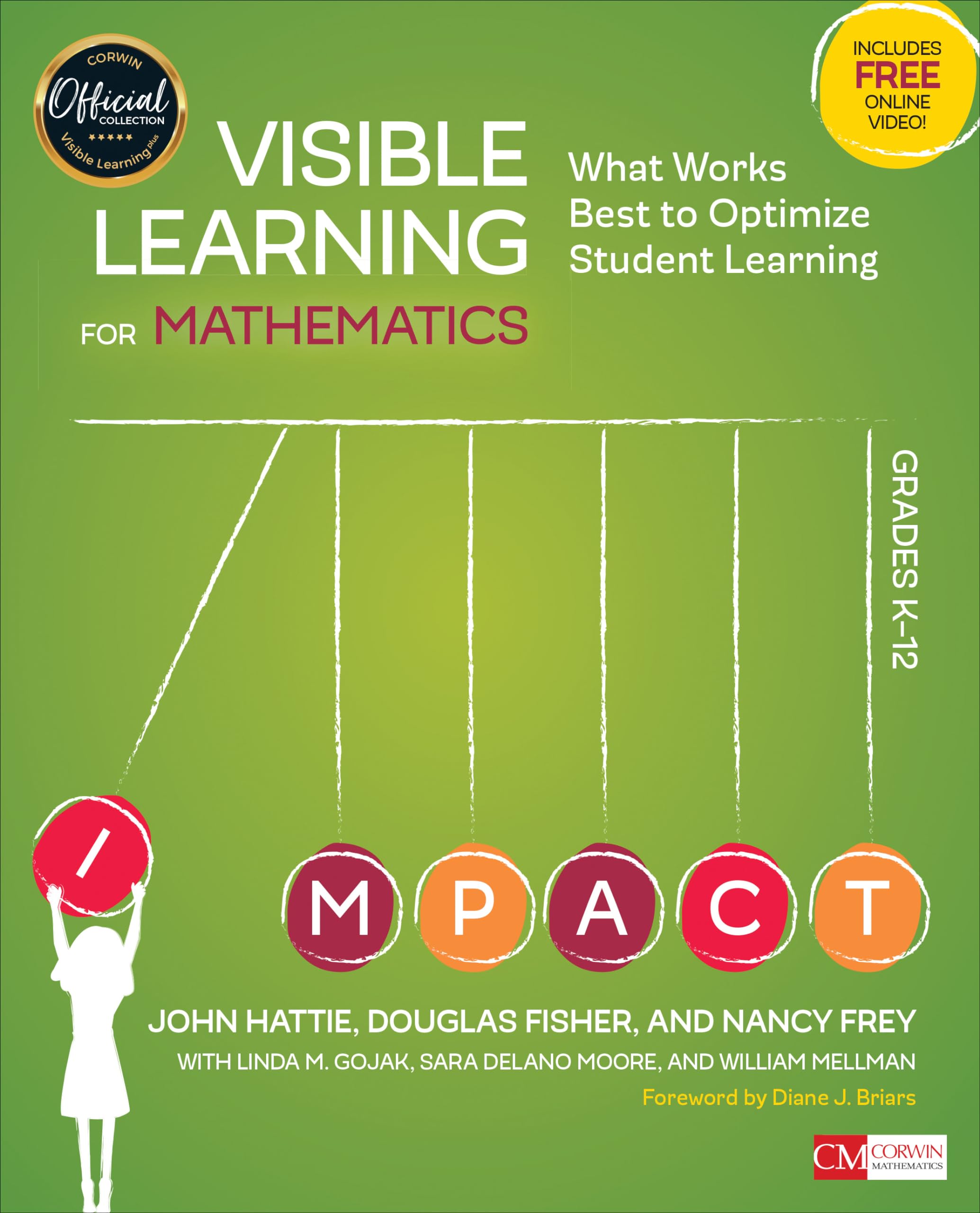
Visible Learning for Mathematics, Grades K12: What Works Best to Optimize Student Learning (Corwin Mathematics Series),New
Sold by Ergodebooks, an authorized reseller.
Returns accepted within 30 days | support@ergodebooks.com
Shipping Information
- Free Standard Shipping — United States only
- Processing Time: 3–5 business days
- Estimated Delivery: 6–10 business days after dispatch
- Double-boxed, fully insured & discreetly packaged
- Tracking number sent via email once dispatched
Returns & Refund
Returns accepted within 30 days of delivery.
Damaged or Defective Item
Free return shipping + replacement or full refund
Wrong Item Received
Free return shipping + replacement or full refund
Change of Mind
Return shipping at customer's expense · 25% restocking fee applies
Payment Option

Rich tasks, collaborative work, number talks, problem based learning, direct instruction?with so many possible approaches, how do we know which ones work the best? In Visible Learning for Mathematics, six acclaimed educators assert it?s not about which oneit?s about whenand show you how to design high impact instruction so all students demonstrate more than a year?s worth of mathematics learning for a year spent in school.That?s a high bar, but with the amazing K 12 framework here, you choose the right approach at the right time, depending upon where learners are within three phases of learning: surface, deep, and transfer. This results in 'visible' learning because theeffect is tangible. The framework is forged out of current research in mathematics combined with John Hattie?s synthesis of more than 15 years of education research involving 300 million students.Chapter by chapter, and equipped with video clips, planning tools, rubrics, and templates, you get the inside track on which instructional strategies to use at each phase of the learning cycle:Surface learning phase: Whenthrough carefully constructed experiencesstudents explore new concepts and make connections to procedural skills and vocabulary that give shape to developing conceptual understandings.Deep learning phase: Whenthrough the solving of rich high cognitive tasks and rigorous discussionstudents make connections among conceptual ideas, form mathematical generalizations, and apply and practice procedural skills with fluency.Transfer phase: When students can independently think through more complex mathematics, and can plan, investigate, and elaborate as they apply what they know to new mathematical situations.To equip students for higher level mathematics learning, we have to be clear about where students are, where they need to go, and what it looks like when they get there. Visible Learning for Math brings about powerful, precision teaching for K 12 through intentionally designed guided, collaborative, and independent learning.
⚠️ WARNING (California Proposition 65):
This product may contain chemicals known to the State of California to cause cancer, birth defects, or other reproductive harm.
For more information, please visit www.P65Warnings.ca.gov.
- Q: What is the main focus of 'Visible Learning for Mathematics'? A: The book focuses on determining which instructional strategies optimize student learning in mathematics across K-12 education, emphasizing the timing of different approaches.
- Q: How many pages does the book contain? A: The book contains 304 pages.
- Q: Who is the author of this book? A: The author of 'Visible Learning for Mathematics' is John Hattie.
- Q: What teaching phases does the book address? A: The book addresses three phases of learning: surface, deep, and transfer, each with specific strategies for effective instruction.
- Q: Is this book suitable for all grade levels? A: Yes, 'Visible Learning for Mathematics' is designed for educators teaching grades K-12.
- Q: What instructional strategies are highlighted in the book? A: The book highlights strategies such as rich tasks, number talks, collaborative work, and problem-based learning.
- Q: What edition of the book is available? A: The available edition of the book is the first edition, published on September 30, 2016.
- Q: What is the binding type of the book? A: The book is available in paperback binding.
- Q: How does the book help in higher-level mathematics learning? A: The book provides a framework to help educators identify where students are in their learning and how to effectively guide them through the necessary phases.
- Q: Are there additional resources included in the book? A: Yes, the book includes video clips, planning tools, rubrics, and templates to support instructional strategies.