
Title
Vision and Information Processing for Automation,Used
Sold by Ergodebooks, an authorized reseller.
Returns accepted within 30 days | support@ergodebooks.com
Shipping Information
- Free Standard Shipping — United States only
- Processing Time: 3–5 business days
- Estimated Delivery: 6–10 business days after dispatch
- Double-boxed, fully insured & discreetly packaged
- Tracking number sent via email once dispatched
Returns & Refund
Returns accepted within 30 days of delivery.
Damaged or Defective Item
Free return shipping + replacement or full refund
Wrong Item Received
Free return shipping + replacement or full refund
Change of Mind
Return shipping at customer's expense · 25% restocking fee applies
Payment Option

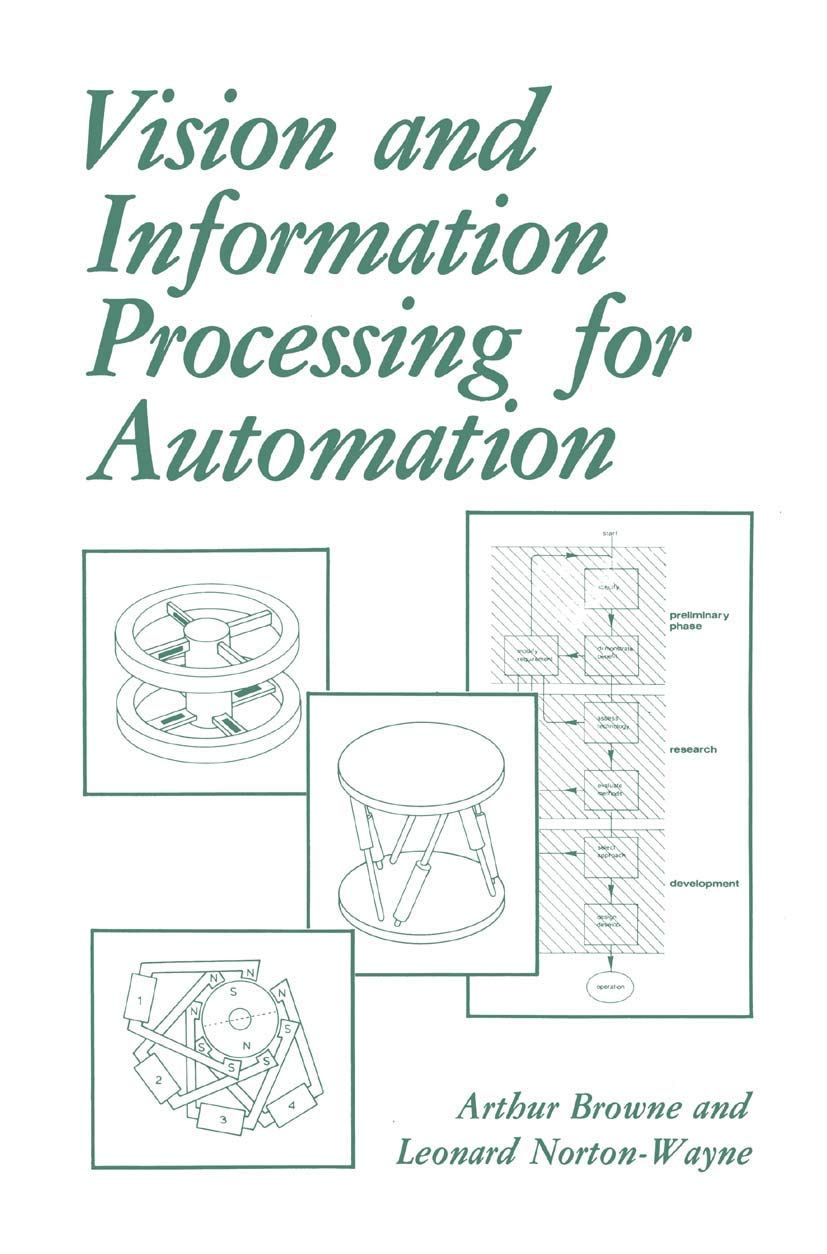
Developments in electronic hardware, particularly microprocessors and solidstate cameras, have resulted in a vast explosion in the range and variety of applications to which intelligent processing may be applied to yield costeffective automation. Typical examples include automated visual inspection and repetitive assembly. The technology required is recent and specialized, and is thus not widely known. VISION AND INFORMATION PROCESSING FOR AUTOMATION has arisen from a short course given by the authors to introduce potential users to the technology. Its content is a development and extension of material presented in the course. The objective of the book is to introduce readers to modern concepts and techniques basic to intelligent automation, and explain how these are applied to prac tical problems. Its emphasis is on machine vision. Intelligent instrumentation is concerned with processing infor mation, and an appreciation of the nature of information is essential in configuring instrumentation to handle it effiCiently. An understand ing of the fundamental principles of efficient computation and of the way in which machines make decisions is vital for the same reasons. Selection of appropriate sensing (e.g., camera type and configuration), of illumination, of hardware for processing (microchip or parallel processor?) to give most effective information flow, and of the most appropriate processing algorithms is critical in obtaining an optimal solution. Analysis of performance, to demonstrate that requirements have been met, and to identify the causes if they have not, is also important. All of these topics are covered in this volume.
⚠️ WARNING (California Proposition 65):
This product may contain chemicals known to the State of California to cause cancer, birth defects, or other reproductive harm.
For more information, please visit www.P65Warnings.ca.gov.