
Title
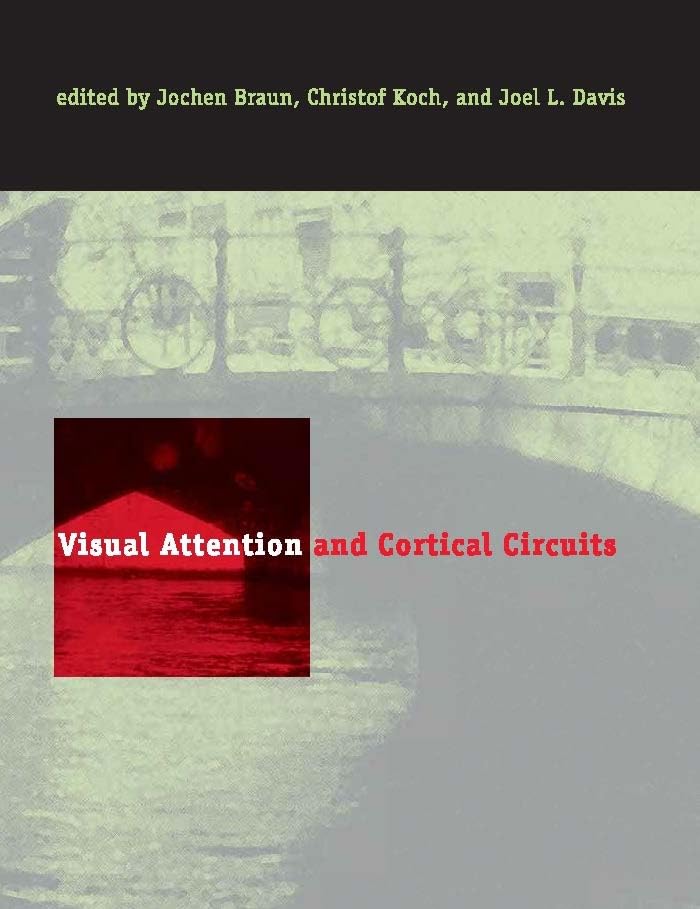
Visual Attention and Cortical Circuits (Bradford Book),Used
Sold by Ergodebooks, an authorized reseller.
Returns accepted within 30 days | support@ergodebooks.com
Shipping Information
- Free Standard Shipping — United States only
- Processing Time: 3–5 business days
- Estimated Delivery: 6–10 business days after dispatch
- Double-boxed, fully insured & discreetly packaged
- Tracking number sent via email once dispatched
Returns & Refund
Returns accepted within 30 days of delivery.
Damaged or Defective Item
Free return shipping + replacement or full refund
Wrong Item Received
Free return shipping + replacement or full refund
Change of Mind
Return shipping at customer's expense · 25% restocking fee applies
Payment Option

An attempt to derive a comprehensive theory of attention from both neurobiological and psychological data.The neurobiology and psychology of attention have much to learn from each other. Neurobiologists recognize that responses in sensory cortex depend on the behavioral relevance of a stimulus, but have few ways to study how perception changes as a result. Psychologists have the conceptual and methodological tools to do just that, but are confounded by the multiple interpretations and theoretical ambiguities. This book attempts to bridge the two fields and to derive a comprehensive theory of attention from both neurobiological and psychological data. It highlights situations where attention can be seen to alter both neural activity and psychophysical performance/phenomenal experience. This bicultural approach contributes not only to attention research but to the larger goal of linking neural activity to conscious experience.The book focuses mainly on the effects of visual attention on the ventral and dorsal streams of visual cortex in humans and monkeys and the associated changes in visual performance. Several larger findings emerge: attention may involve more than one neural system; attention modulates all stages of cortical visual processing; the effect of attention is constrained by the intrinsic connectivity of cortex and the resulting contextual interactions; and the notion of a saliency map remains central to thinking about visual attention. The book also considers several approaches to evaluating the same variable through different methods, such as behavioral measurements, functional imaging, and singleunit recording.ContributorsNarcisse P. Bichot, Erik Blaser, Geoffrey M. Boynton, Jochen Braun, Maurizio Corbetta, Sean M. Culhane, Florin Cutzu, Sophie Deneve, Robert Desimone, John Duncan, Sunil P. Gandhi, Charles D. Gilbert, David J. Heeger, James W. Holsapple, Alexander C. Huk, Minami Ito, Laurent Itti, Christof Koch, Peter E. Latham, Nilli Lavie, D. Kathleen Lee, ZhongLin Lu, John H.R. Maunsell, Carrie J. McAdams, Brad C. Motter, Alexandre Pouget, Adam Reeves, John H. Reynolds, Jeffrey D. Schall, Christian Scheier, Shinsuke Shimojo, Gordon L. Shulman, George Sperling, Kirk G. Thompson, John K. Tsotsos, Katsumi Watanabe, Erich Weichselgartner, Gerald Westheimer
⚠️ WARNING (California Proposition 65):
This product may contain chemicals known to the State of California to cause cancer, birth defects, or other reproductive harm.
For more information, please visit www.P65Warnings.ca.gov.