If you have any questions, you are always welcome to contact us. We'll get back to you as soon as possible, withing 24 hours on weekdays.
Customer service
All questions about your order, return and delivery must be sent to our customer service team by e-mail at yourstore@yourdomain.com
Sale & Press
If you are interested in selling our products, need more information about our brand or wish to make a collaboration, please contact us at press@yourdomain.com
Help
If you have any questions, you are always welcome to contact us. We'll get back to you as soon as possible, withing 24 hours on weekdays.
Customer service
All questions about your order, return and delivery must be sent to our customer service team by e-mail at yourstore@yourdomain.com
Sale & Press
If you are interested in selling our products, need more information about our brand or wish to make a collaboration, please contact us at press@yourdomain.com
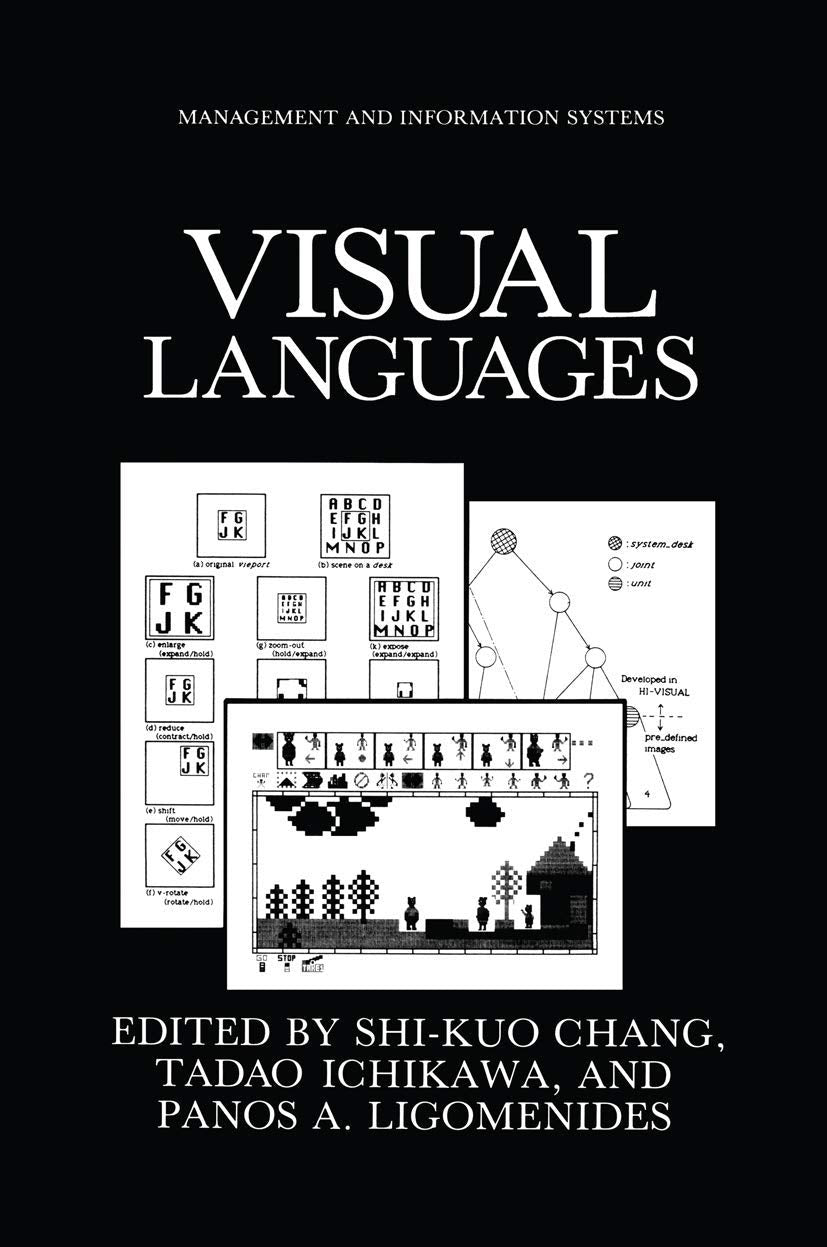
This book is intended as both an introduction to the stateoftheart in visual languages, as well as an exposition of the frontiers of research in advanced visual languages. It is for computer scientists, computer engi neers, information scientists, application programmers, and technical managers responsible for software development projects who are inter ested in the methodology and manifold applications of visual languages and visual programming. The contents of this book are drawn from invited papers, as well as selected papers from two workshops: the 1985 IEEE Workshop on Lan guages for AutomationCognitive Aspects in Information Processing, which was held in Mallorca, Spain, June 2830, 1985; and the 1984 IEEE Workshop on Visual Languages, which was held in Hiroshima, Japan, December 79, 1984. Panos Ligomenides and I organized the technical program of LFA '85, and Tadao Ichikawa and I organized the techni cal program of VL '84. Both workshops have now become successful annual events in their own right. The intersecting area of visual languages and visual programming especially has become a fascinating new research area. It is hoped that this book will focus the reader's attention on some of the interesting research issues as well as the potential for future applications. After reading this book, the reader will undoubtedly get an impression that visual languages and the concept of generalized icons can be studied fruitfully from many different perspectives, including computer graphics, formal language theory, educational methodology, cognitive psychology and visual design.
⚠️ WARNING (California Proposition 65):
This product may contain chemicals known to the State of California to cause cancer,
birth defects, or other reproductive harm.
For MAP (Minimum Advertised Price) violations and Intellectual Property (IP) or Trademark concerns, please contact:
support@ergodebooks.com
⚠️ California Proposition 65 Warning: Some products sold on this website may expose you to chemicals known to the State of California to cause cancer, birth defects, or other reproductive harm. For more information, visit www.P65Warnings.ca.gov.