
Title
Visual Navigation: From Biological Systems To Unmanned Ground Vehicles (Computer Vision Series),Used
Sold by Ergodebooks, an authorized reseller.
Returns accepted within 30 days | support@ergodebooks.com
Shipping Information
- Free Standard Shipping — United States only
- Processing Time: 3–5 business days
- Estimated Delivery: 6–10 business days after dispatch
- Double-boxed, fully insured & discreetly packaged
- Tracking number sent via email once dispatched
Returns & Refund
Returns accepted within 30 days of delivery.
Damaged or Defective Item
Free return shipping + replacement or full refund
Wrong Item Received
Free return shipping + replacement or full refund
Change of Mind
Return shipping at customer's expense · 25% restocking fee applies
Payment Option

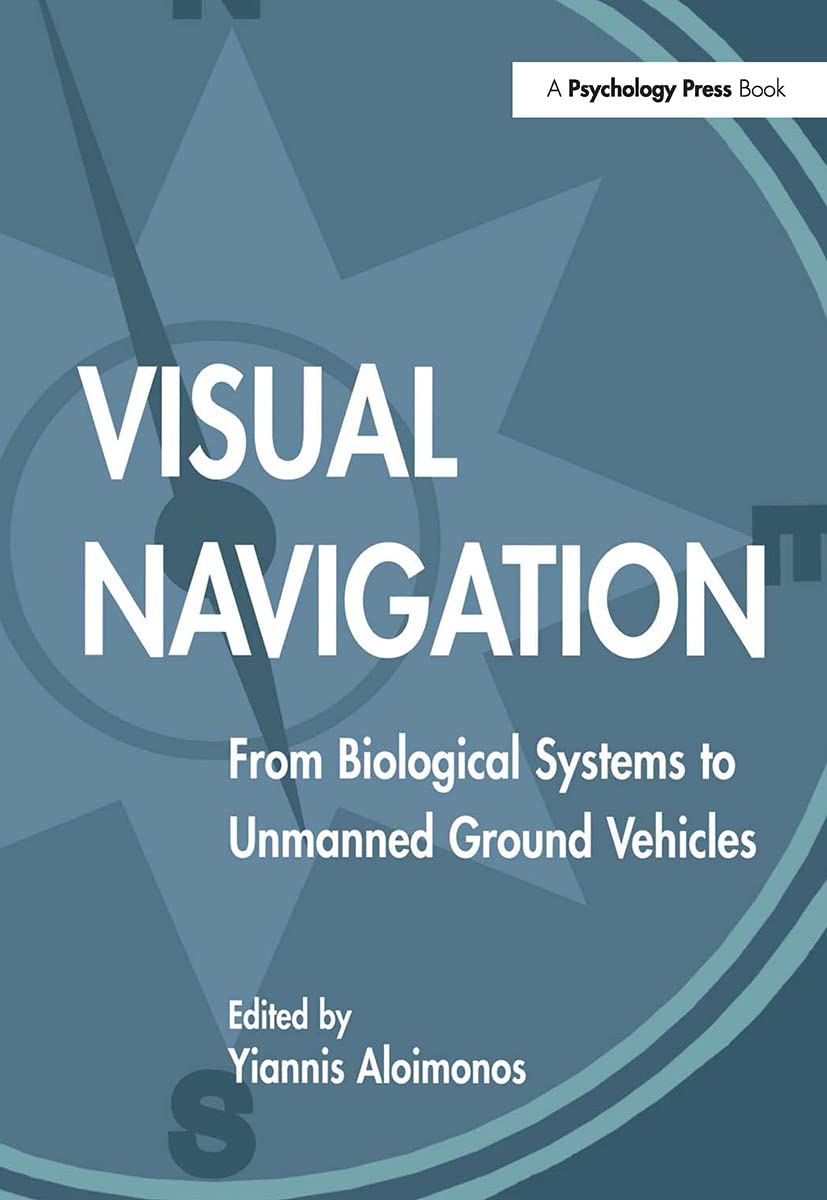
All biological systems with vision move about their environments and successfully perform many tasks. The same capabilities are needed in the world of robots. To that end, recent results in empirical fields that study insects and primates, as well as in theoretical and applied disciplines that design robots, have uncovered a number of the principles of navigation. To offer a unifying approach to the situation, this book brings together ideas from zoology, psychology, neurobiology, mathematics, geometry, computer science, and engineering. It contains theoretical developments that will be essential in future research on the topic especially new representations of space with less complexity than Euclidean representations possess. These representations allow biological and artificial systems to compute from images in order to successfully deal with their environments.In this book, the barriers between different disciplines have been smoothed and the workings of vision systems of biological organisms are made clear in computational terms to computer scientists and engineers. At the same time, fundamental principles arising from computational considerations are made clear both to empirical scientists and engineers. Empiricists can generate a number of hypotheses that they could then study through various experiments. Engineers can gain insight for designing robotic systems that perceive aspects of their environment.For the first time, readers will find:* the insect vision system presented in a way that can be understood by computational scientists working in computer vision and engineering;* three complete, working robotic navigation systems presented with all the issues related to their design analyzed in detail;* the beginning of a computational theory of direct perception, as advocated by Gibson, presented in detail with applications for a variety of problems; and* the idea that vision systems could compute space representations different from perfect metric descriptions and be used in robotic tasks advanced for both artificial and biological systems.
⚠️ WARNING (California Proposition 65):
This product may contain chemicals known to the State of California to cause cancer, birth defects, or other reproductive harm.
For more information, please visit www.P65Warnings.ca.gov.