
Title
Visual Tracking in Conventional Minimally Invasive Surgery,Used
Sold by Ergodebooks, an authorized reseller.
Returns accepted within 30 days | support@ergodebooks.com
Shipping Information
- Free Standard Shipping — United States only
- Processing Time: 3–5 business days
- Estimated Delivery: 6–10 business days after dispatch
- Double-boxed, fully insured & discreetly packaged
- Tracking number sent via email once dispatched
Returns & Refund
Returns accepted within 30 days of delivery.
Damaged or Defective Item
Free return shipping + replacement or full refund
Wrong Item Received
Free return shipping + replacement or full refund
Change of Mind
Return shipping at customer's expense · 25% restocking fee applies
Payment Option

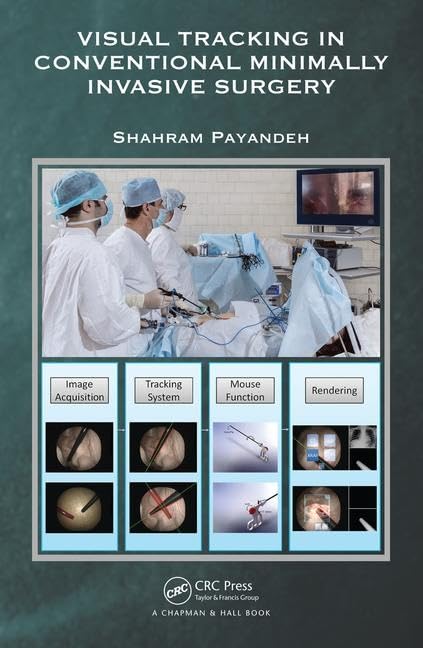
Visual Tracking in Conventional Minimally Invasive Surgery introduces the various tools and methodologiesthat can be used to enhance a conventional surgical setupwith some degree of automation. The main focus of this book is on methods for tracking surgical tools and how they can be used to assist thesurgeon during the surgical operation. Various notions associated withsurgeoncomputer interfaces and imageguided navigation are explored,with a range of experimental results.The book starts with some basic motivations for minimally invasive surgery and states the various distinctions between robotic and nonrobotic (conventional) versions of this procedure. Common components of this type of operation are presented with a review of the literature addressing the automation aspects of such a setup. Examples of tracking results are shown for both motion and gesture recognition of surgical tools, which can be used as part of the surgeoncomputer interface. In the case of markerless tracking, where no special visual markers can be added to the surgical tools, the tracking results are divided into two types of methodology, depending on the nature and the estimate of the visual noise. Details of the tracking methods are presented using standard Kalman filters and particle filters.The last part of the book provides approaches for tracking a region on the surgical scene defined by the surgeon. Examples of how these tracking approaches can be used as part of imageguided navigation are demonstrated. This book is designed for control engineers interested in visual tracking, computer vision researchers and system designers involved with surgical automation, as well as surgeons, biomedical engineers, and robotic researchers.
⚠️ WARNING (California Proposition 65):
This product may contain chemicals known to the State of California to cause cancer, birth defects, or other reproductive harm.
For more information, please visit www.P65Warnings.ca.gov.