
Title
Visuomotor Coordination: Amphibians, Comparisons, Models, and Robots,New
Sold by Ergodebooks, an authorized reseller.
Returns accepted within 30 days | support@ergodebooks.com
Shipping Information
- Free Standard Shipping — United States only
- Processing Time: 3–5 business days
- Estimated Delivery: 6–10 business days after dispatch
- Double-boxed, fully insured & discreetly packaged
- Tracking number sent via email once dispatched
Returns & Refund
Returns accepted within 30 days of delivery.
Damaged or Defective Item
Free return shipping + replacement or full refund
Wrong Item Received
Free return shipping + replacement or full refund
Change of Mind
Return shipping at customer's expense · 25% restocking fee applies
Payment Option

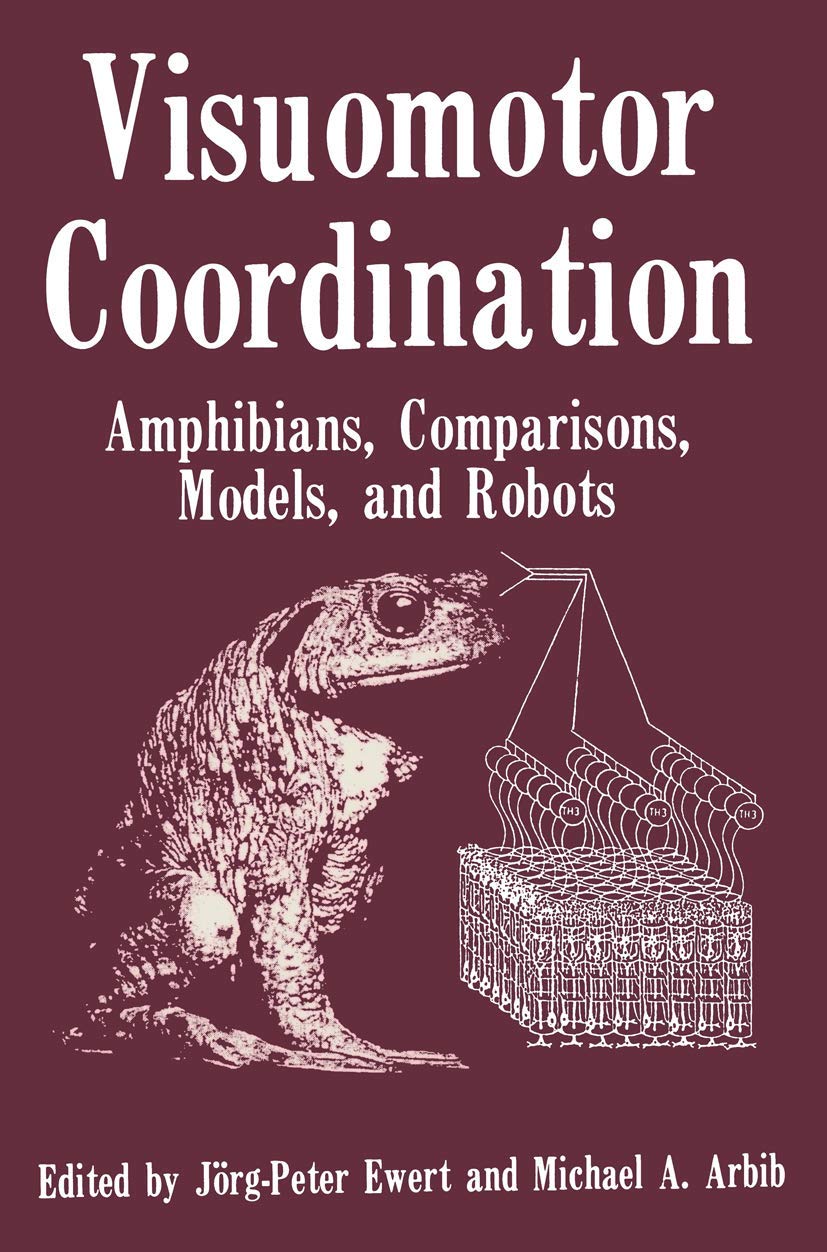
Various brain areas of mammals can phyletically be traced back to homologous structures in amphibians. The amphibian brain may thus be regarded as a kind of 'microcosm' of the highly complex primate brain, as far as certain homologous structures, sensory functions, and assigned ballistic (preplanned and prepro grammed) motor and behavioral processes are concerned. A variety of fundamental operations that underlie perception, cognition, sensorimotor transformation and its modulation appear to proceed in primate's brain in a way understandable in terms of basic principles which can be investigated more easily by experiments in amphibians. We have learned that progress in the quantitative description and evaluation of these principles can be obtained with guidance from theory. Modeling supported by simulation is a process of transforming abstract theory derived from data into testable structures. Where empirical data are lacking or are difficult to obtain because of structural constraints, the modeler makes assumptions and approximations that, by themselves, are a source of hypotheses. If a neural model is then tied to empirical data, it can be used to predict results and hence again to become subject to experimental tests whose resulting data in tum will lead to further improvements of the model. By means of our present models of visuomotor coordination and its modulation by statedependent inputs, we are just beginning to simulate and analyze how external information is represented within different brain structures and how these structures use these operations to control adaptive behavior.
⚠️ WARNING (California Proposition 65):
This product may contain chemicals known to the State of California to cause cancer, birth defects, or other reproductive harm.
For more information, please visit www.P65Warnings.ca.gov.