
Title
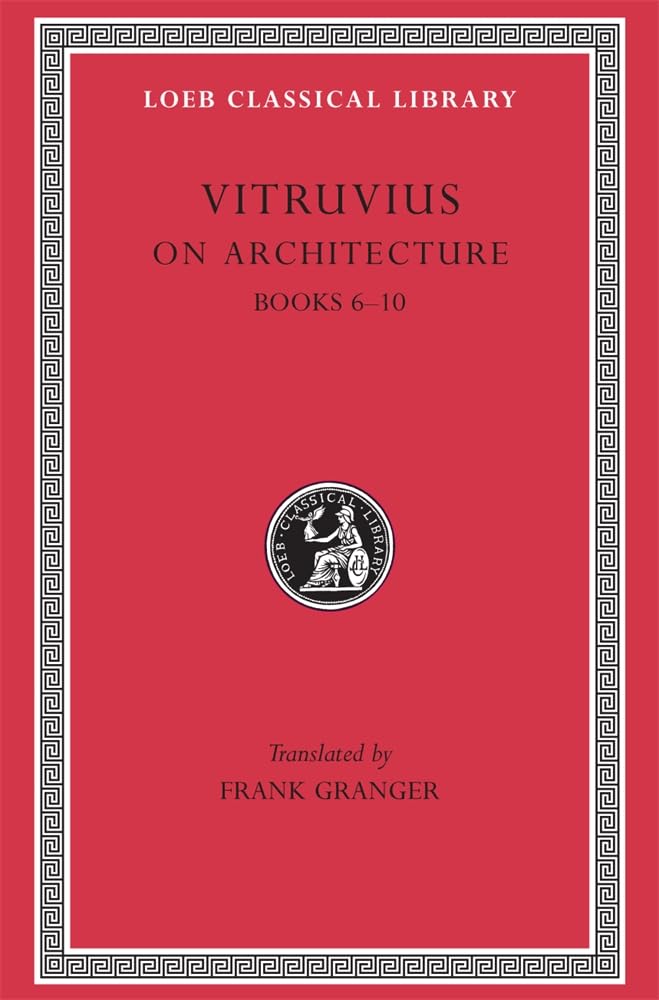
Vitruvius: On Architecture, Volume II, Books 610 (Loeb Classical Library No. 280),Used
Sold by Ergodebooks, an authorized reseller.
Returns accepted within 30 days | support@ergodebooks.com
Shipping Information
- Free Standard Shipping — United States only
- Processing Time: 3–5 business days
- Estimated Delivery: 6–10 business days after dispatch
- Double-boxed, fully insured & discreetly packaged
- Tracking number sent via email once dispatched
Returns & Refund
Returns accepted within 30 days of delivery.
Damaged or Defective Item
Free return shipping + replacement or full refund
Wrong Item Received
Free return shipping + replacement or full refund
Change of Mind
Return shipping at customer's expense · 25% restocking fee applies
Payment Option

The Renaissance man avant la lettre.Vitruvius (Marcus V. Pollio), Roman architect and engineer, studied Greek philosophy and science and gained experience in the course of professional work. He was one of those appointed to be overseers of imperial artillery or military engines, and was architect of at least one unit of buildings for Augustus in the reconstruction of Rome. Late in life and in ill health he completed, sometime before 27 BC, De Architectura which, after its rediscovery in the fifteenth century, was influential enough to be studied by architects from the early Renaissance to recent times.In On Architecture Vitruvius adds to the tradition of Greek theory and practice the results of his own experience. The contents of this treatise in ten books are as follows. Book 1: Requirements for an architect; town planning; design, cities, aspects; temples. 2: Materials and their treatment. Greek systems. 3: Styles. Forms of Greek temples. Ionic. 4: Styles. Corinthian, Ionic, Doric; Tuscan; altars. 5: Other public buildings (fora, basilicae, theaters, colonnades, baths, harbors). 6: Sites and planning, especially of houses. 7: Construction of pavements, roads, mosaic floors, vaults. Decoration (stucco, wall painting, colors). 8: Hydraulic engineering; water supply; aqueducts. 9: Astronomy. Greek and Roman discoveries; signs of the zodiac, planets, moon phases, constellations, astrology, gnomon, sundials. 10: Machines for war and other purposes.
⚠️ WARNING (California Proposition 65):
This product may contain chemicals known to the State of California to cause cancer, birth defects, or other reproductive harm.
For more information, please visit www.P65Warnings.ca.gov.
- Q: How many pages does this book have? A: This book has four hundred forty-eight pages. It provides a comprehensive overview of architecture from a historical perspective.
- Q: What is the binding type of this book? A: The binding type is hardcover. This ensures durability and longevity for readers.
- Q: What are the dimensions of this book? A: The dimensions are four point two five inches in length, one inch in width, and six point three eight inches in height. These measurements make it a manageable size for reading.
- Q: Who is the author of this book? A: The author is Vitruvius, a renowned Roman architect and engineer. His work has been influential in the field of architecture for centuries.
- Q: What topics are covered in this book? A: The book covers topics such as town planning, materials, styles, public buildings, and hydraulic engineering. It offers insights into ancient architectural practices.
- Q: Is this book suitable for beginners in architecture? A: Yes, this book is suitable for beginners. It provides foundational knowledge about architecture and its historical context.
- Q: Can I read this book if I am not familiar with architecture? A: Yes, you can read this book without prior knowledge of architecture. It is designed to introduce key concepts and historical insights.
- Q: What themes are explored in this book? A: Themes include the principles of architecture, the relationship between buildings and their environment, and the influence of ancient Greek philosophy. These themes provide a well-rounded understanding of architectural history.
- Q: How should I care for this hardcover book? A: To care for the book, keep it in a dry and cool place. Avoid exposure to direct sunlight to prevent fading.
- Q: Is this book safe for children? A: Yes, this book is safe for older children. However, it may be more suitable for teens or adults due to its complex themes.
- Q: What if my book arrives damaged? A: If your book arrives damaged, you should contact the seller for a return or exchange. Most sellers provide options for such situations.
- Q: Does this book include illustrations? A: Yes, the book includes illustrations that enhance the understanding of architectural concepts discussed. They provide visual context to the text.
- Q: Is there a specific reading level recommended for this book? A: The recommended reading level is for high school students and above. The content is academically rigorous and may require some background knowledge.
- Q: Can I find this book in libraries? A: Yes, this book is often available in academic and public libraries. It is a recognized work in architecture literature.
- Q: What historical period does this book focus on? A: The book focuses on the Roman period and the influence of Greek architecture. It highlights the evolution of architectural thought through history.