If you have any questions, you are always welcome to contact us. We'll get back to you as soon as possible, withing 24 hours on weekdays.
Customer service
All questions about your order, return and delivery must be sent to our customer service team by e-mail at yourstore@yourdomain.com
Sale & Press
If you are interested in selling our products, need more information about our brand or wish to make a collaboration, please contact us at press@yourdomain.com
Help
If you have any questions, you are always welcome to contact us. We'll get back to you as soon as possible, withing 24 hours on weekdays.
Customer service
All questions about your order, return and delivery must be sent to our customer service team by e-mail at yourstore@yourdomain.com
Sale & Press
If you are interested in selling our products, need more information about our brand or wish to make a collaboration, please contact us at press@yourdomain.com
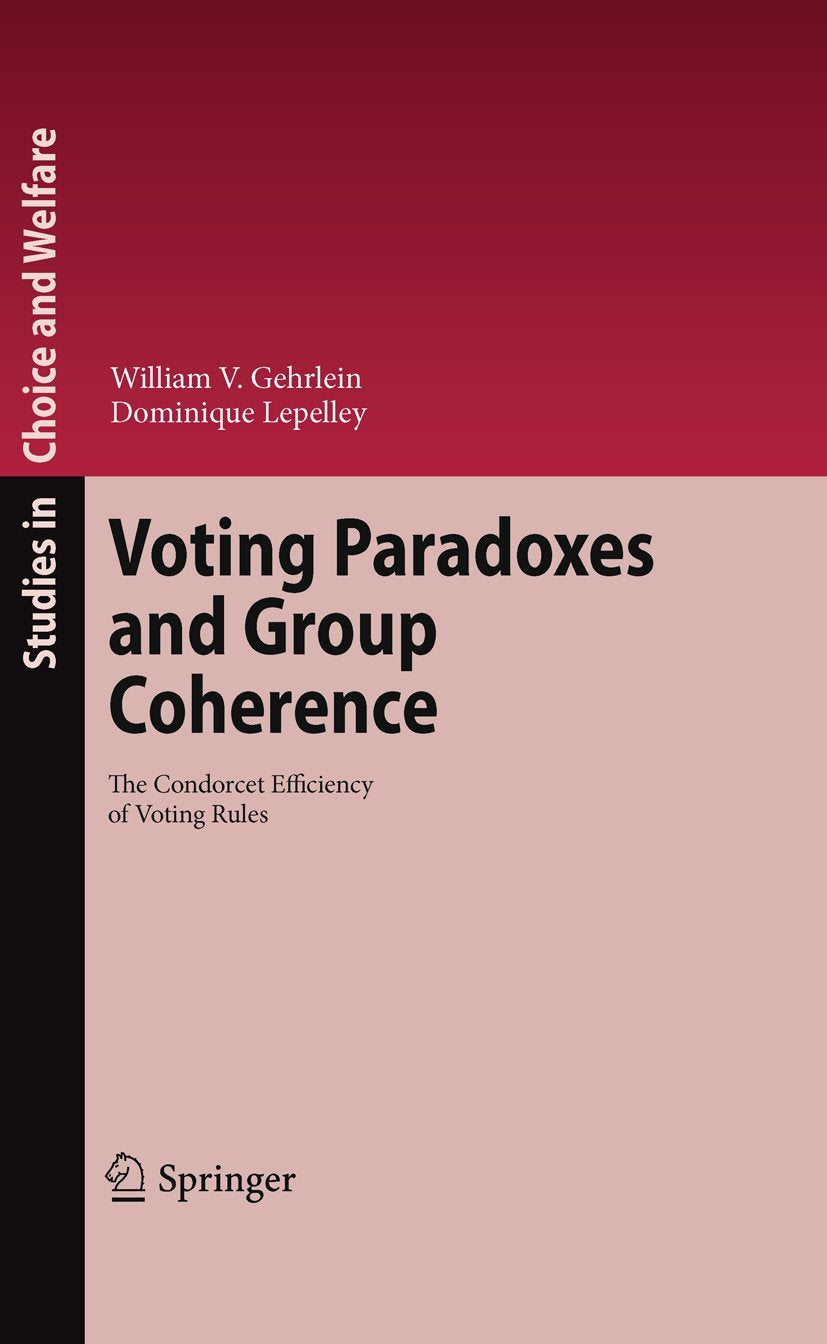
The likelihood of observing Condorcet's Paradox is known to be very low for elections with a small number of candidates if voters preferences on candidates reflect any significant degree of a number of different measures of mutual coherence. This reinforces the intuitive notion that strange election outcomes should become less likely as voters preferences become more mutually coherent. Similar analysis is used here to indicate that this notion is valid for most, but not all, other voting paradoxes. This study also focuses on the Condorcet Criterion, which states that the pairwise majority rule winner should be chosen as the election winner, if one exists. Representations for the Condorcet Efficiency of the most common voting rules are obtained here as a function of various measures of the degree of mutual coherence of voters preferences. An analysis of the Condorcet Efficiency representations that are obtained yields strong support for using Borda Rule.
⚠️ WARNING (California Proposition 65):
This product may contain chemicals known to the State of California to cause cancer,
birth defects, or other reproductive harm.
For MAP (Minimum Advertised Price) violations and Intellectual Property (IP) or Trademark concerns, please contact:
support@ergodebooks.com
⚠️ California Proposition 65 Warning: Some products sold on this website may expose you to chemicals known to the State of California to cause cancer, birth defects, or other reproductive harm. For more information, visit www.P65Warnings.ca.gov.