If you have any questions, you are always welcome to contact us. We'll get back to you as soon as possible, withing 24 hours on weekdays.
Customer service
All questions about your order, return and delivery must be sent to our customer service team by e-mail at yourstore@yourdomain.com
Sale & Press
If you are interested in selling our products, need more information about our brand or wish to make a collaboration, please contact us at press@yourdomain.com
Help
If you have any questions, you are always welcome to contact us. We'll get back to you as soon as possible, withing 24 hours on weekdays.
Customer service
All questions about your order, return and delivery must be sent to our customer service team by e-mail at yourstore@yourdomain.com
Sale & Press
If you are interested in selling our products, need more information about our brand or wish to make a collaboration, please contact us at press@yourdomain.com
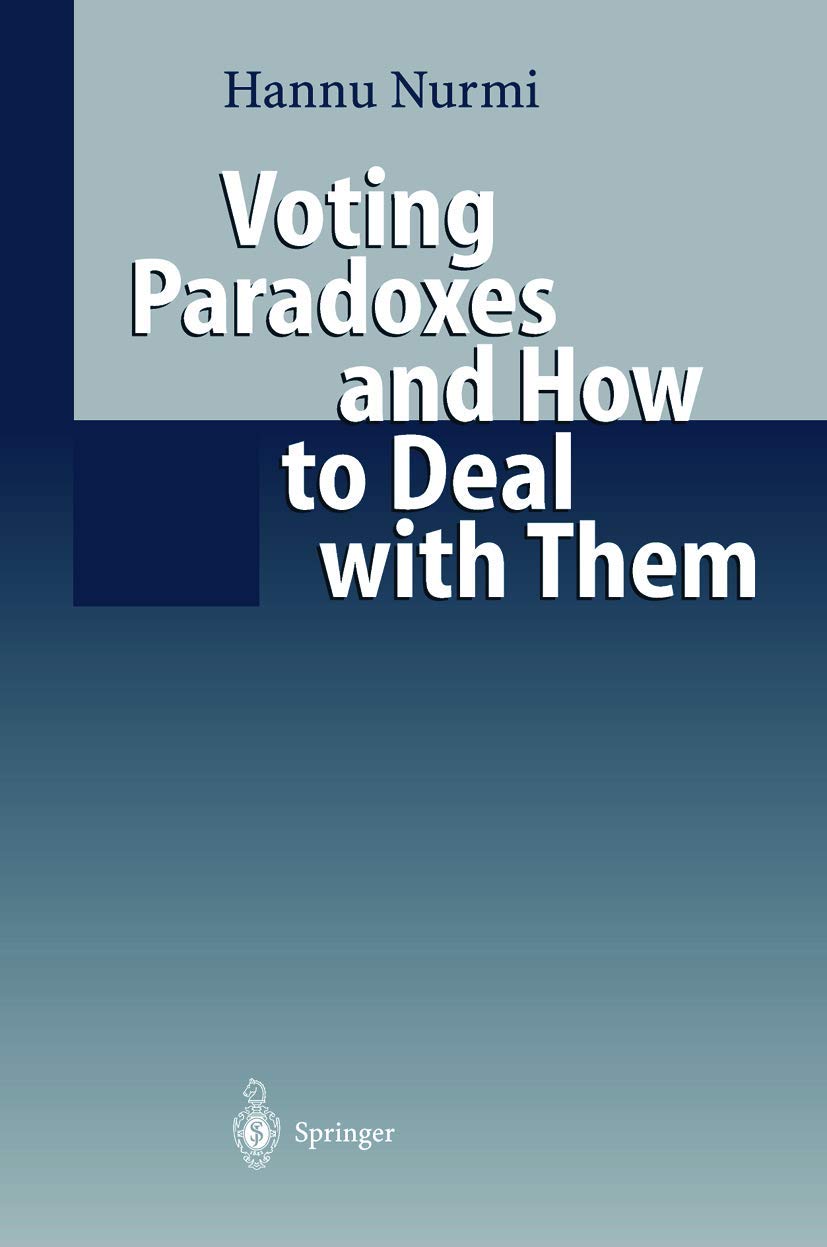
Voting paradoxes are unpleasant surprises encountered in voting. Typically they suggest that something is wrong with the way in dividual opinions are being expressed or processed in voting. The outcomes are bizarre, unfair or otherwise implausible, given the expressed opinions of voters. Voting paradoxes have an important role in the history of social choice theory. The founding fathers of the theory, Marquis de Condorcet and JeanCharles de Borda, were keenly aware of some of them. Indeed, much of the work of these and other forerunners of the modern social choice theory dealt with ways of avoiding paradoxes related to voting. One of the early paradoxes, viz. that bearing the name of Condorcet, has subsequently gained such a prominent place in the literature that it is sometimes called the paradox of voting. One of the aims of the present work is to show that Condorcet's is but one of many paradoxes of voting. Some of these are pretty closely interrelated making it meaningful to classify them. This is the second main aim of this book. The third objective is to suggest ways of dealing with paradoxes. Since voting is and has always been an essential instrument of democratic rule, it is of some in terest to find out how voting paradoxes are being dealt with by past and present methods of voting. Of even greater interest is to find ways of minimizing the probability of occurrence of various paradoxes. By their very nature some paradoxes are unavoidable.
⚠️ WARNING (California Proposition 65):
This product may contain chemicals known to the State of California to cause cancer,
birth defects, or other reproductive harm.
For MAP (Minimum Advertised Price) violations and Intellectual Property (IP) or Trademark concerns, please contact:
support@ergodebooks.com
⚠️ California Proposition 65 Warning: Some products sold on this website may expose you to chemicals known to the State of California to cause cancer, birth defects, or other reproductive harm. For more information, visit www.P65Warnings.ca.gov.