
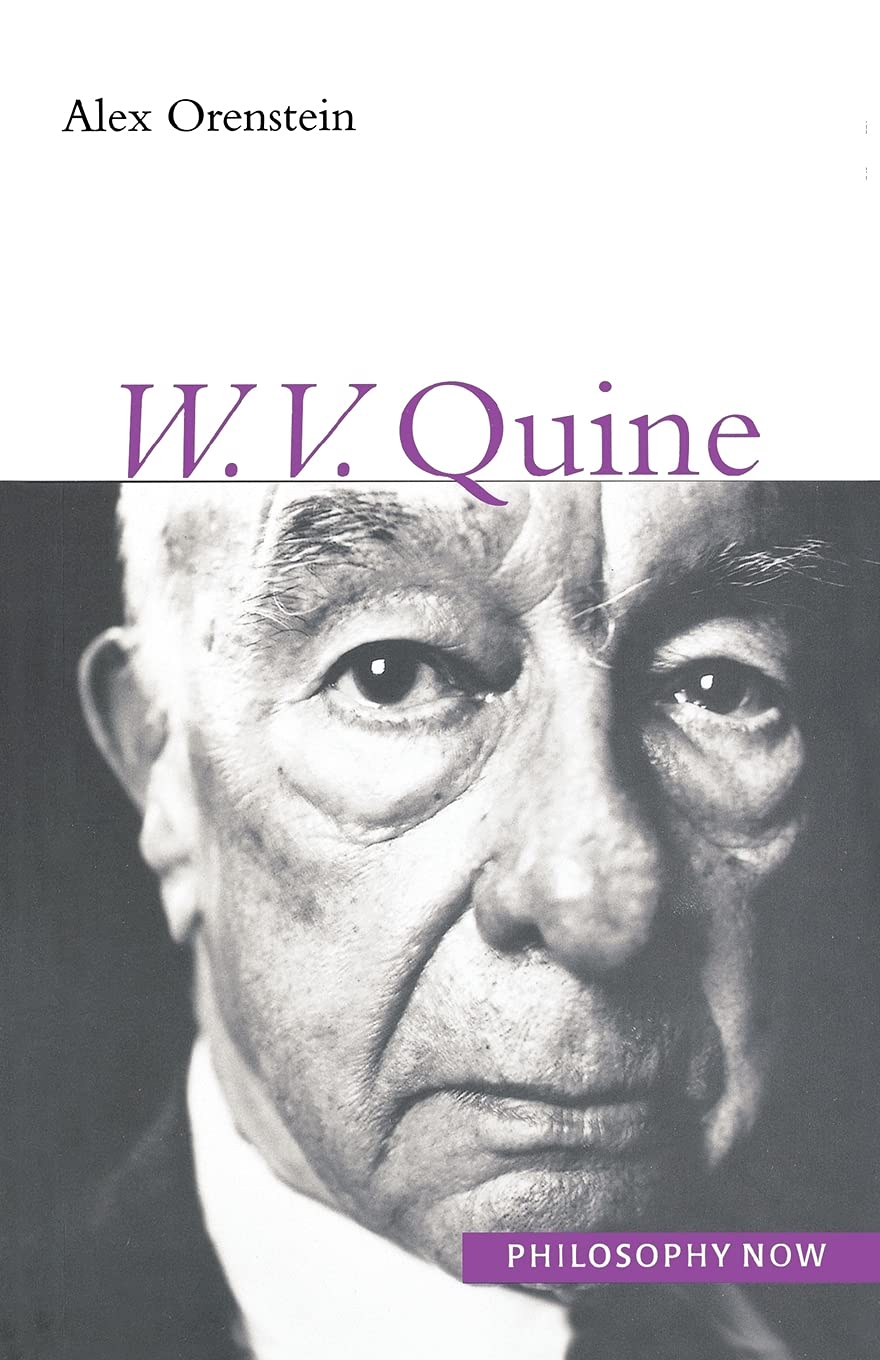
Title
W. V. Quine (Philosophy Now),New
Sold by Ergodebooks, an authorized reseller.
Returns accepted within 30 days | support@ergodebooks.com
Shipping Information
- Free Standard Shipping — United States only
- Processing Time: 3–5 business days
- Estimated Delivery: 6–10 business days after dispatch
- Double-boxed, fully insured & discreetly packaged
- Tracking number sent via email once dispatched
Returns & Refund
Returns accepted within 30 days of delivery.
Damaged or Defective Item
Free return shipping + replacement or full refund
Wrong Item Received
Free return shipping + replacement or full refund
Change of Mind
Return shipping at customer's expense · 25% restocking fee applies
Payment Option

The most influential philosopher in the analytic tradition of his time, Willard Van Orman Quine (19082000) changed the way we think about language and its relation to the world. His rejection of the analytic/synthetic distinction, his scepticism about modal logic and essentialism, his celebrated theme of the indeterminacy of translation, and his advocacy of naturalism have challenged key assumptions of the prevailing orthodoxy and helped shape the development of much of recent philosophy.This introduction to Quine's philosophical ideas provides philosophers, students, and generalists with an authoritative analysis of Quine's lasting contributions to philosophy. The major themes covered include the adaptation of the language of modern logic to formulate a criterion of ontological commitment; Quine's own ontological commitments; DuhemianHolistic empiricism and the attendant rejection of a priori knowledge; the nature and grounds of logical truth; Quine's criticisms of such notions as meaning, synonymy, analyticity, and necessity; the conjecture of the indeterminacy of translation; modal logic; propositional attitudes; and Quine's work on naturalized epistemology.Quine's ideas throughout are contrasted with more traditional views, as well as with contemporaries such as Frege, Russell, Carnap, Davidson, Field, Kripke, and Chomsky, enabling the reader to grasp a clear sense of the place of Quine's views in twentiethcentury philosophy and the important criticisms of them.
⚠️ WARNING (California Proposition 65):
This product may contain chemicals known to the State of California to cause cancer, birth defects, or other reproductive harm.
For more information, please visit www.P65Warnings.ca.gov.
- Q: What are the main themes explored in W. V. Quine (Philosophy Now)? A: The book covers several key themes, including Quine's rejection of the analytic/synthetic distinction, his views on modal logic and essentialism, the indeterminacy of translation, and his advocacy for naturalism.
- Q: Who is the author of this book and what is their background? A: The book is authored by Alex Orenstein, who provides an authoritative analysis of Quine's contributions to philosophy, suitable for philosophers, students, and general readers.
- Q: What is the condition of the book being sold? A: The book is listed as 'Used Book in Good Condition', indicating that it may have some wear but is overall in satisfactory shape for reading.
- Q: How many pages does W. V. Quine (Philosophy Now) have? A: The book contains 224 pages, providing a comprehensive introduction to Quine's philosophical ideas.
- Q: Is this book suitable for beginners in philosophy? A: Yes, this book is designed to be accessible for philosophers, students, and generalists, making it suitable for those new to philosophy as well as seasoned scholars.
- Q: What edition of the book is available? A: The book is available in its First Edition, published on April 14, 2002.
- Q: What is the binding type of this book? A: The book is available in paperback binding, which is lightweight and easy to handle.
- Q: Does the book discuss Quine's criticisms of traditional philosophical concepts? A: Yes, the book discusses Quine's criticisms of notions such as meaning, synonymy, analyticity, and necessity, providing insight into his philosophical stance.
- Q: What philosophical figures are contrasted with Quine's ideas in this book? A: The book contrasts Quine's ideas with those of notable philosophers such as Frege, Russell, Carnap, Davidson, Field, Kripke, and Chomsky.
- Q: What philosophical movements does Quine's work relate to? A: Quine's work is related to movements such as naturalism, empiricism, and the critique of a priori knowledge, significantly impacting contemporary philosophy.