
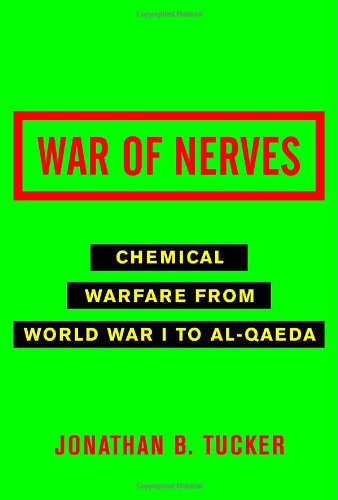
Title
War Of Nerves: Chemical Warfare From World War I To Alqaeda
Sold by Ergodebooks, an authorized reseller.
Returns accepted within 30 days | support@ergodebooks.com
Shipping Information
- Free Standard Shipping — United States only
- Processing Time: 3–5 business days
- Estimated Delivery: 6–10 business days after dispatch
- Double-boxed, fully insured & discreetly packaged
- Tracking number sent via email once dispatched
Returns & Refund
Returns accepted within 30 days of delivery.
Damaged or Defective Item
Free return shipping + replacement or full refund
Wrong Item Received
Free return shipping + replacement or full refund
Change of Mind
Return shipping at customer's expense · 25% restocking fee applies
Payment Option

Statesmen, Generals, And Diplomats Have Long Debated The Military Utility And Morality Of Chemical Warfare. In 1925, The Use Of Chemical Weapons In War Was Prohibited By International Treaty; In 1997 The Ban On The Use Of Chemical Weapons Was Extended To Cover Their Development, Production, And Stockpiling. Nevertheless, Iraq Employed Chemical Weapons On A Large Scale As Recently As The 1980S, First During Its Eightyear War With Iran And Then Against Its Rebellious Kurdish Minority.In War Of Nerves, Jonathan Tucker, A Leading Expert On Chemical And Biological Weapons, Writes About Chemical Warfare From World War I To The Present.The Author Makes Clear How, At The Turn Of The Twentieth Century, The Largescale Use Of Toxic Chemicals On The Battlefield Became Feasible And Cheap; How Germany First Developed And Employed Toxic Weapons During World War I, Burying Some 6,000 Cylinders (Containing 168 Tons Of Chlorine) Opposite The Allied Trenches Defending The Town Of Ypres, In Belgium. German Troops Simultaneously Opened The Chlorine Cylinders, Panicking Two French Divisions And Tearing A Gap Four Miles Wide In The Ypres Front.Chemical Warfare Had Begun: Five Months Later, The Allies Retaliated With Their Own Use Of Chlorine Gas. By The End Of The War, Chemical Warfare Had Inflicted Roughly One Million Casualties, 90,000 Of Them Fatal.Tucker Writes About The Synthesis Of The First Nerve Agenttabunin 1936 By A German Industrial Chemist Developing New Pesticides How Its High Toxicity Made It Unusable As A Pesticide But Viable As A Weapon For The Nazi Regime. A Few Years Later, Two Even More Toxic Nerve Agentssarin And Somanwere Developed For Military Use. Hitler Never Employed This Secret Weapon; German Intelligence Concludedincorrectlythat The Allies Had Developed A Similar Capability.Following World War Ii, We See The Rise Of A Cold War Chemical Competition Between The United States And The Soviet Union That Paralleled The Nuclear Arms Race, As Each Pursued The Secrets Of The German Nerve Agents; How The United States And Britain Planned To Massproduce Sarin (Only The United States Did); How The Superpowers Developed And Massproduced Vagents, A New Generation Of Nerve Agents Of Extraordinary Potency; And How Nerve Agents Spread To The Third World, Including Their Suspected Use By Egypt During The Yemen Civil War (19631967), As Well As Iraqs Use Of Nerve Agents In Its War Against Iran And On Its Own People. Iraqs Use Of Nerve Agents Hastened The Negotiation Of An International Treaty Banning The Use Of Chemical Weapons, Which Went Into Effect In 1997. Although The Treaty Now Has More Than 175 Memberstates, Alqaeda And Related Terrorist Groups Are Seeking To Acquire Nerve Agents.In This Important And Revelatory Book, Jonathan Tucker Makes Clear That We Are At A Crossroads That Could Lead Either To The Further Spread Of These Weapons Or To Their Ultimate Abolition.
⚠️ WARNING (California Proposition 65):
This product may contain chemicals known to the State of California to cause cancer, birth defects, or other reproductive harm.
For more information, please visit www.P65Warnings.ca.gov.
- Q: What is the page count of 'War of Nerves'? A: This book has four hundred ninety-six pages. It's a comprehensive exploration of chemical warfare from World War I to contemporary times.
- Q: What type of binding does this book have? A: This book is available in hardcover binding. Hardcover editions are durable and ideal for long-term use.
- Q: What are the dimensions of 'War of Nerves'? A: The dimensions are six point six two inches in length, one point five four inches in width, and nine point four nine inches in height. These measurements make it a standard-sized book.
- Q: How should I read 'War of Nerves'? A: You can read this book at your own pace. It is suitable for anyone interested in military history, international relations, or ethical discussions surrounding warfare.
- Q: Is 'War of Nerves' suitable for young readers? A: No, this book is not specifically aimed at young readers. It covers complex themes related to warfare and may be more suitable for mature audiences.
- Q: Is there a recommended reading level for this book? A: This book is best suited for adult readers or advanced high school students. The content deals with historical and ethical issues in a detailed manner.
- Q: How do I keep my copy of 'War of Nerves' in good condition? A: Store it in a cool, dry place away from direct sunlight. To clean, use a soft cloth to wipe the cover gently.
- Q: Can I lend my hardcover copy of 'War of Nerves'? A: Yes, you can lend your copy. Just ensure that it is returned in good condition to maintain its quality.
- Q: What should I do if my book gets damaged? A: If your book arrives damaged, you should contact the seller for exchange or refund options. Keep your receipt for warranty purposes.
- Q: Is 'War of Nerves' a scholarly source? A: Yes, it is a scholarly source authored by Jonathan Tucker, a leading expert in chemical and biological weapons.
- Q: How does 'War of Nerves' compare to other books on chemical warfare? A: This book provides a detailed historical perspective and ethical analysis, making it unique compared to other general texts on chemical warfare.
- Q: What themes does 'War of Nerves' explore? A: The book explores themes of military ethics, the development of chemical weapons, and their impact on international relations throughout history.
- Q: Is there a bibliography or references in 'War of Nerves'? A: Yes, the book includes references and a bibliography for further reading. This enhances its credibility as a scholarly work.
- Q: Are there any images or illustrations in 'War of Nerves'? A: No, this book does not include images or illustrations; it focuses primarily on textual content and analysis.
- Q: What is the author's background in 'War of Nerves'? A: Jonathan Tucker is a prominent expert in chemical and biological weapons, which lends authority to the insights presented in this book.