
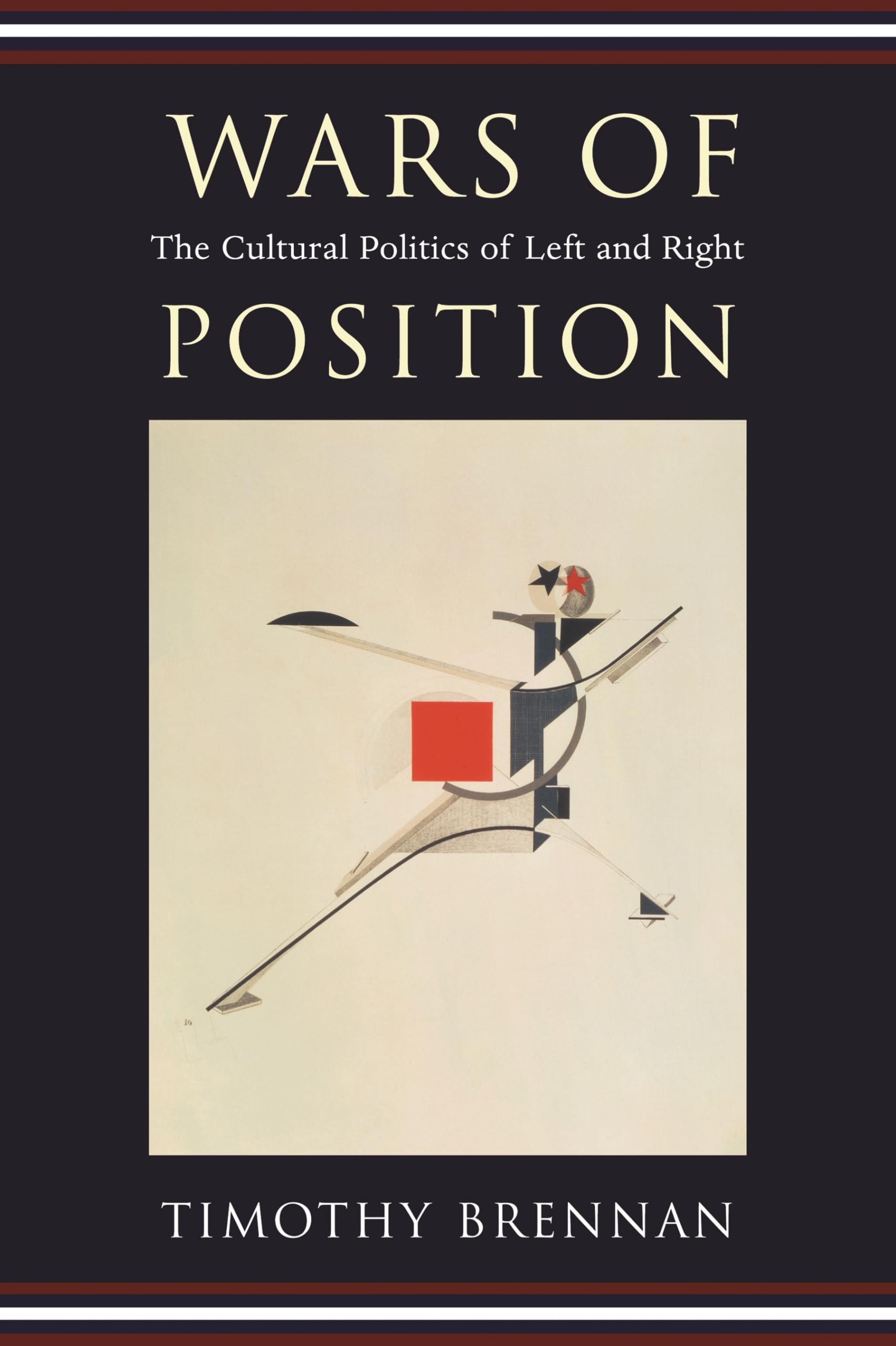
Title
Wars of Position: The Cultural Politics of Left and Right,Used
Sold by Ergodebooks, an authorized reseller.
Returns accepted within 30 days | support@ergodebooks.com
Shipping Information
- Free Standard Shipping — United States only
- Processing Time: 3–5 business days
- Estimated Delivery: 6–10 business days after dispatch
- Double-boxed, fully insured & discreetly packaged
- Tracking number sent via email once dispatched
Returns & Refund
Returns accepted within 30 days of delivery.
Damaged or Defective Item
Free return shipping + replacement or full refund
Wrong Item Received
Free return shipping + replacement or full refund
Change of Mind
Return shipping at customer's expense · 25% restocking fee applies
Payment Option

Taking stock of contemporary social, cultural, and political currents, Timothy Brennan explores key turning points in the recent history of American intellectual life. He contends that a certain socialdemocratic vision of politics has been banished from public discussion, leading to an unlikely convergence of the political right and the academic left and a deadening of critical opposition. Brennan challenges the conventional view that affiliations based on political belief, claims upon the state, or the public interest have been rendered obsolete by the march of events in the years before and after Reagan. Instead, he lays out a new path for a future infused with a sense of intellectual and political possibility.In highlighting the shift in America's intellectual culture, Brennan makes the case for seeing belief as an identity. As much as race or ethnicity, political belief, Brennan argues, is itself an identityone that remains unrecognized and without legal protections while possessing its own distinctive culture. Brennan also champions the idea of cosmopolitanism and critiques those theorists who relegate the left to the status of postcolonial 'other.'Wars of Position documents how alternative views were chased from the public stage by strategic acts of censorship, including within supposedly dissident wings of the humanities. He explores how the humanities entered the cultural and political mainstream and settled into an awkward secular religion of the 'middle way.' In a series of interrelated chapters, Brennan considers narratives of the fall of the Berlin Wall and the Clinton impeachment; reexamines Salman Rushdie's prefatwa writing to illuminate its radical social leanings; presents a startling new interpretation of Edward Said; looks at the fatal reception of Antonio Gramsci within postcolonial history and criticism; and offers a stinging critique of Hardt and Negri's Empire and the influence of Italian radicalism on contemporary cultural theory. Throughout the work, Brennan also draws on and critiques the ideas and influence of Heidegger, Lyotard, Kristeva, and other influential theorists.
⚠️ WARNING (California Proposition 65):
This product may contain chemicals known to the State of California to cause cancer, birth defects, or other reproductive harm.
For more information, please visit www.P65Warnings.ca.gov.