
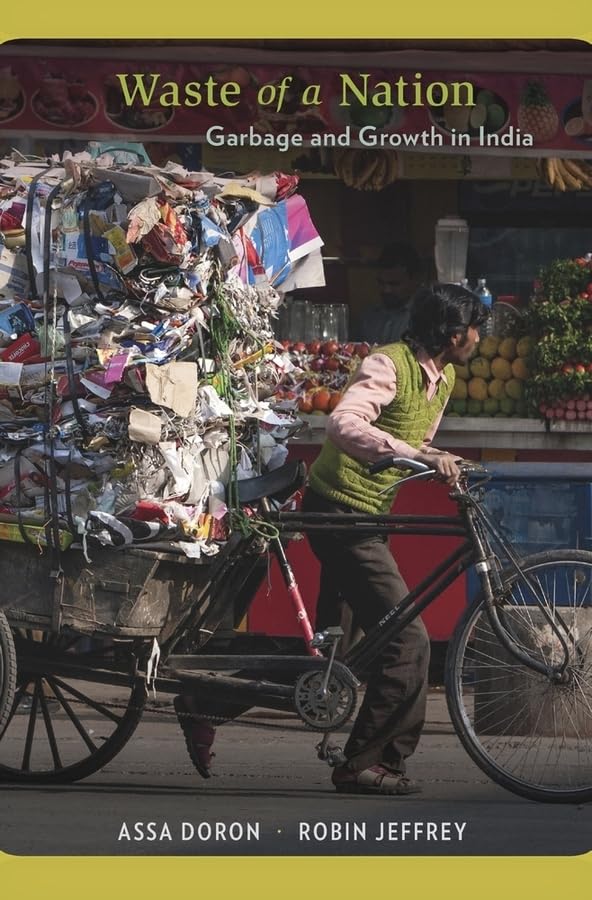
Title
Waste Of A Nation: Garbage And Growth In India,New
Sold by Ergodebooks, an authorized reseller.
Returns accepted within 30 days | support@ergodebooks.com
Shipping Information
- Free Standard Shipping — United States only
- Processing Time: 3–5 business days
- Estimated Delivery: 6–10 business days after dispatch
- Double-boxed, fully insured & discreetly packaged
- Tracking number sent via email once dispatched
Returns & Refund
Returns accepted within 30 days of delivery.
Damaged or Defective Item
Free return shipping + replacement or full refund
Wrong Item Received
Free return shipping + replacement or full refund
Change of Mind
Return shipping at customer's expense · 25% restocking fee applies
Payment Option

In India, you can still find the kabaadiwala, the ragandbone man. He wanders from house to house buying old newspapers, broken utensils, plastic bottlesanything for which he can get a little cash. This custom persists and recreates itself alongside the new economies and ecologies of consumer capitalism. Waste of a Nation offers an anthropological and historical account of Indias complex relationship with garbage.Countries around the world struggle to achieve sustainable futures. Assa Doron and Robin Jeffrey argue that in India the removal of waste and efforts to reuse it also lay waste to the lives of human beings. At the bottom of the pyramid, people who work with waste are injured and stigmatized as they deal with sewage, toxic chemicals, and rotting garbage.Terrifying events, such as atmospheric pollution and childhood stunting, that touch even the wealthy and powerful may lead to substantial changes in practices and attitudes toward sanitation. And innovative technology along with more effective local government may bring about limited improvements. But if a clean new India is to emerge as a model for other parts of the world, a binding morality that reaches beyond the current environmental crisis will be required. Empathy for marginalized underclassesDalits, poor Muslims, landless migrantswho live, almost invisibly, amid waste produced predominantly for the comfort of the betteroff will be the critical element in Indias relationship with waste. Solutions will arise at the intersection of the traditional and the cutting edge, policy and practice, science and spirituality.
⚠️ WARNING (California Proposition 65):
This product may contain chemicals known to the State of California to cause cancer, birth defects, or other reproductive harm.
For more information, please visit www.P65Warnings.ca.gov.