If you have any questions, you are always welcome to contact us. We'll get back to you as soon as possible, withing 24 hours on weekdays.
Customer service
All questions about your order, return and delivery must be sent to our customer service team by e-mail at yourstore@yourdomain.com
Sale & Press
If you are interested in selling our products, need more information about our brand or wish to make a collaboration, please contact us at press@yourdomain.com
Help
If you have any questions, you are always welcome to contact us. We'll get back to you as soon as possible, withing 24 hours on weekdays.
Customer service
All questions about your order, return and delivery must be sent to our customer service team by e-mail at yourstore@yourdomain.com
Sale & Press
If you are interested in selling our products, need more information about our brand or wish to make a collaboration, please contact us at press@yourdomain.com
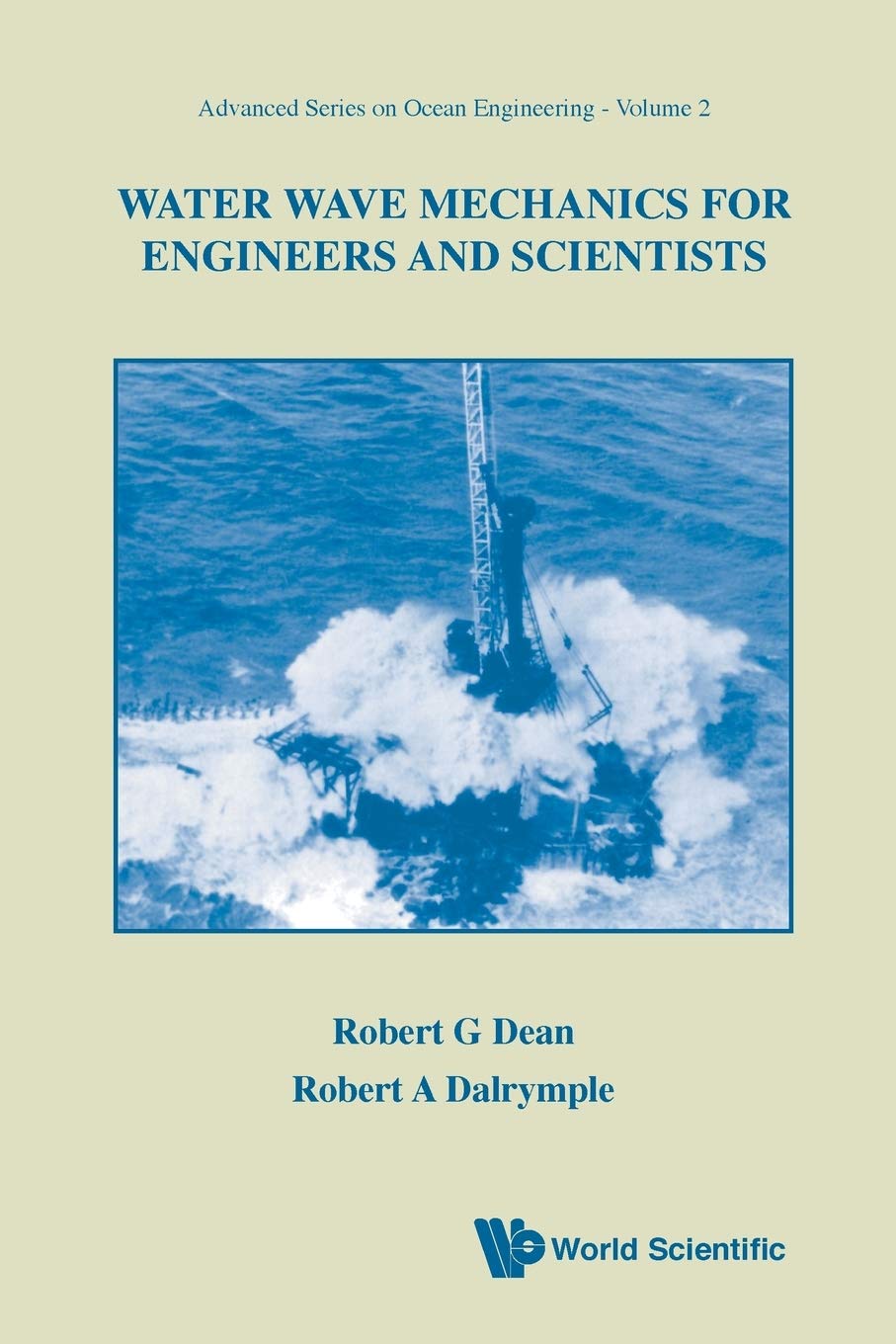
Chapter on wave maker theory is new material, generally not found in text books. The authors pull together good stuff from various widely scattered sources the book makes a good impression it is worth having a copy of this book on your desk. T S Murty Marine Geodesy This book is intended as an introduction to classical water wave theory for the college senior or first year graduate student. The material is selfcontained; almost all mathematical and engineering concepts are presented or derived in the text, thus making the book accessible to practicing engineers as well. The book commences with a review of fluid mechanics and basic vector concepts. The formulation and solution of the governing boundary value problem for small amplitude waves are developed and the kinematic and pressure fields for short and long waves are explored. The transformation of waves due to variations in depth and their interactions with structures are derived. Wavemaker theories and the statistics of ocean waves are reviewed. The application of the water particle motions and pressure fields are applied to the calculation of wave forces on small and large objects. Extension of the linear theory results to several nonlinear wave properties is presented. Each chapter concludes with a set of homework problems exercising and sometimes extending the material presented in the chapter. An appendix provides a description of nine experiments which can be performed, with little additional equipment, in most wave tank facilities.
⚠️ WARNING (California Proposition 65):
This product may contain chemicals known to the State of California to cause cancer,
birth defects, or other reproductive harm.
For MAP (Minimum Advertised Price) violations and Intellectual Property (IP) or Trademark concerns, please contact:
support@ergodebooks.com
⚠️ California Proposition 65 Warning: Some products sold on this website may expose you to chemicals known to the State of California to cause cancer, birth defects, or other reproductive harm. For more information, visit www.P65Warnings.ca.gov.