If you have any questions, you are always welcome to contact us. We'll get back to you as soon as possible, withing 24 hours on weekdays.
Customer service
All questions about your order, return and delivery must be sent to our customer service team by e-mail at yourstore@yourdomain.com
Sale & Press
If you are interested in selling our products, need more information about our brand or wish to make a collaboration, please contact us at press@yourdomain.com
Help
If you have any questions, you are always welcome to contact us. We'll get back to you as soon as possible, withing 24 hours on weekdays.
Customer service
All questions about your order, return and delivery must be sent to our customer service team by e-mail at yourstore@yourdomain.com
Sale & Press
If you are interested in selling our products, need more information about our brand or wish to make a collaboration, please contact us at press@yourdomain.com
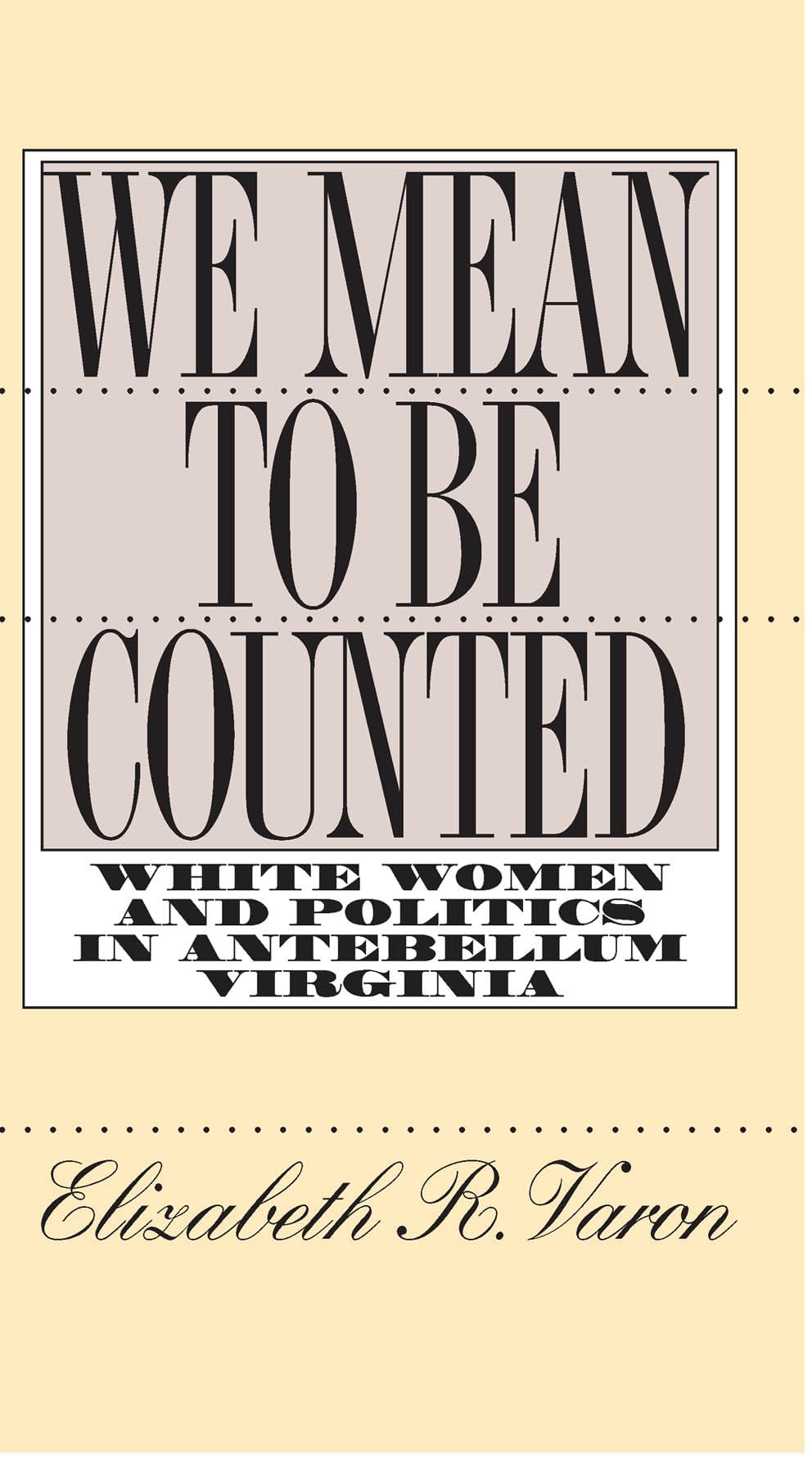
Over the past two decades, historians have successfully disputedthe notion that American women remained wholly outside the realm of politics until the early twentieth century. Still, a consensus has prevailed that, unlike their Northern counterparts, women of the antebellum South were largely excluded from public life. With this book, Elizabeth Varon effectively challenges such historical assumptions. Using a wide array of sources, she demonstrates that throughout the antebellum period, white Southern women of the slaveholding class were important actors in the public drama of politics.Through their voluntary associations, legislative petitions,presence at political meetings and rallies, and publishedappeals, Virginia's elite white women lent their support to suchcontroversial reform enterprises as the temperance movement and the American Colonization Society, to the electoral campaigns of the Whig and Democratic Parties, to the literary defense ofslavery, and to the causes of Unionism and secession. Against the backdrop of increasing sectional tension, Varon argues, thesewomen struggled to fulfill a paradoxical mandate: to act both aspartisans who boldly expressed their political views and asmediators who infused public life with the 'feminine' virtues ofcompassion and harmony.
⚠️ WARNING (California Proposition 65):
This product may contain chemicals known to the State of California to cause cancer,
birth defects, or other reproductive harm.
For MAP (Minimum Advertised Price) violations and Intellectual Property (IP) or Trademark concerns, please contact:
support@ergodebooks.com
⚠️ California Proposition 65 Warning: Some products sold on this website may expose you to chemicals known to the State of California to cause cancer, birth defects, or other reproductive harm. For more information, visit www.P65Warnings.ca.gov.