
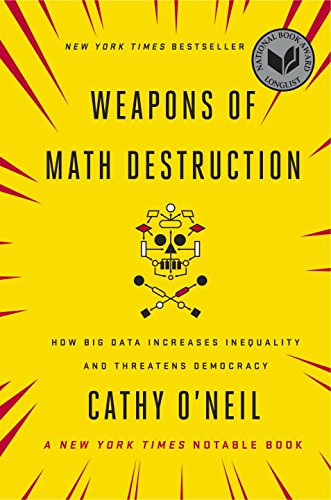
Title
Weapons Of Math Destruction: How Big Data Increases Inequality And Threatens Democracy-used
Sold by Ergodebooks, an authorized reseller.
Returns accepted within 30 days | support@ergodebooks.com
Shipping Information
- Free Standard Shipping — United States only
- Processing Time: 3–5 business days
- Estimated Delivery: 6–10 business days after dispatch
- Double-boxed, fully insured & discreetly packaged
- Tracking number sent via email once dispatched
Returns & Refund
Returns accepted within 30 days of delivery.
Damaged or Defective Item
Free return shipping + replacement or full refund
Wrong Item Received
Free return shipping + replacement or full refund
Change of Mind
Return shipping at customer's expense · 25% restocking fee applies
Payment Option

Longlisted For The National Book Award New York Times Bestsellera Former Wall Street Quant Sounds An Alarm On The Mathematical Models That Pervade Modern Life And Threaten To Rip Apart Our Social Fabric.We Live In The Age Of The Algorithm. Increasingly, The Decisions That Affect Our Liveswhere We Go To School, Whether We Get A Car Loan, How Much We Pay For Health Insuranceare Being Made Not By Humans, But By Mathematical Models. In Theory, This Should Lead To Greater Fairness: Everyone Is Judged According To The Same Rules, And Bias Is Eliminated.But As Cathy Oneil Reveals In This Urgent And Necessary Book, The Opposite Is True. The Models Being Used Today Are Opaque, Unregulated, And Uncontestable, Even When Theyre Wrong. Most Troubling, They Reinforce Discrimination: If A Poor Student Cant Get A Loan Because A Lending Model Deems Him Too Risky (By Virtue Of His Zip Code), Hes Then Cut Off From The Kind Of Education That Could Pull Him Out Of Poverty, And A Vicious Spiral Ensues. Models Are Propping Up The Lucky And Punishing The Downtrodden, Creating A Toxic Cocktail For Democracy. Welcome To The Dark Side Of Big Data.Tracing The Arc Of A Persons Life, Oneil Exposes The Black Box Models That Shape Our Future, Both As Individuals And As A Society. These Weapons Of Math Destruction Score Teachers And Students, Sort Rsums, Grant (Or Deny) Loans, Evaluate Workers, Target Voters, Set Parole, And Monitor Our Health.Oneil Calls On Modelers To Take More Responsibility For Their Algorithms And On Policy Makers To Regulate Their Use. But In The End, Its Up To Us To Become More Savvy About The Models That Govern Our Lives. This Important Book Empowers Us To Ask The Tough Questions, Uncover The Truth, And Demand Change.
⚠️ WARNING (California Proposition 65):
This product may contain chemicals known to the State of California to cause cancer, birth defects, or other reproductive harm.
For more information, please visit www.P65Warnings.ca.gov.
- Q: What is the page count of 'Weapons of Math Destruction'? A: This book has two hundred seventy-two pages. It provides a deep dive into the impact of mathematical models on society.
- Q: What are the dimensions of this book? A: The dimensions are five point seven nine inches in length, one point one inches in width, and eight point five four inches in height. This makes it a standard hardcover size.
- Q: What type of binding does this book have? A: This book is bound in hardcover. Hardcover bindings are known for their durability and longevity.
- Q: Who is the author of 'Weapons of Math Destruction'? A: The author is Cathy O'Neil. She is a former Wall Street quant and a prominent voice on the implications of big data.
- Q: What genre does this book belong to? A: This book falls under the statistics genre. It explores the intersection of mathematics and social justice.
- Q: Is this book suitable for all ages? A: This book is primarily aimed at adults and young adults. It discusses complex themes about data and society that may not be suitable for younger readers.
- Q: How do I use the insights from this book? A: You can apply the insights by critically evaluating data-driven decisions in your own life. It encourages readers to question the algorithms that influence their choices.
- Q: Can I read this book if I'm new to statistics? A: Yes, you can read this book as a beginner. Cathy O'Neil explains complex topics in an accessible manner.
- Q: How should I care for this hardcover book? A: To keep it in good condition, store it upright and away from direct sunlight. Avoid exposure to moisture to prevent damaging the pages.
- Q: Is there a recommended way to clean this book? A: You should use a dry cloth to gently wipe the cover. Avoid using water or cleaning solutions that may damage the book.
- Q: How can I ensure this book stays in good condition? A: Keep it on a sturdy shelf and avoid stacking heavy items on top. Regularly check for any signs of wear or damage.
- Q: Is this book good for someone interested in social justice? A: Yes, this book is excellent for anyone interested in social justice. It discusses how data models can perpetuate inequality.
- Q: What audience is this book intended for? A: This book is intended for readers interested in data science, sociology, and public policy. It appeals to both professionals and general readers.
- Q: What should I do if my book arrives damaged? A: If your book arrives damaged, you should contact customer service for a return or replacement. Most sellers have policies in place for such issues.
- Q: Can I return this book if I don't like it? A: Yes, most sellers allow returns if you are unsatisfied. Be sure to check the specific return policy for the seller.
- Q: What if I have questions while reading this book? A: You can find discussion groups online or forums dedicated to the book. Engaging with others can enhance your understanding.