
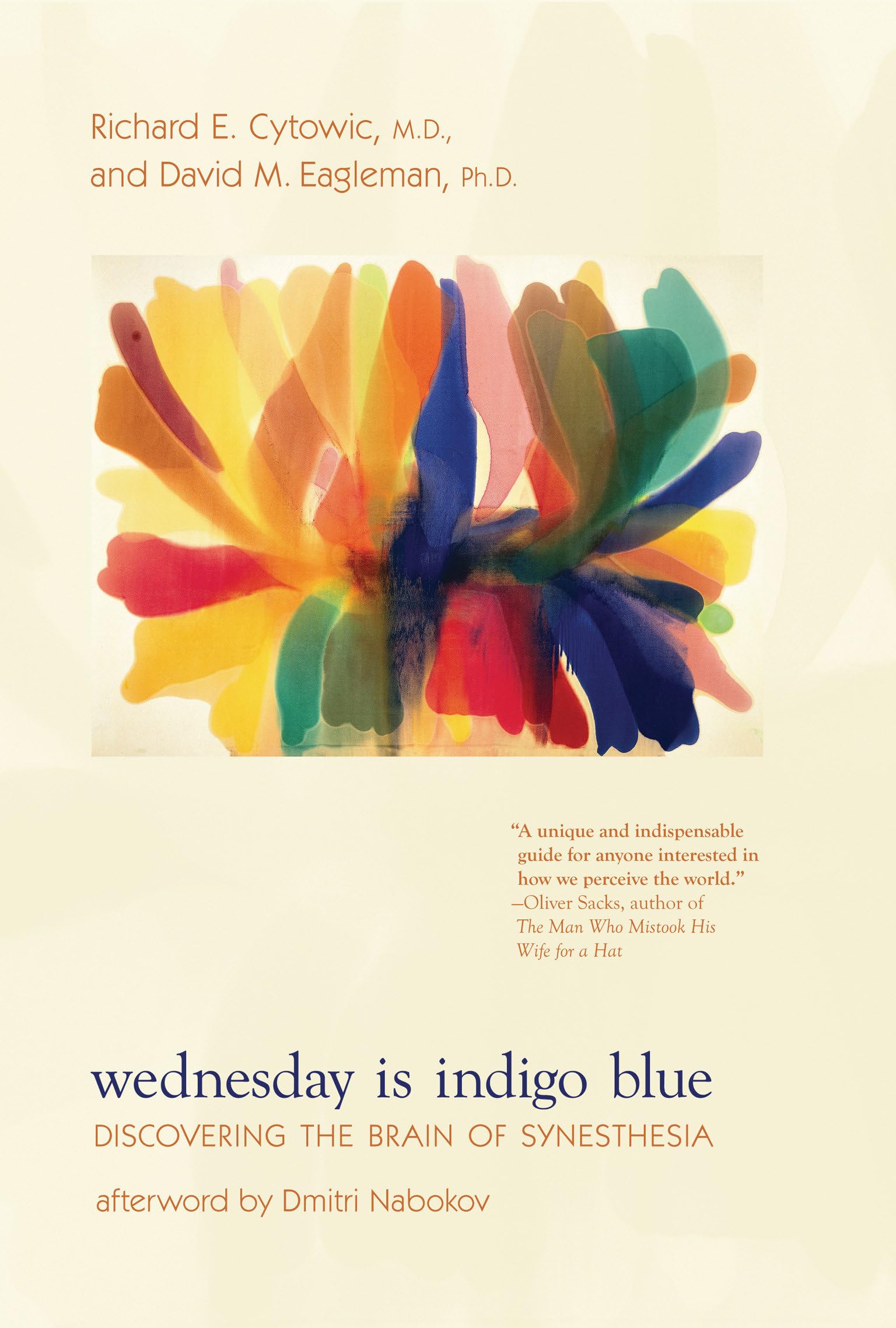
Title
Wednesday Is Indigo Blue: Discovering The Brain Of Synesthesia
Sold by Ergodebooks, an authorized reseller.
Returns accepted within 30 days | support@ergodebooks.com
Shipping Information
- Free Standard Shipping — United States only
- Processing Time: 3–5 business days
- Estimated Delivery: 6–10 business days after dispatch
- Double-boxed, fully insured & discreetly packaged
- Tracking number sent via email once dispatched
Returns & Refund
Returns accepted within 30 days of delivery.
Damaged or Defective Item
Free return shipping + replacement or full refund
Wrong Item Received
Free return shipping + replacement or full refund
Change of Mind
Return shipping at customer's expense · 25% restocking fee applies
Payment Option

How The Extraordinary Multisensory Phenomenon Of Synesthesia Has Changed Our Traditional View Of The Brain.A Person With Synesthesia Might Feel The Flavor Of Food On Her Fingertips, Sense The Letter J As Shimmering Magenta Or The Number 5 As Emerald Green, Hear And Taste Her Husband'S Voice As Buttery Golden Brown. Synesthetes Rarely Talk About Their Peculiar Sensory Giftbelieving Either That Everyone Else Senses The World Exactly As They Do, Or That No One Else Does. Yet Synesthesia Occurs In One In Twenty People, And Is Even More Common Among Artists. One Famous Synesthete Was Novelist Vladimir Nabokov, Who Insisted As A Toddler That The Colors On His Wooden Alphabet Blocks Were All Wrong. His Mother Understood Exactly What He Meant Because She, Too, Had Synesthesia. Nabokov'S Son Dmitri, Who Recounts This Tale In The Afterword To This Book, Is Also A Synesthetefurther Illustrating How Synesthesia Runs In Families.In Wednesday Is Indigo Blue, Pioneering Researcher Richard Cytowic And Distinguished Neuroscientist David Eagleman Explain The Neuroscience And Genetics Behind Synesthesia'S Multisensory Experiences. Because Synesthesia Contradicted Existing Theory, Cytowic Spent Twenty Years Persuading Colleagues That It Was A Realand Importantbrain Phenomenon Rather Than A Mere Curiosity. Today Scientists In Fifteen Countries Are Exploring Synesthesia And How It Is Changing The Traditional View Of How The Brain Works. Cytowic And Eagleman Argue That Perception Is Already Multisensory, Though For Most Of Us Its Multiple Dimensions Exist Beyond The Reach Of Consciousness. Reality, They Point Out, Is More Subjective Than Most People Realize. No Mere Curiosity, Synesthesia Is A Window On The Mind And Brain, Highlighting The Amazing Differences In The Way People See The World.
⚠️ WARNING (California Proposition 65):
This product may contain chemicals known to the State of California to cause cancer, birth defects, or other reproductive harm.
For more information, please visit www.P65Warnings.ca.gov.
- Q: How many pages does the book have? A: The book has three hundred twenty pages. It offers an in-depth exploration of synesthesia and its effects on perception.
- Q: What are the dimensions of the book? A: The book measures six inches in length, zero point five five inches in width, and nine point zero two inches in height. This size makes it convenient for reading.
- Q: What type of binding does this book have? A: The book is published in paperback binding. This allows for easy handling and portability.
- Q: Who are the authors of this book? A: The book is authored by Richard E. Cytowic and David Eagleman. Both are renowned figures in the field of neuroscience.
- Q: What genre does this book belong to? A: This book falls under the genre of neuropsychology. It delves into the complexities of the human brain.
- Q: Is the book suitable for all ages? A: Yes, the book is suitable for a general audience. However, it may be more engaging for adults interested in neuroscience.
- Q: How should I read this book? A: You can read this book at your own pace. It's designed for anyone curious about synesthesia and brain function.
- Q: Is any prior knowledge needed to understand this book? A: No prior knowledge is required. The authors explain concepts clearly, making it accessible to all readers.
- Q: Can this book be used for academic purposes? A: Yes, this book can be a valuable resource for academic studies in psychology and neuroscience. It provides thorough insights into synesthesia.
- Q: How should I store this book? A: Store the book in a cool, dry place away from direct sunlight. This helps maintain its condition over time.
- Q: Does the book contain any illustrations? A: Yes, the book includes illustrations to enhance understanding of synesthesia concepts. These visuals help clarify complex ideas.
- Q: Is this book safe for children? A: While the book is not specifically targeted at children, it is generally safe. However, adult supervision is recommended for younger readers.
- Q: What if I receive a damaged copy of the book? A: If you receive a damaged copy, contact the seller for return or exchange options. Most sellers provide a customer service policy for such issues.
- Q: Can I find this book in libraries? A: Yes, many libraries carry this book. You can check your local library's catalog for availability.
- Q: What makes this book unique? A: This book is unique because it explores the phenomenon of synesthesia through both personal anecdotes and scientific research. It challenges conventional views of perception.
- Q: Is there an afterword or additional content in the book? A: Yes, the book includes an afterword by Dmitri Nabokov, providing personal insights into synesthesia from a familial perspective.