If you have any questions, you are always welcome to contact us. We'll get back to you as soon as possible, withing 24 hours on weekdays.
Customer service
All questions about your order, return and delivery must be sent to our customer service team by e-mail at yourstore@yourdomain.com
Sale & Press
If you are interested in selling our products, need more information about our brand or wish to make a collaboration, please contact us at press@yourdomain.com
Help
If you have any questions, you are always welcome to contact us. We'll get back to you as soon as possible, withing 24 hours on weekdays.
Customer service
All questions about your order, return and delivery must be sent to our customer service team by e-mail at yourstore@yourdomain.com
Sale & Press
If you are interested in selling our products, need more information about our brand or wish to make a collaboration, please contact us at press@yourdomain.com
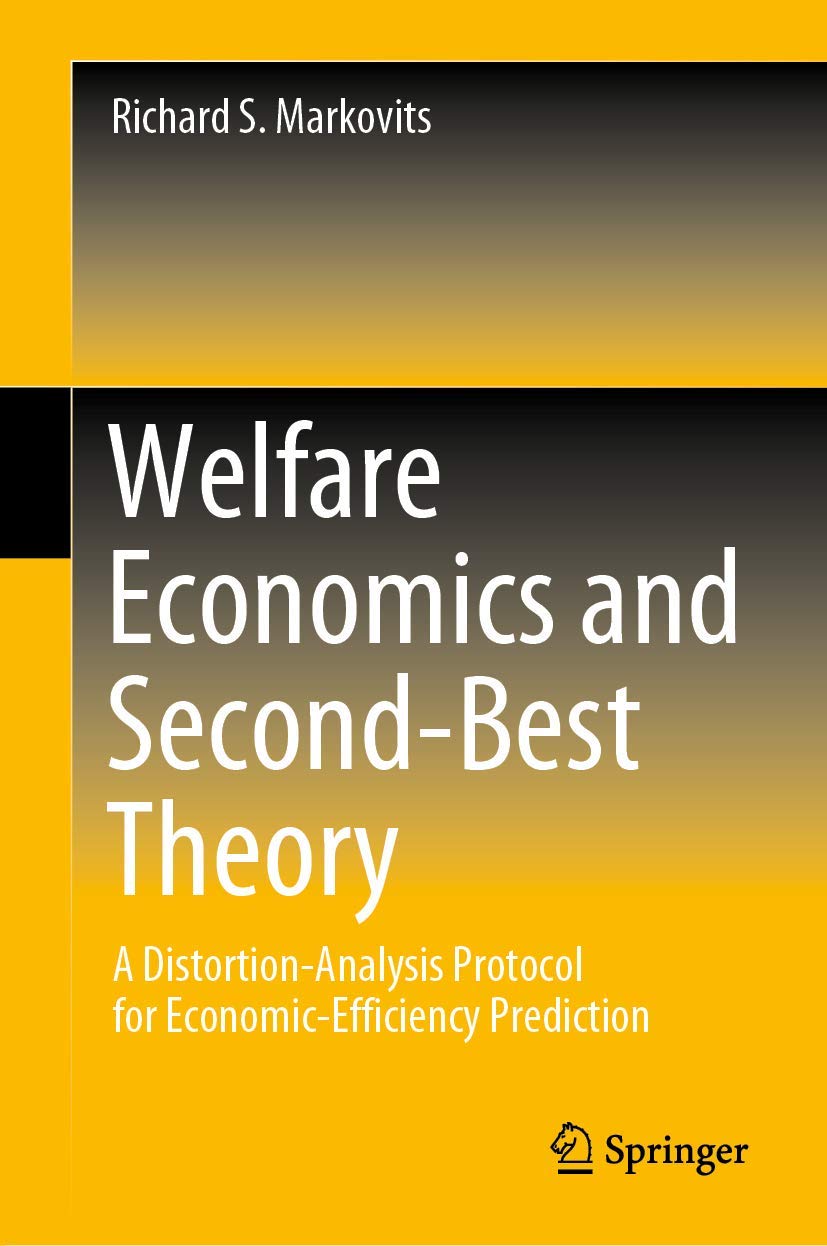
This book examines the implications of The General Theory of Second Best for analyzing the economic efficiency of nongovernment conduct or government policies in an economically efficient way. It develops and legitimates an economically efficient economicefficiencyanalysis protocol with three unique characteristics: First, the protocol focuses separately on each of a wide variety of categories of economic inefficiency, many of which conventional analyses ignore. Second, it analyzes the impact of conduct or policies on each of these categories of economic inefficiency, primarily by predicting the respective conducts/policys impact on the distortion that the economys various Pareto imperfections generate in the profits yielded by the resource allocations associated with the individual categories of economic inefficiencyi.e., on the difference between their profitability and economic efficiency. And third, it is thirdbesti.e., it instructs the analyst to execute a theoretical or empirical research project if and only if the economicefficiency gains the project is expected to generate by increasing the accuracy of economicefficiency conclusions exceed the predicted allocative cost of its execution and public financing. The book also uses the protocol to analyze the economic efficiency of specific policies so as to illustrate both how it differs from the protocols that most applied welfare economists continue to use and how its conclusions differ from those produced by standard analysis.
⚠️ WARNING (California Proposition 65):
This product may contain chemicals known to the State of California to cause cancer,
birth defects, or other reproductive harm.
For MAP (Minimum Advertised Price) violations and Intellectual Property (IP) or Trademark concerns, please contact:
support@ergodebooks.com
⚠️ California Proposition 65 Warning: Some products sold on this website may expose you to chemicals known to the State of California to cause cancer, birth defects, or other reproductive harm. For more information, visit www.P65Warnings.ca.gov.