
Title
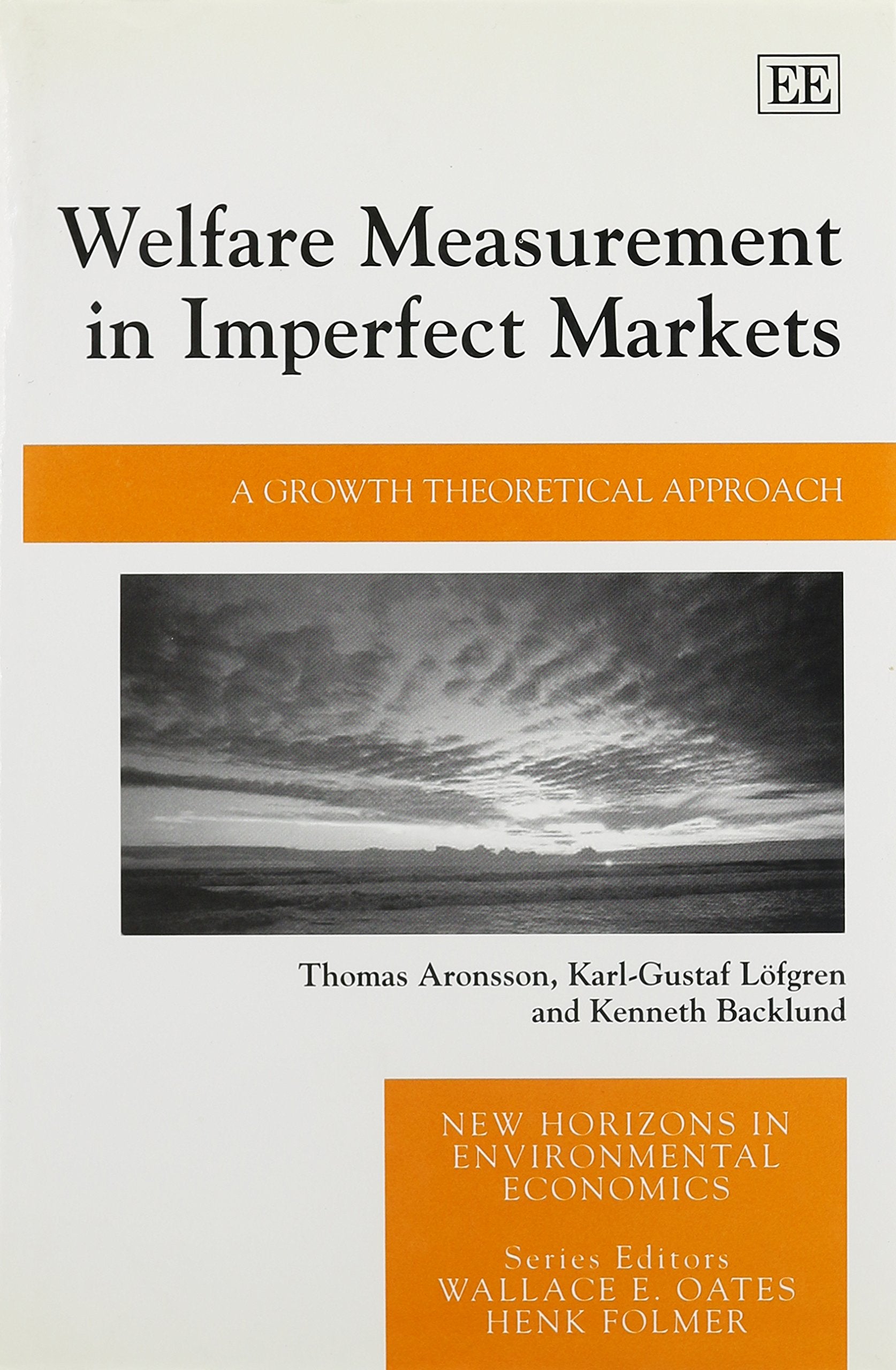
Welfare Measurement In Imperfect Markets: A Growth Theoretical Approach (New Horizons In Environmental Economics Series)
Sold by Ergodebooks, an authorized reseller.
Returns accepted within 30 days | support@ergodebooks.com
Shipping Information
- Free Standard Shipping — United States only
- Processing Time: 3–5 business days
- Estimated Delivery: 6–10 business days after dispatch
- Double-boxed, fully insured & discreetly packaged
- Tracking number sent via email once dispatched
Returns & Refund
Returns accepted within 30 days of delivery.
Damaged or Defective Item
Free return shipping + replacement or full refund
Wrong Item Received
Free return shipping + replacement or full refund
Change of Mind
Return shipping at customer's expense · 25% restocking fee applies
Payment Option

This Book Cleverly Integrates The Research On Welfare Measurement And Social Accounting In Imperfect Market Economies. In Their Previously Acclaimed Volume, Welfare Measurement, Sustainability And Green National Accounting, The Authors Focused On The External Effects Associated With Environmental Damage And Analysed Their Role In The Context Of Social Accounting. This Book Adopts A Much Broader Perspective By Analysing A Wide Spectrum Of Resource Allocation Problems Of Realworld Market Economies.The Authors' Aim Is To Derive Exact Welfare Measures In Imperfect Market Economies And Compare Them With Their Counterparts In A Firstbest Equilibrium. Using Numerical Analysis, They Also Attempt To Make The Leap From Theory To Practical Application By Measuring The Empirical Importance Of Market Imperfections. Such Analysis Provides The Tools For Examining Whether 'Real Life' Approximations Of The Welfare Contribution Of External Effects, Such As Information Collected By Using The Willingnesstopay Method, Actually Capture True And Accurate Values. Finally, The Authors Address The Theory Of Costbenefit Analysis, In Terms Of Environmental And Other Public Policies, In Dynamic General Equilibrium Models.This Book Is An Impressive Investigation Of The Theory Of Social Accounting, With Particular Emphasis On Valuation Problems Facing Imperfectly Competitive Markets. It Will Make Challenging But Highly Rewarding Reading For Academics And Researchers Interested In Environmental Economics, Welfare Measurement, Social Accounting And Green Accounting.
⚠️ WARNING (California Proposition 65):
This product may contain chemicals known to the State of California to cause cancer, birth defects, or other reproductive harm.
For more information, please visit www.P65Warnings.ca.gov.
- Q: How many pages does this book have? A: This book contains two hundred eight pages. It provides an in-depth analysis of welfare measurement in imperfect market economies.
- Q: What is the binding type of this book? A: This book is a hardcover edition. It ensures durability and a professional appearance, suitable for academic or personal libraries.
- Q: What are the dimensions of this book? A: The book measures six and a half inches in length, one point twenty-six inches in width, and nine point twenty-five inches in height. These dimensions make it convenient for reading and shelf storage.
- Q: Who is the author of this book? A: The author of this book is Thomas Aronsson. He is known for his contributions to the field of environmental economics and welfare measurement.
- Q: What is the main theme of this book? A: The main theme is welfare measurement in imperfect market economies. It explores resource allocation problems and their implications for social accounting.
- Q: Is this book suitable for beginners in environmental economics? A: Yes, this book is suitable for both beginners and advanced readers. It provides foundational concepts as well as complex analyses, making it accessible for a wide audience.
- Q: How can I apply the theories discussed in this book? A: You can apply the theories by using the welfare measures in practical scenarios, such as cost-benefit analysis in environmental policies. The book provides numerical analysis and case studies.
- Q: What kind of audience would benefit from this book? A: Academics and researchers interested in environmental economics and social accounting would benefit from this book. It challenges and rewards readers with its in-depth investigation.
- Q: How do I take care of this hardcover book? A: To care for this hardcover book, keep it in a cool, dry place and avoid exposure to direct sunlight. Use a bookmark to prevent spine wear.
- Q: Is this book appropriate for academic courses? A: Yes, this book is appropriate for academic courses in economics and environmental studies. It serves as a valuable resource for coursework and research.
- Q: What if the book arrives damaged? A: If the book arrives damaged, you should contact the seller for a return or replacement. Most sellers provide customer service for resolving such issues.
- Q: Can this book be used for research purposes? A: Yes, this book can be used for research purposes. It includes empirical analysis and theoretical frameworks useful for academic research in environmental economics.
- Q: Does this book discuss any specific public policies? A: Yes, the book discusses public policies in terms of cost-benefit analysis. It emphasizes their implications in dynamic general equilibrium models.
- Q: What is the publisher of this book? A: The publisher is Edward Elgar Publishing. They are known for their focus on academic and professional literature in economics and social sciences.
- Q: Is this book part of a series? A: Yes, this book is part of the New Horizons in Environmental Economics series. The series aims to address contemporary issues in environmental economics.
- Q: What type of analysis does this book provide? A: The book provides numerical analysis and theoretical insights. It bridges the gap between theory and practical application in welfare measurement.