
Title
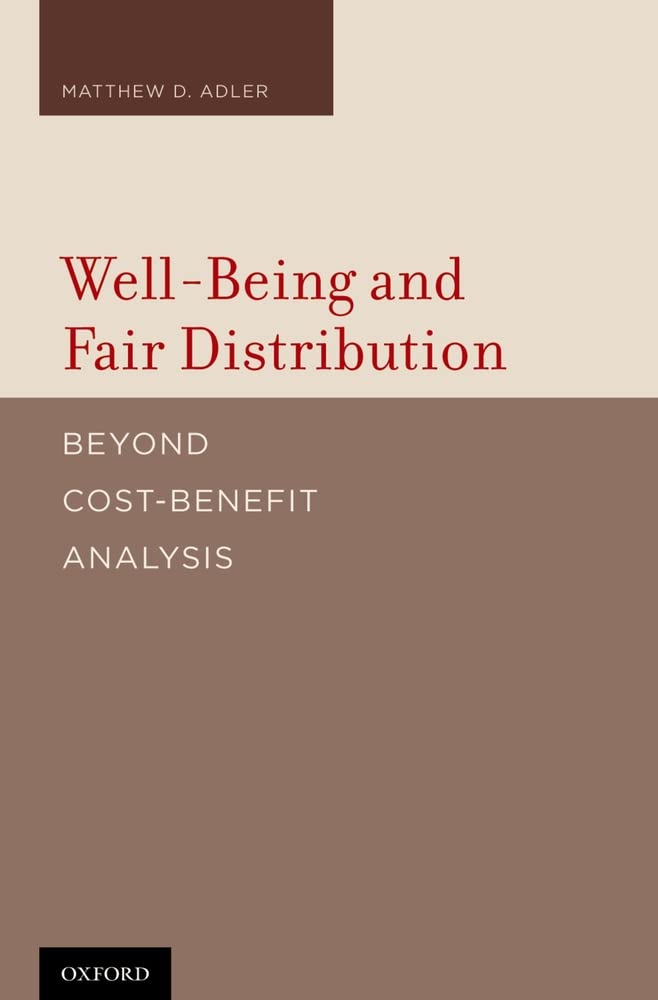
WellBeing and Fair Distribution: Beyond CostBenefit Analysis,Used
Sold by Ergodebooks, an authorized reseller.
Returns accepted within 30 days | support@ergodebooks.com
Shipping Information
- Free Standard Shipping — United States only
- Processing Time: 3–5 business days
- Estimated Delivery: 6–10 business days after dispatch
- Double-boxed, fully insured & discreetly packaged
- Tracking number sent via email once dispatched
Returns & Refund
Returns accepted within 30 days of delivery.
Damaged or Defective Item
Free return shipping + replacement or full refund
Wrong Item Received
Free return shipping + replacement or full refund
Change of Mind
Return shipping at customer's expense · 25% restocking fee applies
Payment Option

In WellBeing and Fair Distribution: Beyond CostBenefit Analysis, author Matthew D. Adler provides readers with a comprehensive, philosophically grounded argument for the use of social welfare functions as a framework for governmental policy analysisa framework that is welfarist but not utilitarian, and sensitive to the distribution of human wellbeing.WellBeing and Fair Distribution addresses a range of relevant theoretical issues, including the nature of wellbeing and the possibility of interpersonal welfare comparisons; the moral value of equality, and how that bears on the form of the social welfare function; social choice under uncertainty; and the integration of individual responsibility into the socialwelfare function approach. Adler also explores issues of implementation by looking at how survey data and other sources of evidence might be used to calibrate both a wellbeing metric and a social welfare function, and discussing whether distributive goals are ever best pursued through regulation rather than the tax system. In working through this range of theoretical and practical issues, WellBeing and Fair Distribution draws from a wide variety of literatures, including philosophical scholarship on equality, 'prioritarianism,' responsibility, wellbeing, and personal identity over time; the social choice literature within economics; applied economic literatures concerning the measurement of inequality and poverty; legal and policyanalytic scholarship on costbenefit analysis, environmental justice, and the choice between regulation and taxation; and the burgeoning field of 'happiness studies.'
⚠️ WARNING (California Proposition 65):
This product may contain chemicals known to the State of California to cause cancer, birth defects, or other reproductive harm.
For more information, please visit www.P65Warnings.ca.gov.