If you have any questions, you are always welcome to contact us. We'll get back to you as soon as possible, withing 24 hours on weekdays.
Customer service
All questions about your order, return and delivery must be sent to our customer service team by e-mail at yourstore@yourdomain.com
Sale & Press
If you are interested in selling our products, need more information about our brand or wish to make a collaboration, please contact us at press@yourdomain.com
Help
If you have any questions, you are always welcome to contact us. We'll get back to you as soon as possible, withing 24 hours on weekdays.
Customer service
All questions about your order, return and delivery must be sent to our customer service team by e-mail at yourstore@yourdomain.com
Sale & Press
If you are interested in selling our products, need more information about our brand or wish to make a collaboration, please contact us at press@yourdomain.com
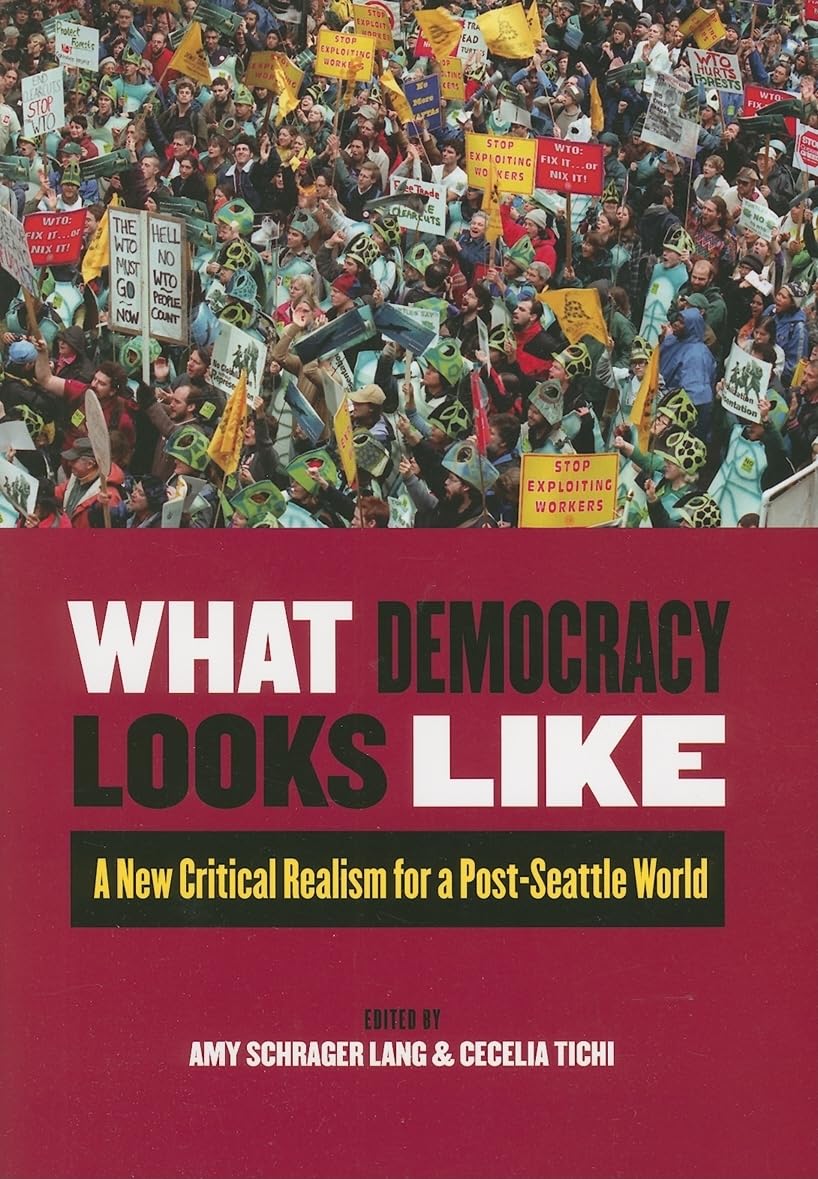
Product Description The convergence of activists in Seattle during the World Trade Organization meetings captured the headlines in 1999. These demonstrations marked the first major expression on U.S. soil of worldwide opposition to inequality, privatization, and political and intellectual repression. This turning point in world politics coincided with an ongoing quandary in academiaparticularly in the humanities where the socalled 'death of theory' has left the field on tenuous footing.In What Democracy Looks Like, the editors and twentyseven contributors argue that these crisesin the world and the academyare not unrelated. The essays insist that, in the wake of 'Seattle,' teachers and scholars of American literature and culture are faced with the challenge of addressing new points of intersection between American studies and literary studies. The narrative, the poem, the essay, and the drama need to be reexamined in ways that are relevant to the urgent social and political issues of our time.Collectively urging scholars and educators to pay fresh attention to the material conditions out of which literature arises, this pathbreaking book inaugurates a new critical realism in American literary studies. It provides a crucial link in the growing need to merge theory and practice with the goal of reconnecting the ivory tower elite to the activists on the street. About the Author Amy Schrager Lang is a professor of English and humanities at Syracuse University in New York. Cecelia Tichi is the William R. Kenan, Jr. professor at Vanderbilt University in Nashville, Tennessee and a past president of the American Studies Association.
⚠️ WARNING (California Proposition 65):
This product may contain chemicals known to the State of California to cause cancer,
birth defects, or other reproductive harm.
For MAP (Minimum Advertised Price) violations and Intellectual Property (IP) or Trademark concerns, please contact:
support@ergodebooks.com
⚠️ California Proposition 65 Warning: Some products sold on this website may expose you to chemicals known to the State of California to cause cancer, birth defects, or other reproductive harm. For more information, visit www.P65Warnings.ca.gov.