
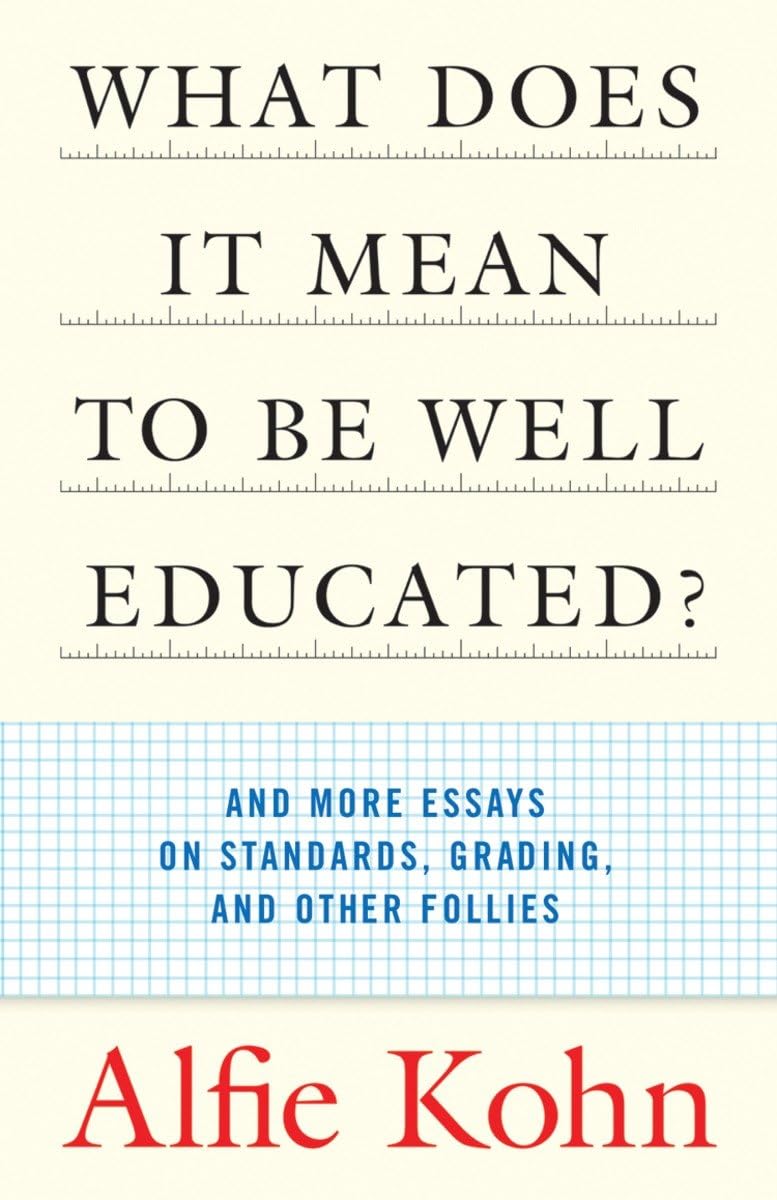
Title
What Does it Mean to Be Well Educated? And Other Essays on Standards, Grading, and Other Follies,New
Sold by Ergodebooks, an authorized reseller.
Returns accepted within 30 days | support@ergodebooks.com
Shipping Information
- Free Standard Shipping — United States only
- Processing Time: 3–5 business days
- Estimated Delivery: 6–10 business days after dispatch
- Double-boxed, fully insured & discreetly packaged
- Tracking number sent via email once dispatched
Returns & Refund
Returns accepted within 30 days of delivery.
Damaged or Defective Item
Free return shipping + replacement or full refund
Wrong Item Received
Free return shipping + replacement or full refund
Change of Mind
Return shipping at customer's expense · 25% restocking fee applies
Payment Option

Few writers ask us to question our fundamental assumptions about education as provocatively as Alfie Kohn. Time magazine has called him'perhaps the country's most outspoken critic of education's fixation on grades [and] test scores.' And the Washington Post says he is 'the most energetic and charismatic figure standing in the way of a major federal effort to make standardized curriculums and tests a fact of life in every U.S. school.'In this new collection of essays, Kohn takes on some of the most important and controversial topics in education of the last few years. His central focus is on the real goals of educationa topic, he argues, that we systematically ignore while lavishing attention on misguided models of learning and counterproductive techniques of motivation.The shift to talking about goals yields radical conclusions and wonderfully pungent essays that only Alfie Kohn could have written. From the title essay's challenge to conventional, conservative definitions of a good education to essays on standards and testing and grades that tally the severe educational costs of overemphasizing a narrow conception of achievement, Kohn boldly builds on his earlier work and writes for a wide audience.Kohn's new book will be greeted with enthusiasm by his many readers and by any teacher or parent looking for a refreshing perspective on today's debates about schools.
⚠️ WARNING (California Proposition 65):
This product may contain chemicals known to the State of California to cause cancer, birth defects, or other reproductive harm.
For more information, please visit www.P65Warnings.ca.gov.
- Q: What is the total number of pages in the book? A: The book contains two hundred twenty-four pages. This makes it a concise collection of essays focused on educational standards and practices.
- Q: What type of binding does this book have? A: This book has a paperback binding. Paperback editions are typically lighter and more flexible than hardcover books.
- Q: What are the dimensions of the book? A: The book measures five point five one inches in length, zero point five six inches in width, and eight point five inches in height. This size makes it portable and easy to handle.
- Q: How should I read this book for the best understanding? A: To maximize understanding, read the essays in order as they build on one another. The author presents strong arguments on educational topics that invite critical thinking.
- Q: Is this book suitable for educators? A: Yes, this book is highly suitable for educators. It provides fresh perspectives that challenge conventional views on grading and standardized tests.
- Q: What age group is this book appropriate for? A: This book is appropriate for adults and older teens. It discusses complex educational theories and critiques that may not resonate with younger readers.
- Q: How do I keep this book in good condition? A: Store the book in a dry place away from direct sunlight. Avoid bending the cover or pages to maintain its shape and readability.
- Q: Can I clean the book if it gets dirty? A: Yes, you can gently wipe the cover with a soft, dry cloth. Avoid using water or cleaning solutions to prevent damage to the pages.
- Q: Is there a recommended way to store this book? A: Store the book upright on a shelf or in a bookcase. Ensure it is not crowded by other books to prevent bending or damage.
- Q: What should I do if the book arrives damaged? A: If the book arrives damaged, contact the seller for a return or exchange. It's important to keep the original packaging for return purposes.
- Q: What is the author's main argument in the book? A: The author's main argument is that the true goals of education are often overlooked. He critiques the focus on grades and standardized testing.
- Q: How does this book compare to other educational literature? A: This book stands out for its provocative questioning of educational norms. Unlike many texts, it directly challenges the emphasis on grading and testing.
- Q: Is this book suitable for parents of school-aged children? A: Yes, this book is suitable for parents. It offers insights into educational practices that can help them better understand their children's schooling.
- Q: What themes are explored in the essays of this book? A: The essays explore themes of educational standards, grading systems, and motivation techniques. The author advocates for a re-examination of what constitutes a good education.
- Q: Are there any specific educational systems criticized in the book? A: Yes, the book criticizes standardized testing and rigid educational curriculums. The author argues these systems often neglect broader educational goals.