
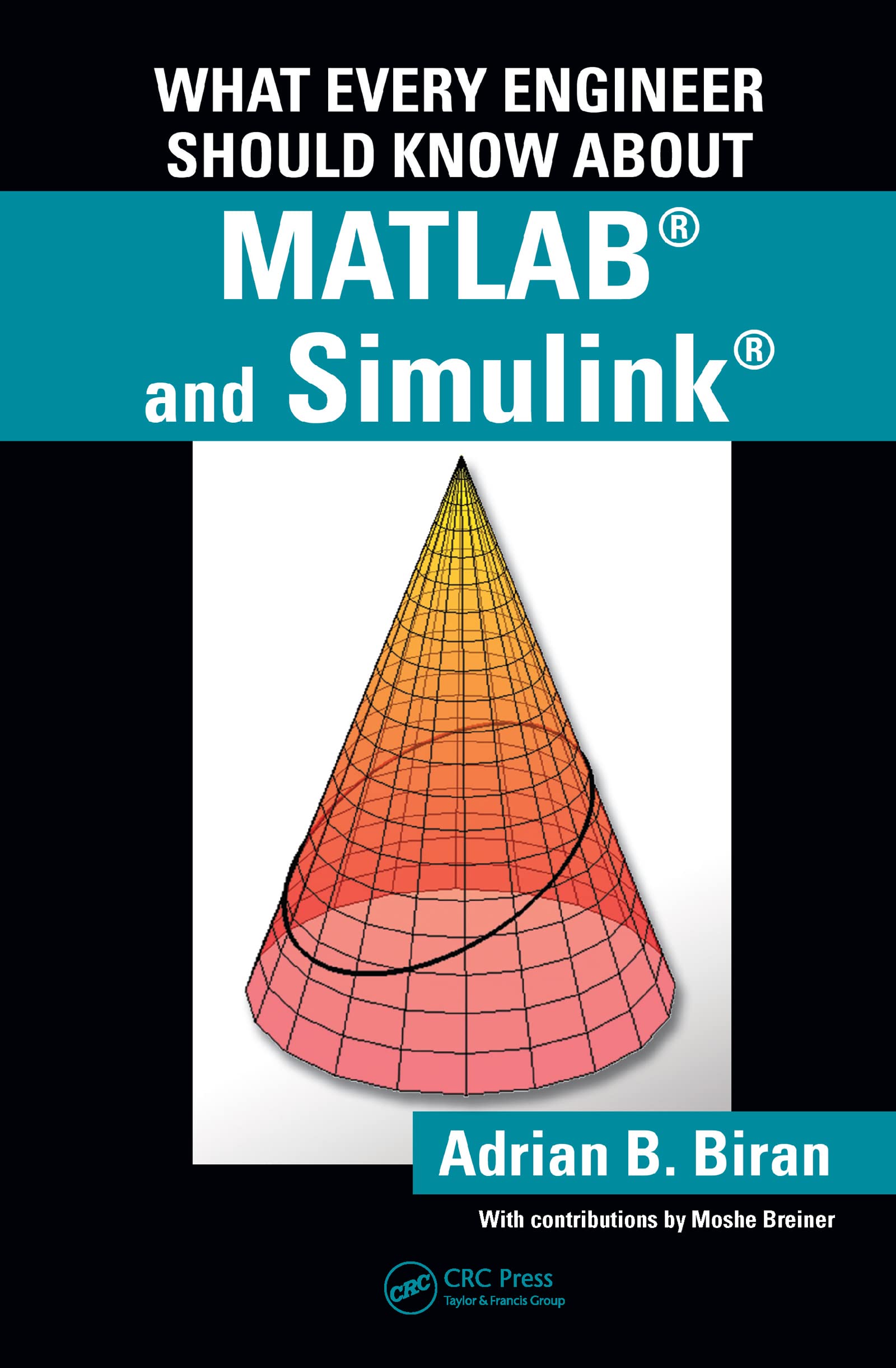
Title
What Every Engineer Should Know about MATLAB and Simulink,Used
Sold by Ergodebooks, an authorized reseller.
Returns accepted within 30 days | support@ergodebooks.com
Shipping Information
- Free Standard Shipping — United States only
- Processing Time: 3–5 business days
- Estimated Delivery: 6–10 business days after dispatch
- Double-boxed, fully insured & discreetly packaged
- Tracking number sent via email once dispatched
Returns & Refund
Returns accepted within 30 days of delivery.
Damaged or Defective Item
Free return shipping + replacement or full refund
Wrong Item Received
Free return shipping + replacement or full refund
Change of Mind
Return shipping at customer's expense · 25% restocking fee applies
Payment Option

MATLAB can be used to execute many mathematical and engineering calculations, as well as a handheld computer canif not better. Moreover, like many other computer languages, it can perform tasks that a handheld computer cannot. Compared to other computer languages, MATLAB provides many builtin functions that make learning easier and reduce prototyping time. Simulink is a toolbox that extends the possibilities of MATLAB by providing a graphical interface for modeling and simulating dynamical processes.Using examples from mathematics, mechanical and electrical engineering, and control and signal processing, What Every Engineer Should Know About MATLAB and Simulink provides an introduction to these two computer environments and examines the advantages and limitations of MATLAB. It first explores the benefits of how to use MATLAB to solve problems and then process and present calculations and experimental results. This book also briefly introduces the reader to more advanced features of the software, such as objectoriented programming (OOP), and it draws the attention to some specialized toolboxes.Key features of the book include demonstrations of how to:Visualize the results of calculations in various kinds of graphical representationsWrite useful script files and functions for solving specific problemsAvoid disastrous computational errorsConvert calculations into technical reports and insert calculations and graphs into either MS Word or LaTeXThis book illustrates the limitations of the computer, as well as the implications associated with errors that can result from approximations or numerical errors. Using selected examples of computeraided errors, the author explains that the set of computer numbers is discrete and boundeda feature that can cause catastrophic errors if not properly taken into account. In conjunction with The Mathworksmarketers of MATLAB and Simulinka supplementary website is presented to offer access to software implemented in the book and the script files used to produce the figures. This book was written by Adrian B. Biran of Technion Israel Institute of Technology, with contributions by Moshe Breiner, managing director of SimACon.
⚠️ WARNING (California Proposition 65):
This product may contain chemicals known to the State of California to cause cancer, birth defects, or other reproductive harm.
For more information, please visit www.P65Warnings.ca.gov.