
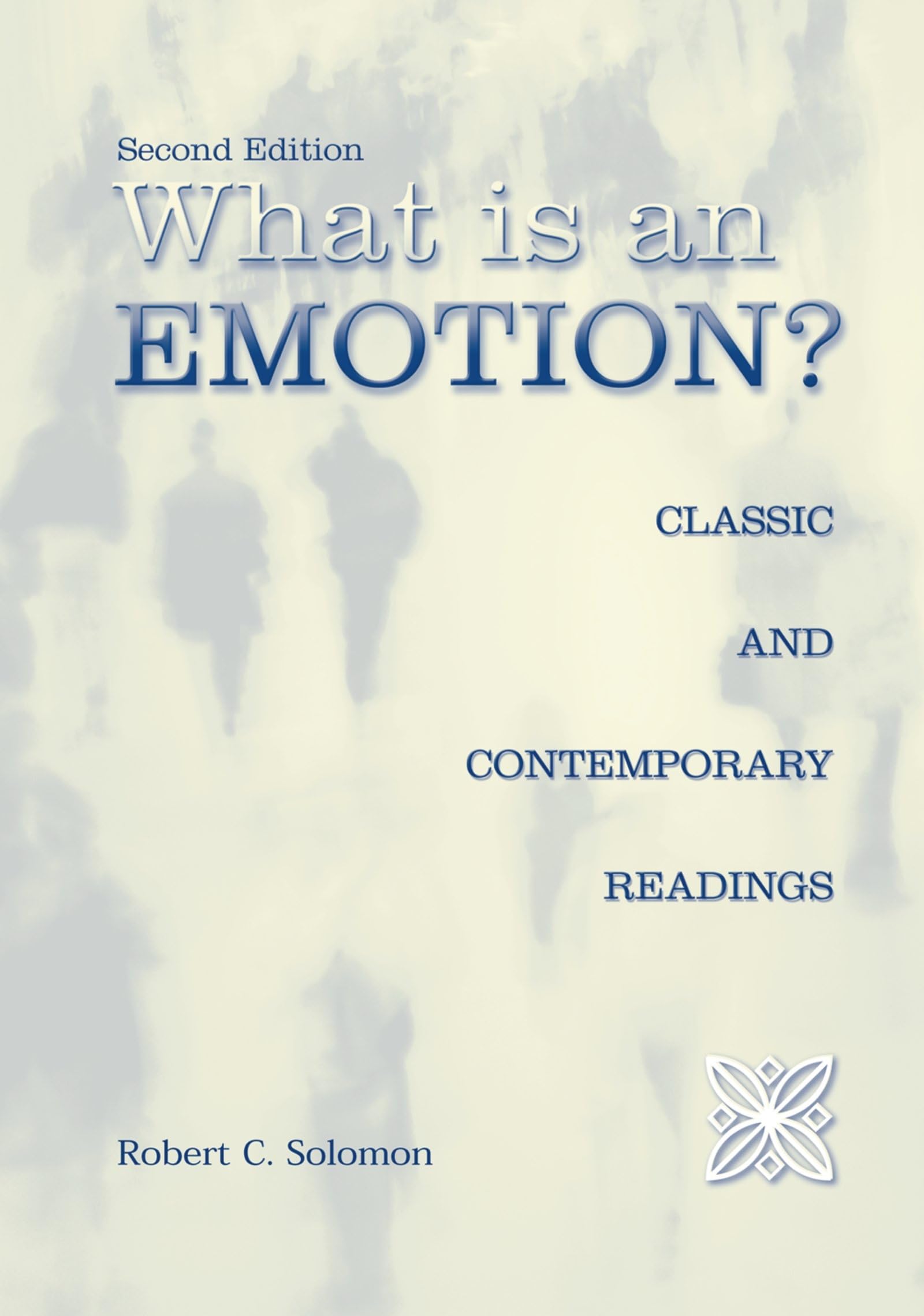
Title
What Is an Emotion?: Classic and Contemporary Readings,Used
Sold by Ergodebooks, an authorized reseller.
Returns accepted within 30 days | support@ergodebooks.com
Shipping Information
- Free Standard Shipping — United States only
- Processing Time: 3–5 business days
- Estimated Delivery: 6–10 business days after dispatch
- Double-boxed, fully insured & discreetly packaged
- Tracking number sent via email once dispatched
Returns & Refund
Returns accepted within 30 days of delivery.
Damaged or Defective Item
Free return shipping + replacement or full refund
Wrong Item Received
Free return shipping + replacement or full refund
Change of Mind
Return shipping at customer's expense · 25% restocking fee applies
Payment Option

What is an Emotion?, 2/e, draws together important selections from classical and contemporary theories and debates about emotion. Utilizing sources from a variety of subject areas including philosophy, psychology, and biology, editor Robert Solomon provides an illuminating look at the 'affective' side of psychology and philosophy from the perspective of the world's great thinkers. Part One of the book features five classic readings from Aristotle, the Stoics, Descartes, Spinoza, and Hume. Part Two offers classic and contemporary theories from the social sciences, presenting selections from such thinkers as Charles Darwin and Sigmund Freud alongside recent work from Paul Ekman, Catherine Lutz, and others. Part Three presents some of the extensive work on emotion that developed in Europe over the past century. Part Four includes essays representing the discussion of emotions among British and American analytic philosophers. The volume is enhanced by a comprehensive introduction by the editor and a multidisciplinary bibliography.What is an Emotion? is appropriate for any course in which the nature of emotion plays a major role, including philosophy of emotion, philosophy of mind, history of psychology, emotion and motivation, moral psychology, and history and psychology of consciousness courses. The second edition provides much more material on emotions in the sciences and more from recent philosophical theories, encompassing recent shifts in theorizing on three fronts: the wealth of new information on the central nervous system and the brain; new developments in crosscultural research and anthropology; and the recent emphasis on 'cognition' in emotion, both in philosophy and the social sciences. New selections include work by Antonio Damasio, Ronald De Sousa, Paul Ekman, Nico Frijda, Patricia Greenspan, Paul Griffiths, Richard Lazarus, Catherine Lutz, Martha Nussbaum, and Michael Stocker.
⚠️ WARNING (California Proposition 65):
This product may contain chemicals known to the State of California to cause cancer, birth defects, or other reproductive harm.
For more information, please visit www.P65Warnings.ca.gov.
- Q: How many pages does this book have? A: This book has three hundred twenty pages. It includes selections from classical and contemporary theories on emotion.
- Q: What are the dimensions of this book? A: The dimensions are six point seven inches by nine point six one inches by zero point seven one inches. This size is typical for a paperback book.
- Q: What binding type does this book have? A: This book is bound in paperback. Paperback binding is flexible and portable, making it easy to carry.
- Q: Who is the author of this book? A: The author of this book is Robert C. Solomon. He is known for his work in philosophy and emotion.
- Q: What is the category of this book? A: This book falls under the category of Emotions. It explores various theories and perspectives on emotional experience.
- Q: Is this book suitable for college courses? A: Yes, this book is appropriate for college-level courses. It is ideal for subjects like philosophy of emotion and moral psychology.
- Q: How do I use this book for study? A: You can use this book as a primary text for courses on emotion. It includes readings that facilitate discussions and deepen understanding.
- Q: Is there a specific reading level for this book? A: This book is suitable for advanced high school and college students. The content is academic and requires critical thinking.
- Q: How should I care for this paperback book? A: To care for this paperback book, keep it in a dry place and avoid bending the cover. This will help maintain its condition.
- Q: What should I do if the book arrives damaged? A: If the book arrives damaged, you should contact the seller for a return or exchange. Most sellers have a policy for damaged items.
- Q: Can I read this book if I’m new to philosophy? A: Yes, you can read this book as a beginner. The editor provides a comprehensive introduction to help new readers understand key concepts.
- Q: Is this book a good choice for psychology students? A: Yes, this book is an excellent choice for psychology students. It covers essential theories and debates on emotion from both historical and contemporary perspectives.
- Q: What theories on emotion are discussed in the book? A: The book discusses theories from philosophers like Aristotle and contemporary thinkers like Paul Ekman. It presents a rich variety of perspectives.
- Q: Does this book include a bibliography? A: Yes, this book includes a multidisciplinary bibliography. It lists sources for further reading and research on emotion.
- Q: Is this book enhanced with any additional material? A: Yes, the book is enhanced by a comprehensive introduction and extensive essays. These additions provide context and depth to the readings.
- Q: What is the focus of this book? A: The focus of the book is to explore the nature of emotion through classical and contemporary readings. It integrates insights from various disciplines.