
Title
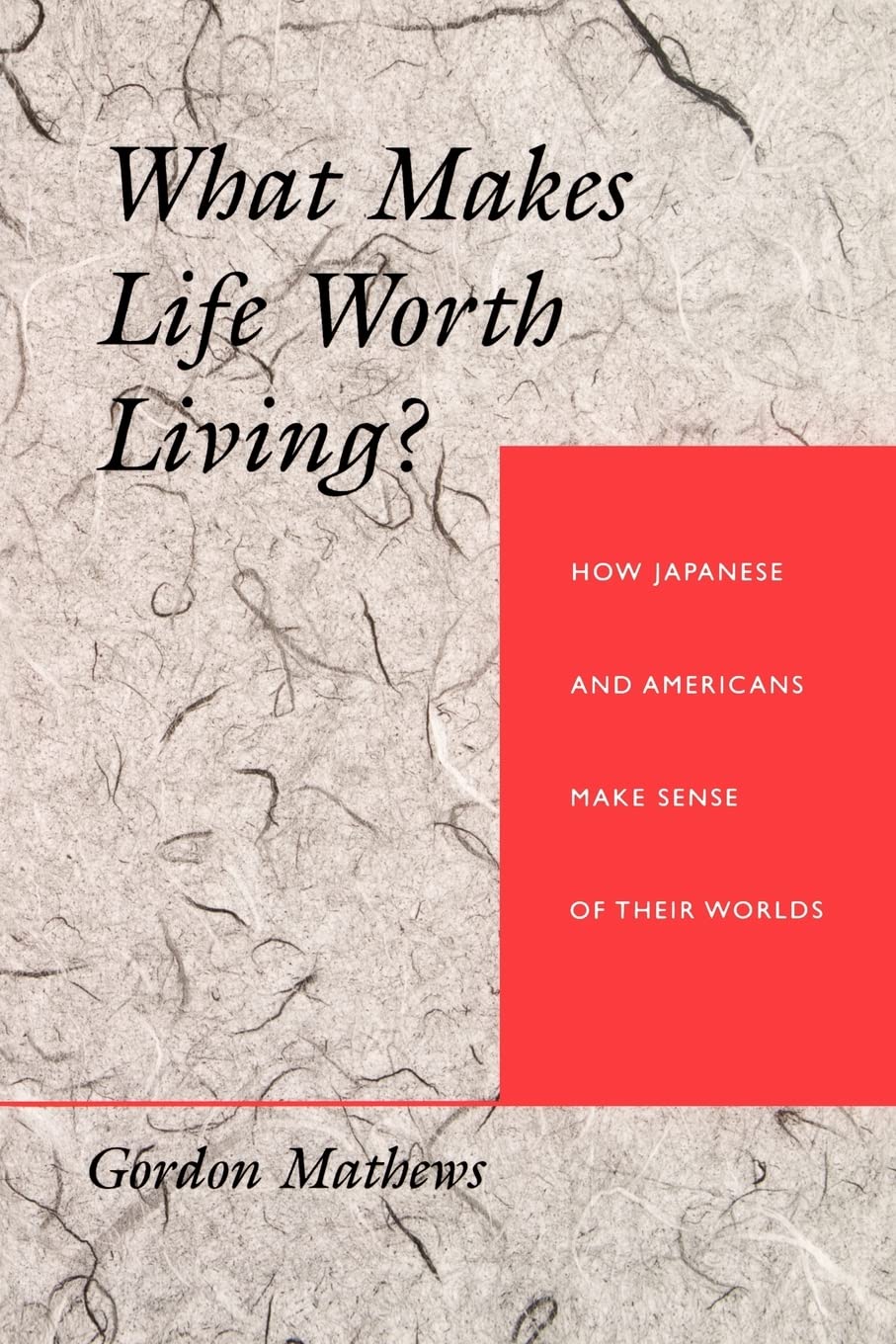
What Makes Life Worth Living?: How Japanese and Americans Make Sense of Their Worlds,Used
Sold by Ergodebooks, an authorized reseller.
Returns accepted within 30 days | support@ergodebooks.com
Shipping Information
- Free Standard Shipping — United States only
- Processing Time: 3–5 business days
- Estimated Delivery: 6–10 business days after dispatch
- Double-boxed, fully insured & discreetly packaged
- Tracking number sent via email once dispatched
Returns & Refund
Returns accepted within 30 days of delivery.
Damaged or Defective Item
Free return shipping + replacement or full refund
Wrong Item Received
Free return shipping + replacement or full refund
Change of Mind
Return shipping at customer's expense · 25% restocking fee applies
Payment Option

Here is an original and provocative anthropological approach to the fundamental philosophical question of what makes life worth living. Gordon Mathews considers this perennial issue by examining nine pairs of similarly situated individuals in the United States and Japan. In the course of exploring how people from these two cultures find meaning in their daily lives, he illuminates a vast and intriguing range of ideas about work and love, religion, creativity, and selfrealization.Mathews explores these topics by means of the Japanese term ikigai, 'that which most makes one's life seem worth living.' American English has no equivalent, but ikigai applies not only to Japanese lives but to American lives as well. Ikigai is what, day after day and year after year, each of us most essentially lives for.Through the life stories of those he interviews, Mathews analyzes the ways Japanese and American lives have been affected by social roles and cultural vocabularies. As we approach the end of the century, the author's investigation into how the inhabitants of the world's two largest economic superpowers make sense of their lives brings a vital new understanding to our skeptical age.
⚠️ WARNING (California Proposition 65):
This product may contain chemicals known to the State of California to cause cancer, birth defects, or other reproductive harm.
For more information, please visit www.P65Warnings.ca.gov.
- Q: What is the page count of this book? A: This book contains two hundred eighty-eight pages. It provides a comprehensive exploration of life perspectives in Japan and the United States.
- Q: What is the binding type of this book? A: The book is available in paperback binding. This makes it lightweight and easier to handle for readers.
- Q: What are the dimensions of this book? A: The book measures six point two inches in length, zero point seventy-two inches in width, and eight point seven inches in height. These dimensions make it a convenient size for reading.
- Q: How should I read this book? A: You can read this book like any standard paperback. It's designed for a general audience interested in cultural anthropology and philosophy.
- Q: Is this book suitable for academic study? A: Yes, this book is suitable for academic study. It provides valuable insights into cultural comparisons between Japan and the United States.
- Q: What themes does this book cover? A: The book covers themes such as work, love, religion, creativity, and self-realization. It provides a rich exploration of what makes life meaningful.
- Q: How do I keep this book in good condition? A: To keep the book in good condition, store it in a dry place away from direct sunlight. Avoid bending the pages or spine to maintain its shape.
- Q: Can I clean this book if it gets dirty? A: Yes, you can clean the book by gently wiping the cover with a dry cloth. Avoid using water or cleaning solutions that could damage the pages.
- Q: What if the book arrives damaged? A: If the book arrives damaged, you should contact the seller for a return or replacement. Most sellers have policies in place for damaged items.
- Q: Is this book good for beginners in anthropology? A: Yes, this book is good for beginners. It provides accessible insights into cultural differences without requiring prior knowledge of anthropology.
- Q: How does this book compare to other cultural studies? A: This book offers a unique perspective by directly comparing Japanese and American lives. Unlike many cultural studies, it emphasizes personal narratives.
- Q: Is there a glossary of terms in this book? A: No, this book does not have a glossary of terms. However, the concepts are explained throughout the text to aid understanding.
- Q: What type of readers would enjoy this book? A: Readers interested in cultural studies, philosophy, and personal narratives will enjoy this book. It appeals to those seeking to understand differing worldviews.
- Q: Does this book contain illustrations or images? A: No, this book does not contain illustrations or images. It focuses on text to convey its anthropological insights.
- Q: What is the author's background? A: The author, Gordon Mathews, is an anthropologist known for his work in cultural studies. His expertise enriches the book's exploration of meaning in life.