If you have any questions, you are always welcome to contact us. We'll get back to you as soon as possible, withing 24 hours on weekdays.
Customer service
All questions about your order, return and delivery must be sent to our customer service team by e-mail at yourstore@yourdomain.com
Sale & Press
If you are interested in selling our products, need more information about our brand or wish to make a collaboration, please contact us at press@yourdomain.com
Help
If you have any questions, you are always welcome to contact us. We'll get back to you as soon as possible, withing 24 hours on weekdays.
Customer service
All questions about your order, return and delivery must be sent to our customer service team by e-mail at yourstore@yourdomain.com
Sale & Press
If you are interested in selling our products, need more information about our brand or wish to make a collaboration, please contact us at press@yourdomain.com
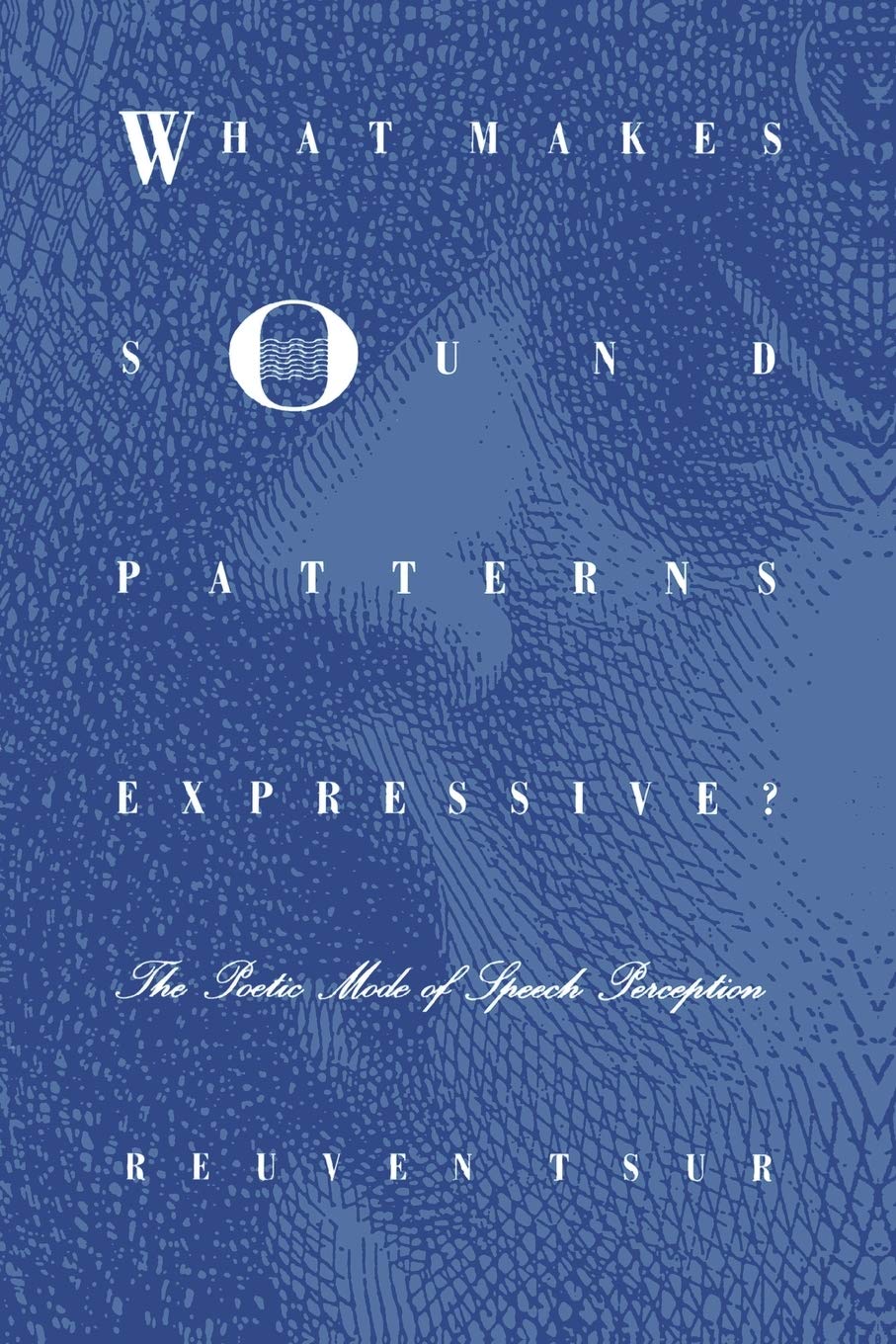
Poets, academics, and those who simply speak a language are subject to mysterious intuitions about the perceptual qualities and emotional symbolism of the sounds of speech. Such intuitions are Reuven Tsurs point of departure in this investigation into the expressive effect of sound patterns, addressing questions of great concern for literary theorists and critics as well as for linguists and psychologists.Research in recent decades has established two distinct types of aural perception: a nonspeech mode, in which the acoustic signals are received in the manner of musical sounds or natural noises; and a speech mode, in which acoustic signals are excluded from awareness and only an abstract phonetic category is perceived. Here, Tsur proposes a third type of speech perception, a poetic mode in which some part of the acoustic signal becomes accessible, however faintly, to consciousness.Using Roman Jakobsons model of childhood acquisition of the phonological system, Tsur shows how the nonreferential babbling sounds made by infants form a basis for aesthetic valuation of language. He tests the intersubjective and intercultural validity of various spatial and tactile metaphors for certain sounds. Illustrating his insights with reference to particular literary texts, Tsur considers the relative merits of cognitive and psychoanalytic approaches to the emotional symbolism of speech sounds.
⚠️ WARNING (California Proposition 65):
This product may contain chemicals known to the State of California to cause cancer,
birth defects, or other reproductive harm.
For MAP (Minimum Advertised Price) violations and Intellectual Property (IP) or Trademark concerns, please contact:
support@ergodebooks.com
⚠️ California Proposition 65 Warning: Some products sold on this website may expose you to chemicals known to the State of California to cause cancer, birth defects, or other reproductive harm. For more information, visit www.P65Warnings.ca.gov.