
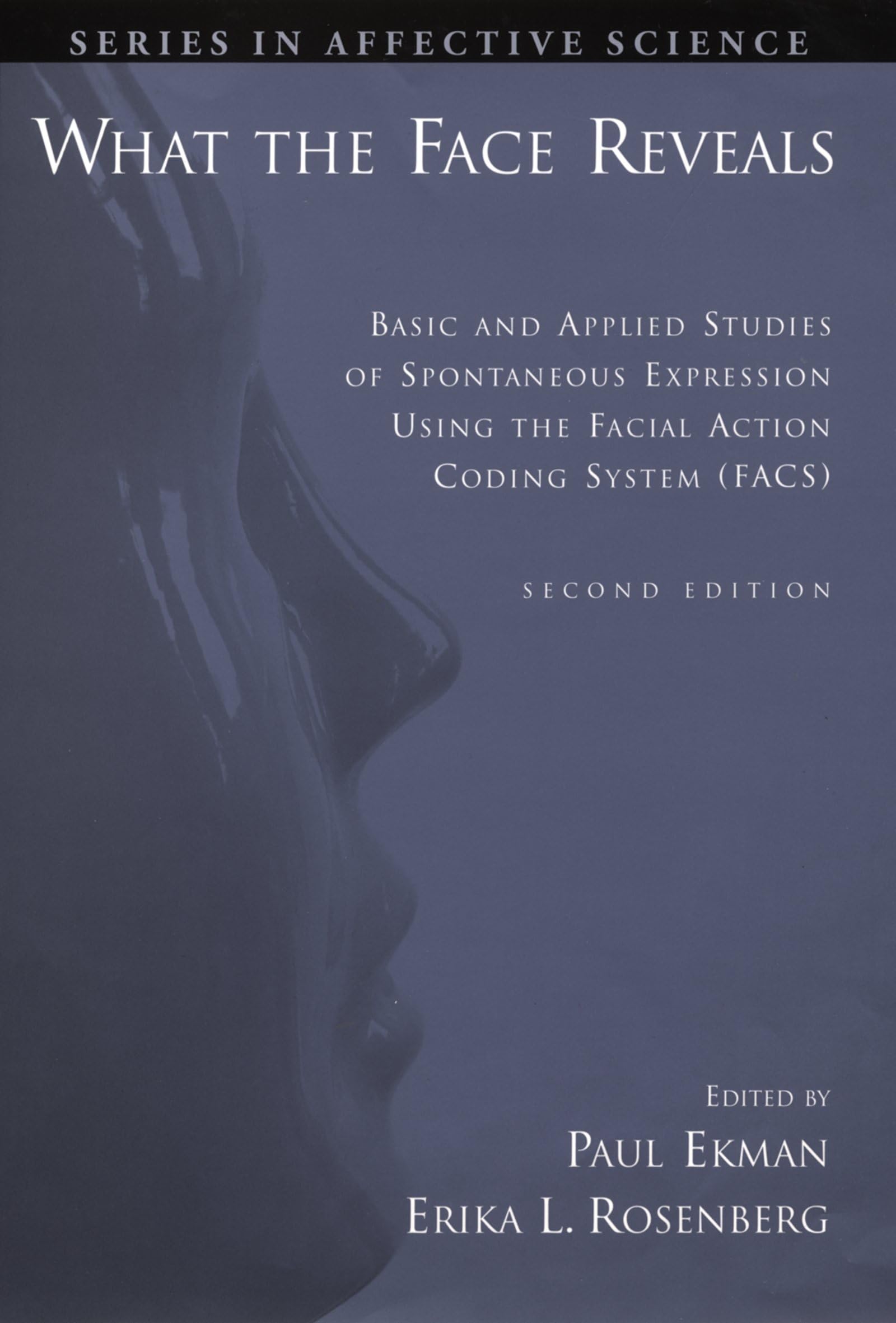
Title
What The Face Reveals: Basic And Applied Studies Of Spontaneous Expression Using The Facial Action Coding System (Facs) (Series
Sold by Ergodebooks, an authorized reseller.
Returns accepted within 30 days | support@ergodebooks.com
Shipping Information
- Free Standard Shipping — United States only
- Processing Time: 3–5 business days
- Estimated Delivery: 6–10 business days after dispatch
- Double-boxed, fully insured & discreetly packaged
- Tracking number sent via email once dispatched
Returns & Refund
Returns accepted within 30 days of delivery.
Damaged or Defective Item
Free return shipping + replacement or full refund
Wrong Item Received
Free return shipping + replacement or full refund
Change of Mind
Return shipping at customer's expense · 25% restocking fee applies
Payment Option

While We Have Known For Centuries That Facial Expressions Can Reveal What People Are Thinking And Feeling, It Is Only Recently That The Face Has Been Studied Scientifically For What It Can Tell Us About Internal States, Social Behavior, And Psychopathology. Today'S Widely Available, Sophisticated Measuring Systems Have Allowed Us To Conduct A Wealth Of New Research On Facial Behavior That Has Contributed Enormously To Our Understanding Of The Relationship Between Facial Expression And Human Psychology. The Chapters In This Volume Present The Stateoftheart In This Research. They Address Key Topics And Questions, Such As The Dynamic And Morphological Differences Between Voluntary And Involuntary Expressions, The Relationship Between What People Show On Their Faces And What They Say They Feel, Whether It Is Possible To Use Facial Behavior To Draw Distinctions Among Psychiatric Populations, And How Far Research On Automating Facial Measurement Has Progressed. The Book Also Includes Followup Commentary On All Of The Original Research Presented And A Concluding Integration And Critique Of All The Contributions Made By Paul Ekman.As An Essential Reference For All Those Working In The Area Of Facial Analysis And Expression, This Volume Will Be Indispensable For A Wide Range Of Professionals And Students In The Fields Of Psychology, Psychiatry, And Behavioral Medicine.
⚠️ WARNING (California Proposition 65):
This product may contain chemicals known to the State of California to cause cancer, birth defects, or other reproductive harm.
For more information, please visit www.P65Warnings.ca.gov.
- Q: What is the page count of the book? A: The book contains six hundred seventy-two pages. It provides extensive research on facial expressions and psychology.
- Q: What are the dimensions of this book? A: The book measures nine point five seven inches in length, six point five eight inches in width, and one point four two inches in height.
- Q: What type of binding does the book have? A: The book has a hardcover binding. This ensures durability and longevity for frequent use.
- Q: Who is the author of this book? A: The author is Paul Ekman. He is a renowned psychologist known for his work on facial expressions.
- Q: What category does this book fall under? A: The book is categorized under Psychology and Counseling. It is suitable for professionals and students in related fields.
- Q: How is the information in this book presented? A: The book presents state-of-the-art research findings. It includes original research, commentary, and a critique by Paul Ekman.
- Q: What is the main focus of this book? A: The main focus is on facial expressions and their relation to human psychology. It explores the dynamics of spontaneous expression.
- Q: Is this book suitable for beginners in psychology? A: Yes, it is suitable for beginners. It offers comprehensive insights into facial analysis, making it accessible for all levels.
- Q: Can this book be used for academic studies? A: Yes, it is an essential reference for academic studies. It is highly relevant for students in psychology and psychiatry.
- Q: How should I store this book to keep it in good condition? A: Store the book upright in a cool, dry place. Avoid exposure to direct sunlight to prevent fading and damage.
- Q: Are there any special care instructions for this book? A: Handle the book with clean hands to avoid smudging. Keep it away from moisture to maintain its condition.
- Q: What should I do if I receive a damaged book? A: If the book arrives damaged, contact customer service for a return or exchange. Ensure you have your order details ready.
- Q: Is there a warranty for this book? A: Books typically do not come with a warranty. Check the return policy for any specific conditions.
- Q: How can I contact support if I have questions about the book? A: You can contact customer support through the retailer's website or customer service number. They will assist with any inquiries.
- Q: What makes this book a good choice for psychology professionals? A: The book offers in-depth research and analysis on facial expressions, making it a valuable resource for professionals in psychology.
- Q: What themes are covered in this book? A: The book covers themes such as facial expression dynamics, psychiatric distinctions, and automated facial measurement research.