
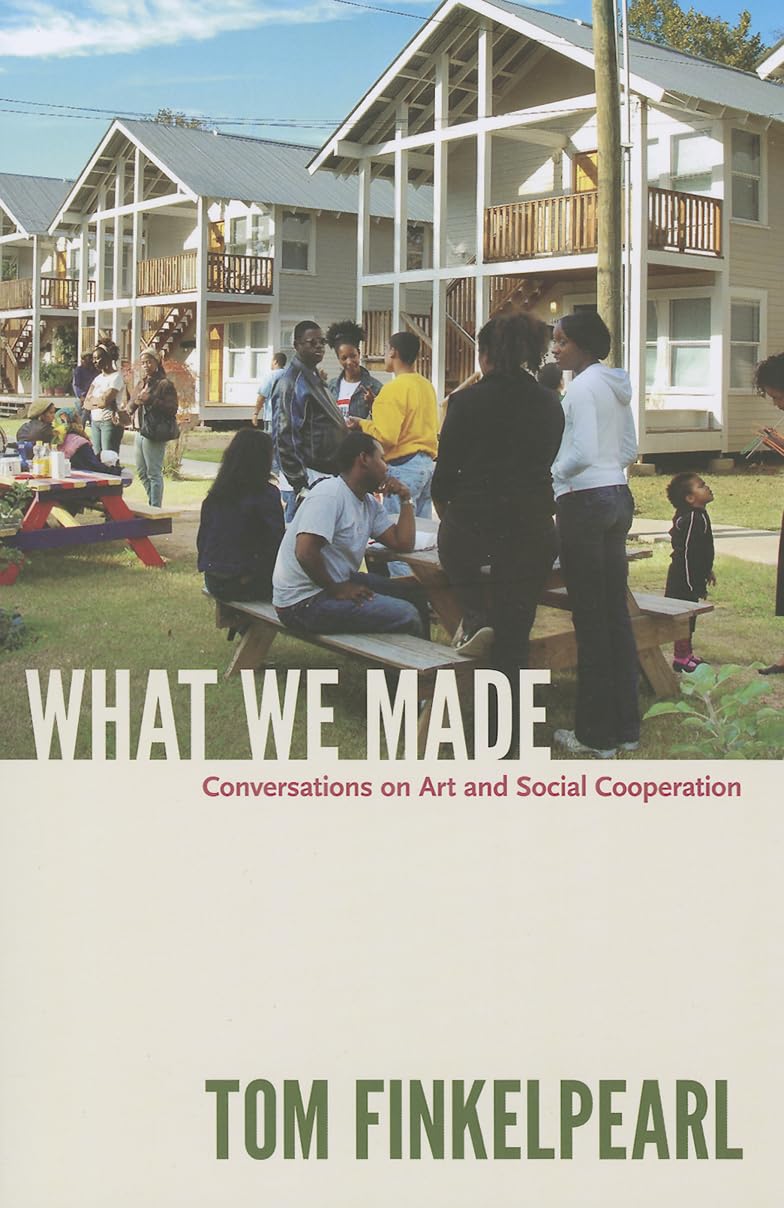
Title
What We Made: Conversations on Art and Social Cooperation,New
Sold by Ergodebooks, an authorized reseller.
Returns accepted within 30 days | support@ergodebooks.com
Shipping Information
- Free Standard Shipping — United States only
- Processing Time: 3–5 business days
- Estimated Delivery: 6–10 business days after dispatch
- Double-boxed, fully insured & discreetly packaged
- Tracking number sent via email once dispatched
Returns & Refund
Returns accepted within 30 days of delivery.
Damaged or Defective Item
Free return shipping + replacement or full refund
Wrong Item Received
Free return shipping + replacement or full refund
Change of Mind
Return shipping at customer's expense · 25% restocking fee applies
Payment Option

In What We Made, Tom Finkelpearl examines the activist, participatory, coauthored aesthetic experiences being created in contemporary art. He suggests social cooperation as a meaningful way to think about this work and provides a framework for understanding its emergence and acceptance. In a series of fifteen conversations, artists comment on their experiences working cooperatively, joined at times by colleagues from related fields, including social policy, architecture, art history, urban planning, and new media. Issues discussed include the experiences of working in public and of working with museums and libraries, opportunities for social change, the lines between education and art, spirituality, collaborative opportunities made available by new media, and the elusive criteria for evaluating cooperative art. Finkelpearl engages the art historians Grant Kester and Claire Bishop in conversation on the challenges of writing critically about this work and the aesthetic status of the dialogical encounter. He also interviews the often overlooked cocreators of cooperative art, 'expert participants' who have worked with artists. In his conclusion, Finkelpearl argues that pragmatism offers a useful critical platform for understanding the experiential nature of social cooperation, and he brings pragmatism to bear in a discussion of Houston's Project Row Houses.Interviewees. Naomi Beckwith, Claire Bishop, Tania Bruguera, Brett Cook, Teddy Cruz, Jay Dykeman, Wendy Ewald, Sondra Farganis, Harrell Fletcher, David Henry, Gregg Horowitz, Grant Kester, Mierle Laderman Ukeles, Pedro Lasch, Rick Lowe, Daniel Martinez, Lee Mingwei, Jonah Peretti, Ernesto Pujol, Evan Roth, Ethan Seltzer, and Mark Stern
⚠️ WARNING (California Proposition 65):
This product may contain chemicals known to the State of California to cause cancer, birth defects, or other reproductive harm.
For more information, please visit www.P65Warnings.ca.gov.
- Q: What is the binding type of 'What We Made'? A: The binding type is paperback. This makes it flexible and easy to carry, suitable for casual reading.
- Q: How many pages does 'What We Made' have? A: The book contains four hundred sixteen pages. This length allows for an in-depth exploration of its themes.
- Q: What are the dimensions of 'What We Made'? A: The dimensions are six point five inches in length, zero point ninety-eight inches in width, and nine point forty-nine inches in height. These measurements make it suitable for standard book storage.
- Q: Who is the author of 'What We Made'? A: The author is Tom Finkelpearl. He is known for his insights into contemporary art and social cooperation.
- Q: What topics are covered in 'What We Made'? A: Topics include social cooperation, collaborative art, and public engagement. The book features conversations with various artists and experts.
- Q: Is 'What We Made' suitable for academic study? A: Yes, it is suitable for academic study. The book provides a framework for understanding contemporary art practices and social cooperation.
- Q: How does 'What We Made' contribute to the understanding of art? A: It offers insights into cooperative artistic practices and the role of social engagement in contemporary art. The conversations included enhance its academic value.
- Q: Is 'What We Made' appropriate for general readers? A: Yes, it is appropriate for general readers. The conversational format makes complex ideas accessible.
- Q: What is the main theme of 'What We Made'? A: The main theme is the exploration of social cooperation in contemporary art. It examines how collaboration impacts artistic processes.
- Q: How do I care for my copy of 'What We Made'? A: To care for your copy, keep it in a dry place and avoid direct sunlight. This will help maintain its condition over time.
- Q: What should I do if my copy of 'What We Made' arrives damaged? A: If your copy arrives damaged, contact the seller for return options. Most sellers will provide a refund or replacement.
- Q: Can 'What We Made' be used in art education courses? A: Yes, it can be used in art education courses. Its discussions on cooperation and dialogue are beneficial for art students.
- Q: Is there a warranty for 'What We Made'? A: Typically, books do not come with a warranty. However, check with the seller for any return policies.
- Q: How does 'What We Made' compare to other art criticism books? A: It uniquely focuses on social cooperation, setting it apart from other books that may emphasize technical skills or individual artists.
- Q: Are the interviews in 'What We Made' with well-known artists? A: Yes, the interviews include prominent figures like Naomi Beckwith and Grant Kester. Their insights add depth to the discussions.