
Title
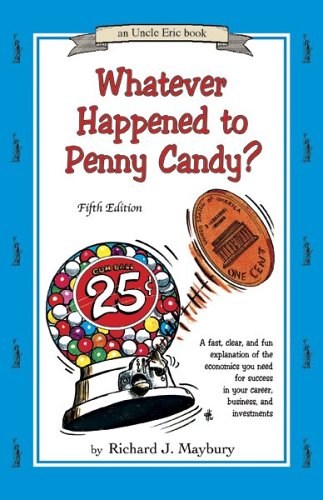
Whatever Happened to Penny Candy? A Fast, Clear, and Fun Explanation of the Economics You Need For Success in Your Career, Busin,New
Sold by Ergodebooks, an authorized reseller.
Returns accepted within 30 days | support@ergodebooks.com
Shipping Information
- Free Standard Shipping — United States only
- Processing Time: 3–5 business days
- Estimated Delivery: 6–10 business days after dispatch
- Double-boxed, fully insured & discreetly packaged
- Tracking number sent via email once dispatched
Returns & Refund
Returns accepted within 30 days of delivery.
Damaged or Defective Item
Free return shipping + replacement or full refund
Wrong Item Received
Free return shipping + replacement or full refund
Change of Mind
Return shipping at customer's expense · 25% restocking fee applies
Payment Option

In 'Whatever Happened to Penny Candy?' Richard Maybury uses historical events from Ancient Rome to explain economic principles. This clearly written book about economics is a remarkably easy and fun explanation of investment cycles, velocity, business cycles, recessions, inflation, the demand for money and more. Essential for every student, businessperson and investor. Recommended by former U.S. Treasury Secretary William Simon. It is also on many recommended reading lists.Can be used for courses in Economics, Business, Finance, Government and Ancient Rome. To improve the student's learning experience, also purchase the student study guide for 'Whatever Happened to Penny Candy?' titled 'A Bluestocking Guide: Economics' also available through Amazon.com.Table of Contents for Whatever Happened to Penny Candy?AcknowledgementsStudy Guide AvailablePrefaceNote to ReaderA Note About EconomicsSmart1. Money: Coins and Paper2. Tanstaafl, The Romans, and Us3. Inflation4. Dollars, Money, and Legal Tender5. Revolutions, Elections, and Printing Presses6. Wages, Prices, Spirals, and Controls7. Wallpaper, Wheelbarrows, and RecessionsBoom and Bust Cycle Since the Civil War8. Fast MoneyHistory Repeats9. Getting Rich Quick10. The Boom and Bust Cycle11. How Much is a Trillion?The Roaring 90sFederal Debt Chart12. What's So Bad About the Federal Debt?An Interesting ExerciseOne Reason Governments Spend So Much13. Summary14. Where Do We Go From Here?15. Natural Law and Economic ProsperityNations and Legal SystemsAppendix (not a complete listing)Supply of Dollars ChartReal Wages ChartQuotesMedian Income ChartThe Oil MythHow to Invest in Gold and SilverMeasures of Money SupplyThe Truth About InflationReal Investment ValueResourcesInternet AddressesBook SuppliersDistilled WisdomBibliographyGlossaryAnswers to Exercises for Real Investment ValueIndexFor Further Study (also available through Amazon.com)Economics: A Free Market ReaderContains articles by noted economists that expand on the concepts presented in Penny Candy. Study questions/answers included.Capitalism for KidsExplains the philosophy of entrepreneurship. Excellent information for both kids and adults. Includes a test to help kids determine if they have the personality to become an entrepreneurCommon Sense Business for KidsExplains common sense strategies behind basic business principles. Gems of wisdom for the businessperson (young or experienced) conveyed through reallife stories and anecdotes. Though written with young people in mind, this book is engaging and beneficial for adults as well.Whatever Happened to Justice? rev. ed.Explains the common law model. Maybury says, 'In my opinion, you and your family and friends will avoid a lot of trouble, and find success of every kind easier to achieve, if you adopt these two models, Austrian economics and common law. 'Penny Candy' explains the Economic model. Now, read 'Justice' for the Legal model. Underlying common law are two basic rules: 1) do all that you agreed to do and 2) do not encroach on other persons or their property.'
⚠️ WARNING (California Proposition 65):
This product may contain chemicals known to the State of California to cause cancer, birth defects, or other reproductive harm.
For more information, please visit www.P65Warnings.ca.gov.
- Q: How many pages does the book have? A: The book has one hundred ninety-one pages. This length makes it a concise yet informative read on economics.
- Q: What is the binding type of this book? A: The book is paperback bound. This makes it lightweight and easy to handle for readers.
- Q: Who is the author of 'Whatever Happened to Penny Candy?' A: The author is Richard J. Maybury. He is known for his clear explanations of complex economic concepts.
- Q: What age group is this book suitable for? A: This book is suitable for students and adults alike. It is recommended for anyone interested in understanding economics.
- Q: Is this book suitable for beginners in economics? A: Yes, it is suitable for beginners. The book presents economic principles in a fun and easy-to-understand manner.
- Q: Can this book be used in academic settings? A: Yes, it can be used for courses in Economics, Business, and Finance. It is recommended for students and educators.
- Q: What is the best way to store this book? A: Store the book in a dry place away from direct sunlight. This will help maintain its condition over time.
- Q: How should I clean the book if it gets dirty? A: Wipe the cover gently with a damp cloth. Avoid using harsh chemicals to prevent damage to the pages.
- Q: Does the book include a glossary? A: Yes, the book includes a glossary. This helps readers understand key economic terms used throughout the text.
- Q: What topics does the book cover? A: The book covers topics like inflation, investment cycles, and business cycles. It provides a historical context for these concepts.
- Q: Is there a study guide available for this book? A: Yes, there is a study guide titled 'A Bluestocking Guide: Economics.' It is available to enhance the learning experience.
- Q: What makes this book stand out from other economic texts? A: This book stands out due to its engaging writing style and use of historical events to explain economic principles.
- Q: What is the recommended reading level for this book? A: The recommended reading level is suitable for high school students and above. It is accessible for a wide audience.
- Q: Can this book help with understanding financial investments? A: Yes, it provides essential insights into investment cycles and economic principles that are critical for investors.
- Q: Is this book recommended by any notable figures? A: Yes, it is recommended by former U.S. Treasury Secretary William Simon. His endorsement adds credibility to the book.
- Q: What is the main theme of 'Whatever Happened to Penny Candy?' A: The main theme is to provide a clear and engaging explanation of economic principles using historical examples.