
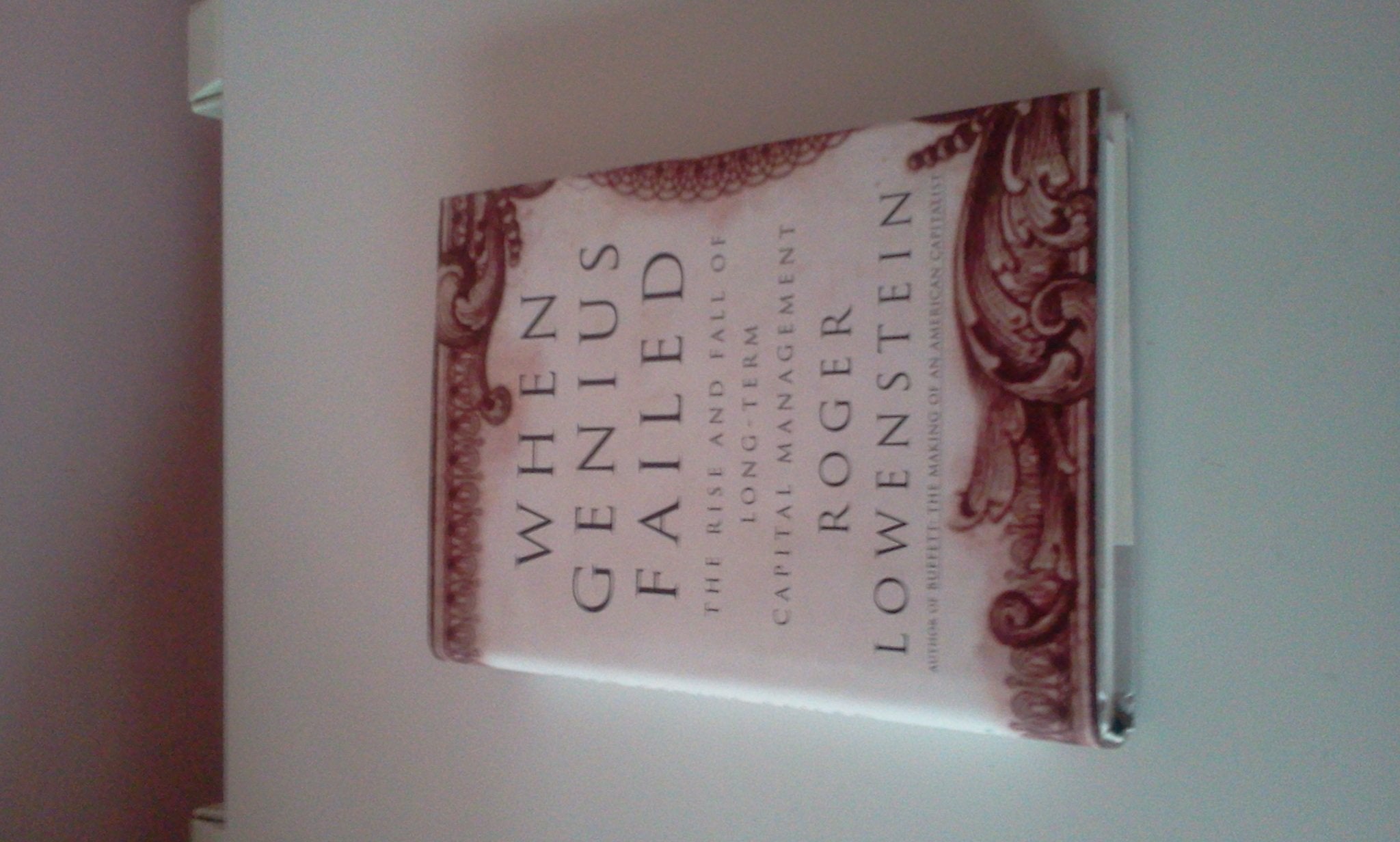
Title
When Genius Failed: The Rise and Fall of LongTerm Capital Management,New
Sold by Ergodebooks, an authorized reseller.
Returns accepted within 30 days | support@ergodebooks.com
Shipping Information
- Free Standard Shipping — United States only
- Processing Time: 3–5 business days
- Estimated Delivery: 6–10 business days after dispatch
- Double-boxed, fully insured & discreetly packaged
- Tracking number sent via email once dispatched
Returns & Refund
Returns accepted within 30 days of delivery.
Damaged or Defective Item
Free return shipping + replacement or full refund
Wrong Item Received
Free return shipping + replacement or full refund
Change of Mind
Return shipping at customer's expense · 25% restocking fee applies
Payment Option

John Meriwether, a famously successful Wall Street trader, spent the 1980s as a partner at Salomon Brothers, establishing the bestand the brainiestbond arbitrage group in the world. A mysterious and shy midwesterner, he knitted together a group of Ph.D.certified arbitrageurs who rewarded him with filial devotion and fabulous profits. Then, in 1991, in the wake of a scandal involving one of his traders, Meriwether abruptly resigned. For two years, his fiercely loyal teamconvinced that the chief had been unfairly victimizedplotted their boss's return. Then, in 1993, Meriwether made a historic offer. He gathered together his former disciples and a handful of supereconomists from academia and proposed that they become partners in a new hedge fund different from any Wall Street had ever seen. And so LongTerm Capital Management was born.In a decade that had seen the longest and most rewarding bull market in history, hedge funds were the ne plus ultra of investments: discreet, private clubs limited to those rich enough to pony up millions. They promised that the investors' money would be placed in a variety of trades simultaneouslya 'hedging' strategy designed to minimize the possibility of loss. At LongTerm, Meriwether & Co. truly believed that their finely tuned computer models had tamed the genie of risk, and would allow them to bet on the future with near mathematical certainty. And thanks to their castwhich included a pair of future Nobel Prize winnersinvestors believed them.From the moment LongTerm opened their offices in posh Greenwich, Connecticut, miles from the pandemonium of Wall Street, it was clear that this would be a hedge fund apart from all others. Though they viewed the big Wall Street investment banks with disdain, so great was LongTerm's aura that these very banks lined up to provide the firm with financing, and on the very sweetest of terms. So selfcertain were LongTerm's traders that they borrowed with little concern about the leverage. At first, LongTerm's models stayed on script, and this new gold standard in hedge funds boasted such incredible returns that private investors and even central banks clamored to invest more money. It seemed the geniuses in Greenwich couldn't lose.Four years later, when a default in Russia set off a global storm that LongTerm's models hadn't anticipated, its supposedly safe portfolios imploded. In five weeks, the professors went from megarich geniuses to discredited failures. With the firm about to go under, its staggering $100 billion balance sheet threatened to drag down markets around the world. At the eleventh hour, fearing that the financial system of the world was in peril, the Federal Reserve Bank hastily summoned Wall Street's leading banks to underwrite a bailout.Roger Lowenstein, the bestselling author of Buffett, captures LongTerm's rollercoaster ride in gripping detail. Drawing on confidential internal memos and interviews with dozens of key players, Lowenstein crafts a story that reads like a firstrate thriller from beginning to end. He explains not just how the fund made and lost its money, but what it was about the personalities of LongTerm's partners, the arrogance of their mathematical certainties, and the latenineties culture of Wall Street that made it all possible.When Genius Failed is the cautionary financial tale of our time, the gripping saga of what happened when an elite group of investors believed they could actually deconstruct risk and use virtually limitless leverage to create limitless wealth. In Roger Lowenstein's hands, it is a brilliant tale peppered with fast money, vivid characters, and high drama.
⚠️ WARNING (California Proposition 65):
This product may contain chemicals known to the State of California to cause cancer, birth defects, or other reproductive harm.
For more information, please visit www.P65Warnings.ca.gov.
- Q: How many pages does the book have? A: This book has two hundred eighty-eight pages. It provides an in-depth narrative of the rise and fall of Long-Term Capital Management.
- Q: What is the binding type of this book? A: The binding type is hardcover. This ensures durability and presents well on bookshelves.
- Q: What are the dimensions of the book? A: The dimensions are six and a half inches in length, one inch in width, and nine and a half inches in height.
- Q: Who is the author of this book? A: The author is Roger Lowenstein. He is known for his insightful financial narratives and analysis.
- Q: What genre does this book belong to? A: The book belongs to the genre of Free Enterprise and Capitalism. It explores financial markets and the hedge fund industry.
- Q: What is the main theme of 'When Genius Failed'? A: The main theme is the cautionary tale of risk management failures. It illustrates the hubris in the financial industry.
- Q: Is the book suitable for beginners in finance? A: Yes, the book is suitable for beginners. It presents complex financial concepts in an engaging and relatable manner.
- Q: At what reading level is this book aimed? A: The book is aimed at adult readers. It is designed for those interested in finance, economics, and history.
- Q: How can I use this book for research? A: You can use this book as a case study for financial failures. It provides valuable insights into risk management and hedge funds.
- Q: Is this book recommended for financial professionals? A: Yes, it is highly recommended for financial professionals. It offers lessons on risk assessment and market behavior.
- Q: How should I store this book to keep it in good condition? A: Store the book upright on a shelf. Keep it away from direct sunlight and humidity to preserve its quality.
- Q: Can this book be cleaned if it gets dirty? A: Yes, you can clean it gently. Use a soft, dry cloth to wipe the cover and avoid using water or chemicals.
- Q: What if my book arrives damaged? A: If your book arrives damaged, contact customer service immediately. They will assist you with a return or replacement.
- Q: Is there a warranty on the book? A: Books typically do not come with a warranty. However, you can inquire about return policies with the seller.
- Q: What are common issues with this book's printing? A: Common issues may include printing errors or misaligned pages. Report these issues to the seller for resolution.
- Q: How can I return the book if I change my mind? A: You can return the book by following the seller's return policy. Ensure it's in original condition for a full refund.