
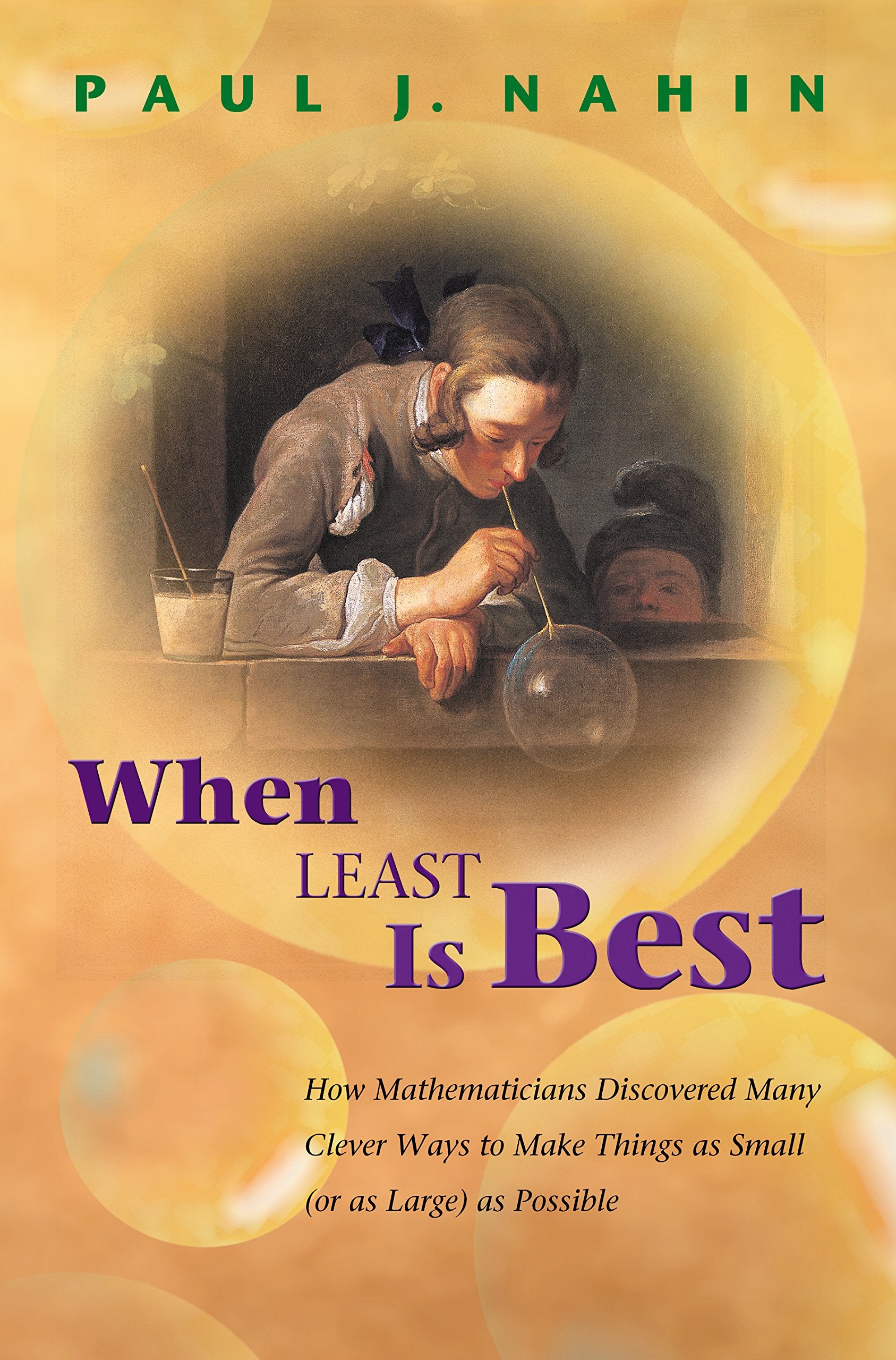
Title
When Least Is Best: How Mathematicians Discovered Many Clever Ways To Make Things As Small (Or As Large) As Possible
Sold by Ergodebooks, an authorized reseller.
Returns accepted within 30 days | support@ergodebooks.com
Shipping Information
- Free Standard Shipping — United States only
- Processing Time: 3–5 business days
- Estimated Delivery: 6–10 business days after dispatch
- Double-boxed, fully insured & discreetly packaged
- Tracking number sent via email once dispatched
Returns & Refund
Returns accepted within 30 days of delivery.
Damaged or Defective Item
Free return shipping + replacement or full refund
Wrong Item Received
Free return shipping + replacement or full refund
Change of Mind
Return shipping at customer's expense · 25% restocking fee applies
Payment Option

What Is The Best Way To Photograph A Speeding Bullet? Why Does Light Move Through Glass In The Least Amount Of Time Possible? How Can Lost Hikers Find Their Way Out Of A Forest? What Will Rainbows Look Like In The Future? Why Do Soap Bubbles Have A Shape That Gives Them The Least Area?By Combining The Mathematical History Of Extrema With Contemporary Examples, Paul J. Nahin Answers These Intriguing Questions And More In This Engaging And Witty Volume. He Shows How Life Often Works At The Extremeswith Values Becoming As Small (Or As Large) As Possibleand How Mathematicians Over The Centuries Have Struggled To Calculate These Problems Of Minima And Maxima. From Medieval Writings To The Development Of Modern Calculus To The Current Field Of Optimization, Nahin Tells The Story Of Dido'S Problem, Fermat And Descartes, Torricelli, Bishop Berkeley, Goldschmidt, And More. Along The Way, He Explores How To Build The Shortest Bridge Possible Between Two Towns, How To Shop For Garbage Bags, How To Vary Speed During A Race, And How To Make The Perfect Basketball Shot.Written In A Conversational Tone And Requiring Only An Early Undergraduate Level Of Mathematical Knowledge, When Least Is Best Is Full Of Fascinating Examples And Readytotryathome Experiments. This Is The First Book On Optimization Written For A Wide Audience, And Math Enthusiasts Of All Backgrounds Will Delight In Its Lively Topics.
⚠️ WARNING (California Proposition 65):
This product may contain chemicals known to the State of California to cause cancer, birth defects, or other reproductive harm.
For more information, please visit www.P65Warnings.ca.gov.
- Q: What is the title of the book? A: The title of the book is 'When Least Is Best: How Mathematicians Discovered Many Clever Ways to Make Things as Small (or as Large) as Possible'.
- Q: Who is the author of this book? A: The author of the book is Paul J. Nahin.
- Q: How many pages does this book have? A: This book has three hundred seventy pages.
- Q: What is the book's binding type? A: The book is available in hardcover binding.
- Q: What are the dimensions of the book? A: The book measures six point two six inches in length, one point two six inches in width, and nine point seven six inches in height.
- Q: What category does this book belong to? A: This book belongs to the History category.
- Q: How do I read this book? A: You can read this book independently as it is designed for readers with an early undergraduate level of mathematical knowledge.
- Q: Is this book suitable for beginners? A: Yes, this book is suitable for beginners interested in mathematics and optimization.
- Q: Can I find practical examples in this book? A: Yes, the book includes fascinating examples and experiments that readers can try at home.
- Q: What topics are covered in this book? A: The book covers topics related to optimization, including historical problems and modern applications.
- Q: How should I store this book? A: Store this book in a cool, dry place away from direct sunlight to preserve its condition.
- Q: Can I clean the book's cover? A: Yes, you can gently wipe the book's cover with a soft, dry cloth to remove dust.
- Q: What if the book arrives damaged? A: If the book arrives damaged, you should contact customer support for return or replacement options.
- Q: Is there a warranty for this book? A: Books typically do not come with a warranty, but check with the seller for their return policy.
- Q: What if I have questions about the content? A: You can reach out to online forums or communities focused on mathematics for discussions about the book's content.