
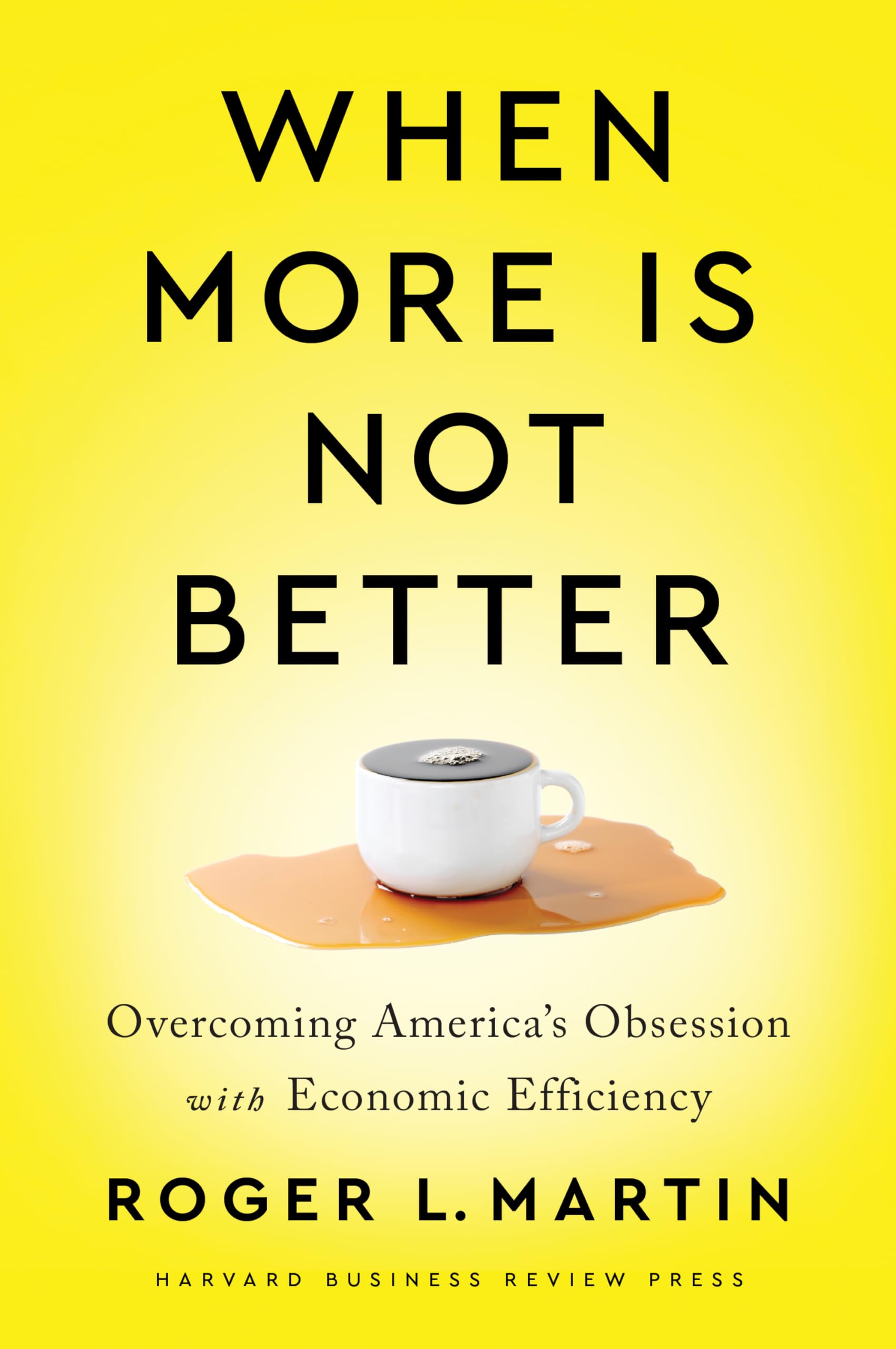
Title
When More Is Not Better: Overcoming America's Obsession with Economic Efficiency,New
Sold by Ergodebooks, an authorized reseller.
Returns accepted within 30 days | support@ergodebooks.com
Shipping Information
- Free Standard Shipping — United States only
- Processing Time: 3–5 business days
- Estimated Delivery: 6–10 business days after dispatch
- Double-boxed, fully insured & discreetly packaged
- Tracking number sent via email once dispatched
Returns & Refund
Returns accepted within 30 days of delivery.
Damaged or Defective Item
Free return shipping + replacement or full refund
Wrong Item Received
Free return shipping + replacement or full refund
Change of Mind
Return shipping at customer's expense · 25% restocking fee applies
Payment Option

American democratic capitalism is in danger. How can we save it?For its first two hundred years, the American economy exhibited truly impressive performance. The combination of democratically elected governments and a capitalist system worked, with everincreasing levels of efficiency spurred by division of labor, international trade, and scientific management of companies. By the nation's bicentennial celebration in 1976, the American economy was the envy of the world.But since then, outcomes have changed dramatically. Growth in the economic prosperity of the average American family has slowed to a crawl, while the wealth of the richest Americans has skyrocketed. This imbalance threatens the American democratic capitalist system and our way of life.In this bracing yet constructive book, worldrenowned business thinker Roger Martin starkly outlines the fundamental problem: We have treated the economy as a machine, pursuing evergreater efficiency as an inherent good. But efficiency has become too much of a good thing. Our obsession with it has inadvertently shifted the shape of our economy, from a large middle class and smaller numbers of rich and poor (think of a bellshaped curve) to a greater share of benefits accruing to a thin tail of alreadyrich Americans (a Pareto distribution).With lucid analysis and engaging anecdotes, Martin argues that we must stop treating the economy as a perfectible machine and shift toward viewing it as a complex adaptive system in which we seek a fundamental balance of efficiency with resilience. To achieve this, we need to keep in mind the whole while working on the component parts; pursue improvement, not perfection; and relentlessly tweak instead of attempting to find permanent solutions.Filled with keen economic insight and advice for citizens, executives, policy makers, and educators, When More Is Not Better is the mustread guide for saving democratic capitalism.
⚠️ WARNING (California Proposition 65):
This product may contain chemicals known to the State of California to cause cancer, birth defects, or other reproductive harm.
For more information, please visit www.P65Warnings.ca.gov.