
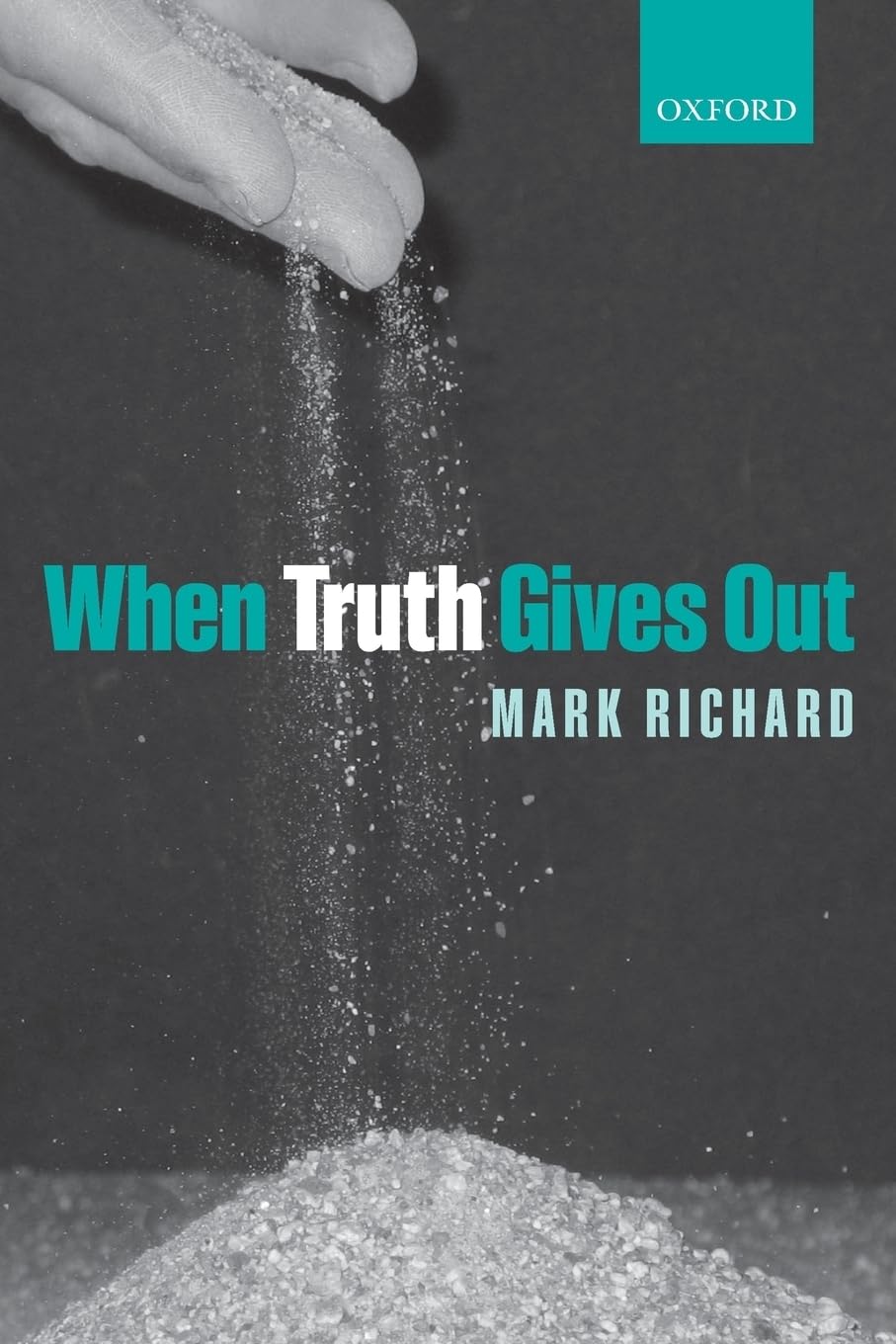
Title
When Truth Gives Out,Used
Sold by Ergodebooks, an authorized reseller.
Returns accepted within 30 days | support@ergodebooks.com
Shipping Information
- Free Standard Shipping — United States only
- Processing Time: 3–5 business days
- Estimated Delivery: 6–10 business days after dispatch
- Double-boxed, fully insured & discreetly packaged
- Tracking number sent via email once dispatched
Returns & Refund
Returns accepted within 30 days of delivery.
Damaged or Defective Item
Free return shipping + replacement or full refund
Wrong Item Received
Free return shipping + replacement or full refund
Change of Mind
Return shipping at customer's expense · 25% restocking fee applies
Payment Option

Is the point of belief and assertion invariably to think or say something true? Is the truth of a belief or assertion absolute, or is it only relative to human interests? Most philosophers think it incoherent to profess to believe something but not think it true, or to say that some of the things we believe are only relatively true. Common sense disagrees. It sees many opinions, such as those about matters of taste, as neither true nor false; it takes it as obvious that some of the truth is relative.Mark Richard's accessible book argues that when it comes to truth, common sense is right, philosophical orthodoxy wrong. The first half of the book examines connections between the performative aspects of talk (what we do when we speak), our emotions and evaluations, and the conditions under which talk and thought qualifies as true or false. It argues that the performative and expressive sometimes trump the semantic, making truth and falsity the wrong dimension of evaluation for belief or assertion. Among the topics taken up are: racial slurs and other epithets; relations between logic and truth; the status of moral and ethical talk; vagueness and the liar paradox. The book's second half defends the idea that much of everyday thought and talk is only relatively true or false. Truth is inevitably relative, given that we cannot work out in advance how our concepts will apply to the world. Richard explains what it is for truth to be relative, rebuts standard objections to relativism, and argues that relativism is consistent with the idea that one view can be objectively better than another. The book concludes with an account of matters of taste and of how it is possible for divergent views of such matters to be equally valid, even if not true or false.When Truth Gives Out will be of interest not only to philosophers who work on language, ethics, knowledge, or logic, but to any thoughtful person who has wondered what it is, or isn't, for something to be true.
⚠️ WARNING (California Proposition 65):
This product may contain chemicals known to the State of California to cause cancer, birth defects, or other reproductive harm.
For more information, please visit www.P65Warnings.ca.gov.
- Q: What is the main theme of 'When Truth Gives Out'? A: The main theme of 'When Truth Gives Out' is the exploration of truth in relation to belief and assertion, particularly arguing that truth is often relative rather than absolute.
- Q: Who is the author of the book? A: The author of 'When Truth Gives Out' is Mark Richard.
- Q: What are some topics covered in the book? A: The book covers topics such as the performative aspects of language, emotions and evaluations, moral and ethical talk, vagueness, and the liar paradox.
- Q: What is the publication date of 'When Truth Gives Out'? A: The book was published on July 8, 2010.
- Q: How many pages does the book have? A: The book contains 194 pages.
- Q: What is the binding type of this book? A: The binding type of 'When Truth Gives Out' is paperback.
- Q: What category does this book fall under? A: This book falls under the category of Epistemology.
- Q: Is 'When Truth Gives Out' suitable for beginners in philosophy? A: Yes, the book is accessible and is suitable for both philosophers and thoughtful individuals who are interested in the nature of truth.
- Q: Does the book discuss the concept of relativism? A: Yes, the book defends the idea that truth is often relative and addresses standard objections to relativism.
- Q: What is the main argument presented in the book regarding truth? A: The main argument is that common sense views on truth are often correct, and that the performative aspects of language can sometimes take precedence over strict semantic evaluations.