
Title
Where Does Money Come From?,Used
Processing time: 1-3 days
US Orders Ships in: 3-5 days
International Orders Ships in: 8-12 days
Return Policy: 15-days return on defective items
Payment Option

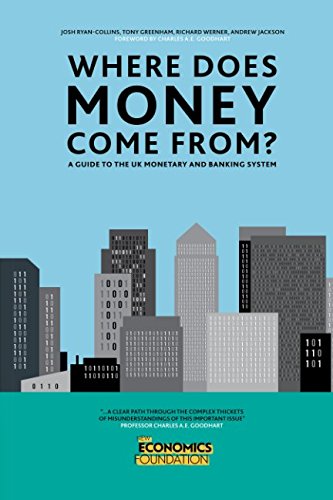
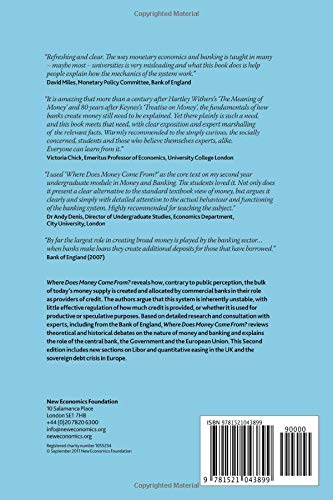
Where Does Money Come From? reveals how, contrary to public perception, the bulk of todays money supply is created and allocated by commercial banks in their role as providers of credit. The authors argue that this system is inherently unstable, with little effective regulation of how much credit is provided or whether it is used for productive or speculative purposes. Based on detailed research and consultation with experts, including from the Bank of England, Where Does Money Come From? reviews theoretical and historical debates on the nature of money and banking and explains the role of the central bank, the Government and the European Union. This Second edition includes new sections on Libor and quantitative easing in the UK and the sovereign debt crisis in Europe. Praise for Where Does Money Come From? ?efreshing and clear. The way monetary economics and banking is taught in many maybe most universities is very misleading and what this book does is help people explain how the mechanics of the system work? David Miles, Monetary Policy Committee, Bank of England ?t is amazing that more than a century after Hartley Withers? The Meaning of Money and 80 years after Keynes? Treatise on Money, the fundamentals of how banks create money still need to be explained. Yet there plainly is such a need, and this book meets that need, with clear exposition and expert marshalling of the relevant facts. Warmly recommended to the simply curious, the socially concerned, students and those who believe themselves experts, alike. Everyone can learn from it? Victoria Chick, Emeritus Professor of Economics, University College London. I used Where Does Money Come From? as the core text on my second year undergraduate module in Money and Banking. The students loved it. Not only does it present a clear alternative to the standard textbook view of money, but argues it clearly and simply with detailed attention to the actual behaviour and functioning of the banking system. Highly recommended for teaching the subject. Dr Andy Denis, Director of Undergraduate Studies, Economics Department, City University, London
⚠️ WARNING (California Proposition 65):
This product may contain chemicals known to the State of California to cause cancer, birth defects, or other reproductive harm.
For more information, please visit www.P65Warnings.ca.gov.
- Q: What is the main theme of 'Where Does Money Come From?' A: 'Where Does Money Come From?' explores how commercial banks create and allocate the majority of today's money supply through credit provision, challenging the common perception of money creation.
- Q: Who are the authors of the book? A: The book is authored by Josh Ryan-Collins, along with co-authors who are experts in economics and banking.
- Q: What are the key topics covered in this book? A: Key topics include the nature of money and banking, the role of central banks, government policies, and recent financial phenomena such as Libor and quantitative easing.
- Q: Is the book suitable for students? A: Yes, the book is highly recommended for students, especially in courses related to money and banking, as it provides a clear alternative viewpoint to standard textbooks.
- Q: How many pages does 'Where Does Money Come From?' have? A: The book has 184 pages, making it a concise yet comprehensive read on monetary economics.
- Q: What edition of the book is available? A: This is the second edition of 'Where Does Money Come From?', which includes updated sections on current economic issues.
- Q: What is the condition of the book? A: The book is in 'New' condition, ensuring that it is pristine and ready for readers.
- Q: When was 'Where Does Money Come From?' published? A: The book was published on May 4, 2017.
- Q: What type of binding does the book have? A: The book is available in paperback binding, making it portable and easy to handle.
- Q: Does the book include real-world examples? A: Yes, the authors utilize detailed research and expert consultations to provide real-world examples and insights into the banking system.