
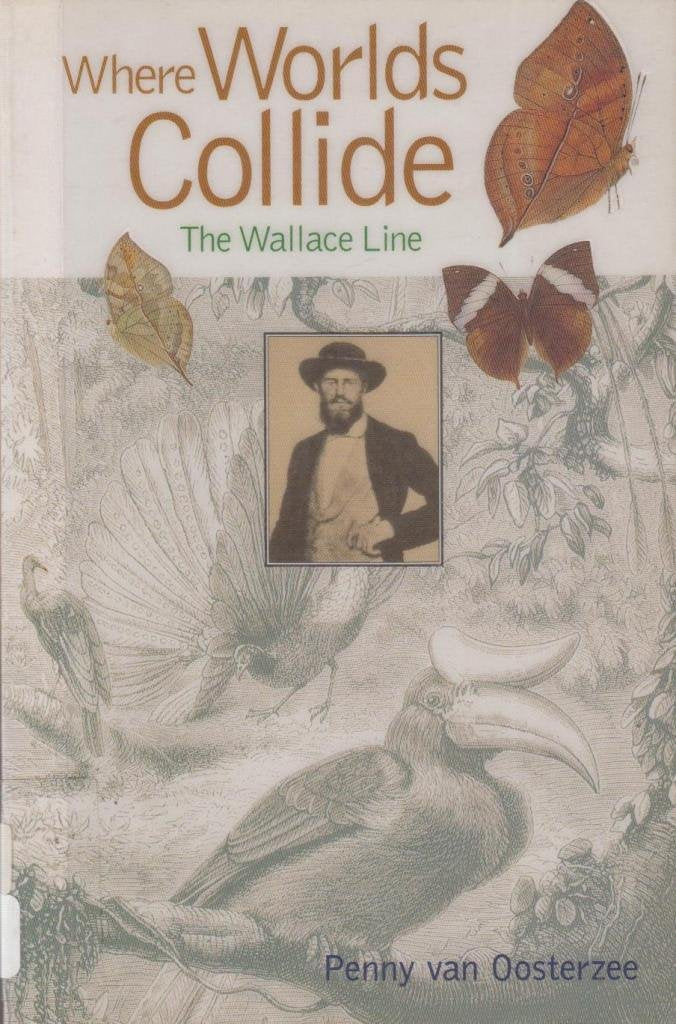
Title
Where Worlds Collide: The Wallace Line
Sold by Ergodebooks, an authorized reseller.
Returns accepted within 30 days | support@ergodebooks.com
Shipping Information
- Free Standard Shipping — United States only
- Processing Time: 3–5 business days
- Estimated Delivery: 6–10 business days after dispatch
- Double-boxed, fully insured & discreetly packaged
- Tracking number sent via email once dispatched
Returns & Refund
Returns accepted within 30 days of delivery.
Damaged or Defective Item
Free return shipping + replacement or full refund
Wrong Item Received
Free return shipping + replacement or full refund
Change of Mind
Return shipping at customer's expense · 25% restocking fee applies
Payment Option

Alfred Russel Wallace, The Father Of Biogeography, Discovered The Flora And Fauna Of The South East Asian Islands And The Extraordinary Way In Which They Are Geographically Distinct. In A Lively Historical Narrative, Penny Van Oosterzee Tells The Story Of His Achievement. His Legacy Is The Wallace Line, A Faunal Barrier Separating The Asian From The Australian: Monkeys From Kangaroos, Weaver Birds From Cockatoos, And Pheasants From Parrots. This Invisible Boundary And The Difference Between The Species It Divides Catalyzed Wallace'S Theory Of Evolution And Prodded Darwin To Articulate His Own Theory.In Where Worlds Collide, Van Oosterzee Follows Wallace'S Journeys Through The Islands Of South East Asia. She Draws On Wallace'S Natural History Travelogue, The Malay Archipelago, A Book He Wrote After Spending The Years From 1854 To 1862 In Malaysia, Indonesia, And New Guinea. Explaining His Theory And How It Has Been Interpreted By Biologists, Van Oosterzee Also Recreates Wallace'S Sense Of Excitement With His Discoveries. She Devotes A Chapter To The Diversity Of Butterfly Wing Patterns, For Example, Because Wallace Was So Enamored Of Them.
⚠️ WARNING (California Proposition 65):
This product may contain chemicals known to the State of California to cause cancer, birth defects, or other reproductive harm.
For more information, please visit www.P65Warnings.ca.gov.
- Q: How many pages does the book have? A: This book has two hundred thirty-four pages. It provides a detailed account of Alfred Russel Wallace's contributions to biogeography.
- Q: What is the binding type of this book? A: The binding type is paperback. This makes it lightweight and portable, ideal for reading on the go.
- Q: What are the dimensions of the book? A: The book measures six inches in length, nine inches in height, and three-fourths of an inch in width. These dimensions make it easy to handle and store.
- Q: Who is the author of the book? A: The author is Penny van Oosterzee. She narrates the historical significance of Alfred Russel Wallace's discoveries.
- Q: What genre does this book belong to? A: This book belongs to the Biographies and Memoirs genre. It focuses on the life and achievements of a notable scientist.
- Q: Is this book suitable for young readers? A: Yes, this book is suitable for young readers with an interest in science and history. It presents complex ideas in an engaging manner.
- Q: Can I read this book in one sitting? A: Yes, many readers can finish this book in one sitting. Its compelling narrative makes it hard to put down.
- Q: Is this book a good resource for studying evolution? A: Yes, it is an excellent resource for studying evolution. It explains Wallace's theories and their impact on Darwin's work.
- Q: Are there illustrations in the book? A: No, the book does not include illustrations. It focuses on narrative and historical accounts.
- Q: How should I store this book? A: Store this book upright on a shelf to prevent warping. Keep it away from direct sunlight and moisture.
- Q: What is the condition of a used copy? A: The used copy is in good condition. It may show minor signs of wear but is fully readable.
- Q: Can I return the book if I don't like it? A: Yes, you can return the book if it doesn't meet your expectations. Check the seller's return policy for details.
- Q: What if the book arrives damaged? A: If the book arrives damaged, contact the seller for a replacement or refund. Most sellers have clear policies for such situations.
- Q: Is this book available in other formats? A: Currently, the book is only available in paperback format. Check with the publisher for future editions.
- Q: Will I need any prior knowledge to understand this book? A: No, prior knowledge is not required. The book explains concepts in an accessible way for all readers.
- Q: Does the book cover modern implications of Wallace's work? A: Yes, the book discusses modern implications of Wallace's work in biogeography and evolutionary biology.