
Title
Which Is Round? Which Is Bigger?,Used
Sold by Ergodebooks, an authorized reseller.
Returns accepted within 30 days | support@ergodebooks.com
Shipping Information
- Free Standard Shipping — United States only
- Processing Time: 3–5 business days
- Estimated Delivery: 6–10 business days after dispatch
- Double-boxed, fully insured & discreetly packaged
- Tracking number sent via email once dispatched
Returns & Refund
Returns accepted within 30 days of delivery.
Damaged or Defective Item
Free return shipping + replacement or full refund
Wrong Item Received
Free return shipping + replacement or full refund
Change of Mind
Return shipping at customer's expense · 25% restocking fee applies
Payment Option

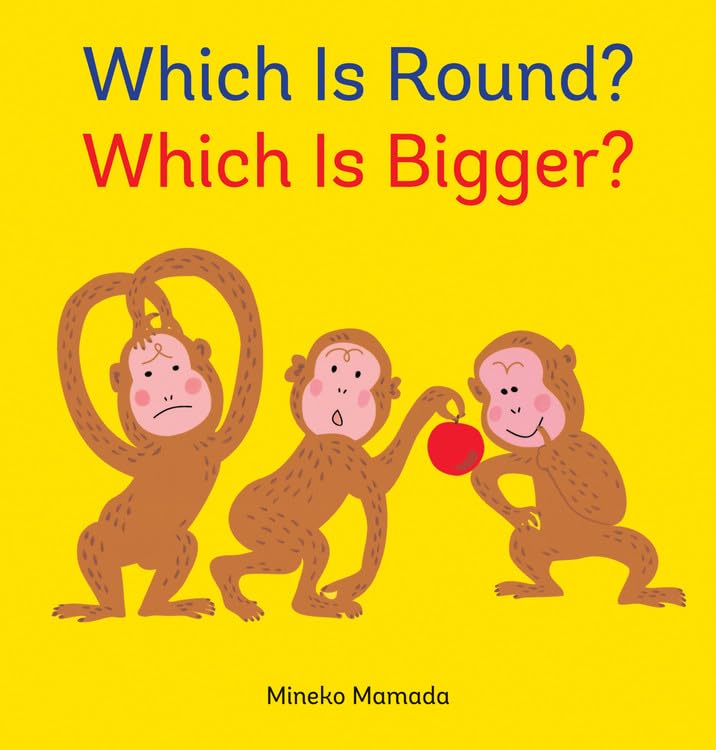
On the first twopage spread of this deceptively simple picture book, the text asks, Which one is round? There are two straightforward drawings showing the choices: an apple or an armadillo. For the child who understands what round means, that's an easy one the apple is round. Until you turn to the next spread. There you'll see that the same question is asked, Which one is round? What do you think? But this time, the apple has been eaten down to its (unround) core, and the armadillo is asleep, curled into a (round) ball. Surprise! Though the objects being featured are the same, the answer to the question has now changed. This interactive concept book, written and illustrated by Mineko Mamada, contains six such pairs, illustrated with appealing, unfussy colored drawings. For each pair, children are asked to compare them based on their shape, size, height, speed or color. As with the apple and the armadillo, at first the answer to the question seems obvious, but then a turn of the page provides an unexpected twist. Young children get drawn in, first to figure out the easier answer, then to laugh when they discover the new way of looking at things. This is a unique, innovative approach to the popular concept of comparatives. It's a terrific tool for promoting school readiness with preschoolers in areas such as observation, critical thinking and creativity. But with its playful spirit, young children will just see it as a lot of fun!
⚠️ WARNING (California Proposition 65):
This product may contain chemicals known to the State of California to cause cancer, birth defects, or other reproductive harm.
For more information, please visit www.P65Warnings.ca.gov.
- Q: What age group is 'Which Is Round? Which Is Bigger?' suitable for? A: This book is ideal for preschoolers and young children aged 3 to 5 years, promoting early learning concepts such as observation and critical thinking.
- Q: How many pages does the book have? A: The book contains 24 pages filled with engaging illustrations and interactive content.
- Q: What is the binding type of this book? A: The book is a hardcover edition, providing durability for young readers.
- Q: Who is the author of 'Which Is Round? Which Is Bigger?' A: The book is authored and illustrated by Mineko Mamada.
- Q: What are the main themes of this book? A: The book explores themes of size, shape, height, speed, and color, encouraging children to compare and contrast different objects.
- Q: Is this book in good condition? A: Yes, the book is labeled as 'Used Book in Good Condition', indicating it has been well maintained.
- Q: What are the unique features of this book? A: This interactive concept book features surprising twists on simple questions, engaging children in a fun and educational way.
- Q: When was 'Which Is Round? Which Is Bigger?' published? A: The book was published on March 1, 2013.
- Q: What kind of illustrations does the book have? A: The book features appealing, unfussy colored drawings that capture children's attention.
- Q: How does this book promote school readiness? A: The book encourages critical thinking and observation skills, making it a valuable tool for preschool readiness.